In assessing the development of the non-state owned sector, there are four aspects in general to be taken into consideration: (1) the contribution by the non-state owned sector to the increase of the total volume of the national economy. (2) the property relation in the non-state owned sector; (3) market access for the non-state owned sector; and 4, the standardized market behavior of the non-state owned sector. Of the four aspects, the first one is of the comprehensive significance.
(Ⅰ)Contribution by the Non-state Owned Sector to the Growth of Total Volume of National Economy
Since the initiation of reform and opening-up, especially after 1992, the contribution from the non-state owned sector in the total volume of China's national economy has been continuously on the rise. This tendency is shown in the following several indicators:
1. Proportion of Value Added by the Non-state Owned Sector in GDP
The proportion of GDP created by the non-state owned sector in the total GDP reflects the contribution of the non-state owned sector to the total volume of the national economy and the role played by them in the marketization process of China's enterprises. From 1992 to 2001, the proportion of value added created by the non-state owned sector accounted for 62.32 percent from the original 53.6 percent, an average annual increase of 1.69 percent.
In industry, the proportion of total industrial output by the non-state owned industry in that of the national total is also a good comprehensive indicator to reflect the development of the non-state owned sector. From 1992 to 2001, the proportion of total industrial output by the non-state owned industry in that of the national total rose from 48.5 percent to 78.3 percent, at an average increase rate of 5.47 percent. Of which, after 1992, the development of individual, private and foreign invested sectors that are more market-oriented overtook that of the collectively owned sector, which tends to be stabilized with a slight decline. From 1992 to 2001, in the total industrial output, the proportion of the collective industry's output declined from 35.1 percent to 30.1 percent, while the proportion of output by the individual and private industries rose from 5.8 percent to 17.2 percent. The proportion of output from other industries including the foreign invested enterprises rose from 7.6 percent to 29.5 percent.
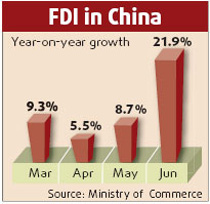
Especially worth mentioning is that the contribution by the foreign invested sector rose considerably in the growth of the national economy. From 1993 to 2001, the industrial value added created by the foreign invested sector rose from 8.4 percent to 24.57 percent of the total industrial value added, at an average annual increase rate of 14.36 percent; taxes paid by this sector rose from 5.7 percent to 19.01 percent of the total, at an average annual growth of 16.25 percent. In 2001, the foreign invested enterprises accounted for 37.48 percent of the total settled foreign exchanged revenues, representing an increase of 6.29 percent than the previous period; of the total sales of foreign exchanges for payment purposes, the foreign invested enterprises took up 26.33 percent, an increase of 2.11 percent than before.
2.Proportion of Investment in Fixed Assets by the Non-state Owned Sector in the Society's Total Investment in Fixed Assets
Investment in fixed assets is an important factor in the growth of national economy and the development of enterprises. This indicator reflects the rate of contribution in investment in fixed assets by the non-state owned sector and the marketization of investment in fixed assets. From 1992 to 2001, the proportion of investment in fixed assets by the non-state owned sector rose from 31.95 percent to 52.69 percent of the total of the whole society, an average annual increase of 5.72 percent.
A similar indicator is the contribution rate made by the non-state owned sector to the growth of the total social investment in fixed assets. This rate was 31.94 percent in 1992 and rose to 52.54 percent in 2001, representing an average annual increase of 5.69 percent. Of which, the contribution rate of sectors other than the collective and individual sectors (including the joint stock sector, foreign-Hong Kong- Macao and Taiwan invested sectors, and joint-operation sectors etc.) grew faster, from zero in 1992 to 24 percent in 2001.
3.Proportion of Urban Employees in the Non-state Owned Sector in the Total Urban Employment
The market-oriented reforms smashed the traditional system of fixed employment, and the labor force spontaneously started to flow. In urban areas where the labor forces are concentrated, the non-state owned sector steadily increased their capacity for receiving labor forces following the transformation and market exit of the state-owned enterprises. Therefore, this indicator represents the contribution rate by the non-state owned sector in providing job opportunities and the marketization of urban labor supply. From 1992 to 2001, the proportion of the non-state owned sector in respect of the urban employment rose from 39.03 percent to 68.09 percent, an average annual increase of 6.38 percent.
4.Proportion or Tax Revenue Created by the Non-state Owned Sector in that by the Whole Society
Tax revenues are the main source of the national fiscal revenue and marketization brings out the initiatives of the non-state owned economic entities. For this reason, this indicator reflects the contribution to the national fiscal revenue as a result of the development of non-state owned sector under marketization. From 1992 to 2001, the proportion of tax revenue created by the non-state owned sector in that by the whole society rose for 33 percent to 64.42 percent, at an average annual increase of 7.72 percent.
5.Proportion of Import & Export Volume by the Non-state Owned Sector in Those of the National Total
The volume of import and export is an indicator for measuring the performance of international trade. China's accession to WTO and the integration tendency of the world economy made the import and export volume present an increasing tendency. The contribution by the non-state owned sector to such increase is growing continuously in size as a result of marketization. From 1992 to 2001, the proportion of total import and export volume of the non-state owned sector in that of the national total grew from 27.45 percent to 55.04 percent, or an average increase of 8.04 percent annually.
6.Proportion of Owner's Equity in the Non-state Owned Sector in That of All the State-owned Sector and of the Non-state Owned Industry Above Designated Size
Industry is the key trade of the national economy, and the owner's equity represents the contribution in investment by the economic entity. However, the owmer's equity of the non-state owned sector that are below norms and of the non-public owner within enterprises with the State as the controlling party was not taken into consideration, this indicator can only reflect to a limited extent the contribution by the non-state owned sector to the marketization of industry as a key trade. From 1992 to 2001, the proportion of the industrial owner's equity of the non-state owned sector in that of all the state-owned and of the above-norm non-state owned industry rose from 34.1 percent to 45.13 percent, at an average annual increase of 3.16 percent.
A basic conclusion is that the role of the non-state owned sector has surpassed that of the state owned sector, and that this trend is continuing.
(Ⅱ)Property Relation of the Non-state Owned Sector
The non-state owned sector covers the collective sector, the private sector, the joint stock sector and the foreign-invested sector. Their different historical backgrounds shaped their respective property relations. But there is one common feature shared by all of them, namely a relatively clearly defined property relation.
1. Collective Enterprises
Before the 1990s, the property relation was ambiguous due to historical reasons. After the 1990s, transformation of collective enterprise was conducted on a large scale to form different types joint ventures. In the place of the "big collectives", joint stock enterprises with stocks being held by the State, the collective and the individuals respectively were set up on the basis of reappraisal of the stocks and assets; with regard to the collectively owned medium or small sized enterprises, joint stock enterprises were set up, the stocks of which could be held by collectives, individual staff members and individuals from outside of the enterprise. The individual was allowed to be the controlling shareholder, or even take over the collectively owned shares, so that the enterprise became completely private owned; the collective enterprises may establish new joint stock enterprises in association with other enterprises in which the shares were held in proportion to the investment by the relevant parties; there were also some collectives that were auctioned or let out for rentals. After this type of transformation, the property relations of the collectives were basically clarified. In addition, the collectives (mainly the science and technology related enterprises) founded in compliance with the Company Law after the 1990s all had clearly defined property relations right from the beginning. Take the township enterprises for example. In 2001 over 95 percent of them went through a variety of transformations including being turned into joint ventures, auctioned or let out for rentals etc. Many of them established the modern enterprise system, with clarified property rights, improved operation mechanism and enhanced enterprise vigor.
2. Private Enterprises
The registered capital of the private enterprises mostly came from individuals or their families. They are often in the form of a partnership or a company with limited liability. There has been a quick development of private enterprises in the form of companies with limited liability since the 1990s. In 2001, this type of private enterprises accounted for 68.02 percent of the total private enterprises, a rise by 10.24 percent than the year before. Partnerships accounted for 6.44 percent, or 24.96 percent lower than the same time a year before. The proprietorships accounted for 25.5 percent, an increase of 3.48 percent than the same period a year before. This trend reflects that the private sectors were no longer satisfied with a clearly defined property relation, but were more concerned with the standardized management of the property.
3. Joint Stock Enterprises
Joint stock enterprises include companies with limited liability and joint stock limited companies. They are typical types of enterprises in the modern market system. In other words, they are the so-called "modern enterprises". All types of enterprises including state-owned enterprises, collective enterprises and private enterprises may take the form of joint stock limited companies, so that the company property is diversified and clarified. Diversification and clarification of property are inseparable as if they were the two surfaces of the "coin" of modern enterprise. Precisely for this reason the joint stock enterprises achieved rapid development. By the end of 2001, over 90 percent of the newly established enterprises were joint stock enterprises and over 70 percent of the existing enterprises were turned into joint ventures.
4. Foreign Invested Enterprises
Included in the foreign invested enterprises there are Sino-foreign equity joint ventures, Sino-foreign contractual joint ventures and wholly foreign owned enterprises. Sino-foreign equity joint-ventures are in general joint stock enterprises, with the investing parties enjoying the rights in proportion to their respective invested amounts, and assuming corresponding duties and responsibilities, with the directors, general managers and deputy general managers being deputed by all the parties. Sino-foreign contractual joint ventures are jointly operated enterprises on a contractual basis; the rights and obligations of both parties are written in a contract after consensus is reached through consultations. In the case of wholly foreign owned enterprises, if there is only one investor, the property structure is very simple; if there are several foreign investors, the property structure is then diversified. It is obvious, then, that all three types of foreign invested enterprises have clearly defined property relation. By the end of 2001, the accumulated number of foreign invested enterprises reached 389,549, which was 4.29 times of the figure by the end of 1992, which was 90,791, representing an average annual increase of 17.57 percent over the past nine years. The total value of direct foreign investment accumulated to US$393.5l2 billion, 11.45 times of the accumulated US$34.355 billion in 1992, or an average annual increase of 31.12 percent over the past nine years.
(Ⅲ)Market Access for the Non-state owned sector
Since 1992, the government adopted more positive and open policies in the form of regulations and laws in respect of market access in favor of the non-state owned sector. Administrative barriers in many important aspects were abolished or lowered, correcting the discrimination on market access. Moreover, in November 1993, the Central Committee of the CPC stated that "the State shall create conditions for economic sectors of all types of ownership to participate equally in the market competition and all types of enterprises shall be treated alike". Furthermore, in 1999, the importance of the non-state owned sector was incorporated in the newly amended Constitution. These policies and regulations greatly encouraged the non-state owned sector to advance into vaster scopes of business fields.
1. Collective Enterprises
Take rural township enterprises for example. In as early as 1997, the Ministry of Agriculture pointed out in a report submitted to the State Council that "the business activities of the rural township enterprises almost covered all fields of the national economy", especially in the tertiary industry, where the situation was encouraging. Of the value added created by the rural township enterprises, the ratio between the primary, secondary and tertiary industries was 1.36: 77.64:2l.00 in 1999, in 2000 this ratio became 1.16:77.01:21.83, for the year 2001 the ratio became 0.98:76.67:22.35, showing in 2001 the tertiary industry was 3.16 percent higher than in 1999, and the proportion of the primary and secondary industries, on the other hand, tended to become lower. In terms of segmentation of industries, wholesale and retail trade, traffic and transportation and industry achieved faster growth: in 2001 the value added increased by 12.6 percent, 10 percent and 8 percent respectively as compared with the same period of the year before. Moreover, the rural town-ship enterprises even managed to enter some of the trades that were previously exclusively run by the State, such as tobacco and medicine processing. Further, by the end of 2001, there were more than 50 rural township enterprises around the country that became listed companies. If the achievements by the rural township enterprises were considered impressive, then the urban town-ship enterprises performed even better.
2. Private Enterprises
After 1992, a series of policies, regulations and by-laws were issued by the central and local governments in order to encourage the development of the private sector. In 1993, the relevant departments of the government reduced the number of trades that were closed to the private enterprises from 50 to 35. At the beginning of the year 2000, the government further emphasized that all fields, except those relating to the national security or those must be monopolized by the State, should be open to the private capital. A Catalogue for the Guidance of Medium-and-small Enterprises and Industries was published in the same year, providing a more open, standardized and transparent market access system to encourage the development of the private enterprises. During the years 2000 and 2001, the tertiary industry took the overwhelming importance of all three orders of industry as far as the private enterprises were concerned, and the proportion was still growing. The primary industry showed a tendency to decline and the secondary industry had slightly declined, but was rising in terms of absolute quantity. In segmented trades, manufacturing, wholesale and retailing and catering took the overwhelming proportion but on the decline with the absolute quantity still rising; social services and other trades, on the other hand, were on the rise both in terms of proportion taken and in absolute quantity.
3. Foreign Invested Enterprises
Since 1992, the government implemented open policies in all aspects. From 1992 to 1994, the previously "forbidden" trades including commercial services were opened. The Catalogue for the Guidance of Industries for Foreign Investment issued in 1995 was further amended in 1996, and the market access was made more transparent. At the beginning of 2000, Zhu Rongji, the Chinese Premier at the time, pointed out that as the pace for joining the WTO was being accelerated, China must take a more positive stance in opening up more fields to the outside world, so that the fields such as commerce, foreign trade, financing, insurance, securities, telecommunications, tourism and intermediary services would all be gradually involved, and restrictions on the maximum ratio of shares allowed to the foreign businesses in some trades were to be relaxed. In 2001, the proportion of foreign-invested enterprises in the three orders of industries was 3.39:74.18:22.43, and the proportion of foreign funds actually used was 1.92:72.51:25.57. Of which, manufacturing took most of the investment. Within manufacturing, the manufacture of electronic and telecommunication equipment, chemical raw materials and products and special equipment that mainly rely on high and new technology grew faster. In 2001, the increases in the number of enterprises in the three orders of industries were 30.35 percent, 17.95 percent and 15.24 percent respectively as compared with the same period of the year before, all the increase in the actually used foreign funds were 54.38 percent, 22.53 percent and 46.85 percent respectively as compared with the same period the year before. Besides, the actual use of foreign funds by the real estate and hotel businesses reversed from a downward tendency for a rise.
4.Market Access for the Non-state Owned Sector in the Three Order of Industries
Measuring the access by non-state owned enterprises in the three orders of industry against the GDP, it is found that the primary industry enjoys the absolute advantage, since the contribution by the non-state owned sector to the GDP of that industry was kept stabilized at a level above 97 percent. The secondary industry was where the non-state owned sector were developing the fastest, the contribution to the GDP of that industry raised from 49.48 percent in 1992 to 74.33 percent in 2001, an average annual increase of 4.63 percent. Of which, industry increased by an average of 4.93 percent annually, and construction by an average of 2.08 percent annually. The non-state owned sector developed slower in the tertiary industry, the contribution to that industry's GDP increased from 30.14 percent in 1992 to 42.31 percent, at an average annual increase of 3.84 percent. Of which, the non-state owned sector accounted for a heavier proportion in catering, wholesale and retailing and other service business, but accounted for a lower proportion in traffic/transportation and warehouse storage, combined with a lower speed of development, at an average annual increase of only 1.77 percent. At present, only postal and telecommunications are remaining entirely in the state-owned sector. Except for a few trades that must be monopolized according to State regulations (such as manufacturing of weapons and production of gold) into which the accession by the non-state owned sector is Prohibited, and part of the trades that are subject restrictive rules requiring examination and approval in advance, there are no longer restrictive rules specially designed against the non-state owned sector. In the so-called monopolized industries such as petroleum and natural gas exploration, the number of non-state owned enterprises has surpassed that of state-owned enterprises, with the industrial value added accounting for over 65 percent and their assets accounting for nearly 50 percent.
(China.org.cn November 7, 2003)