"Wherever Chinese people go, Chinese restaurants will be
opened." For overseas Chinese, Chinese restaurants are not only
places to have meals but also an important means for subsistence.
Survey data indicates that more than half of the overseas Chinese
work inside the catering industry or related food industries. And
in Britain, Germany and Netherlands this percentage is even higher,
reaching about 80 percent.
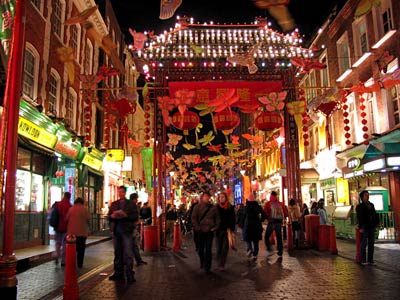
Entrance of China Town,
London
To some degree, the ups and downs of Chinese restaurants reflect
the living conditions of overseas Chinese.??
At 9:25 AM on November 20 the Quanjude (Group) Co., Ltd.,
China's famous roast duck chain, formally went public on the
Shenzhen Stock Market.
Quanjude's listing provides a new development idea for other
traditional Chinese brands. It's just like a shot in the arm for
other catering giants seeking overseas expansion, according to Yang
Liu, Secretary-General of the World Association of Chinese Cuisine
(WACC).
As the economic backbone for overseas Chinese, Chinese
restaurants may now have a brand new future after a history of more
than 100 years that have included some hard times in the recent
past.
Make a fortune via opening restaurants
A primary way for overseas Chinese to obtain a strong foothold
in a foreign country is by opening a restaurant. Indeed, most first
generation overseas Chinese began their adventures by opening
restaurants. It seemed that this was their only employment
choice.
Today it is difficult to tell when and where the first Chinese
restaurant was opened outside of China. According to some
documents, the first Chinese restaurant in the U.S. – the CanTon
Chinese Restaurant – opened in San Francisco in 1849. By 1920, 25
percent of the Chinese Americans in the USA worked in the food
business.
Currently the oldest existing Chinese restaurant in America is
the Imperial Dynasty restaurant located in Hanford, California.
Jiang Rong, a Guangdong railway worker, first opened this
restaurant in 1883. Today his fourth generation family members are
still operating this restaurant.
In 1914, the first Chinese restaurant in France, the "China
Restaurant", opened. The boss, Li Shizeng, began operations as a
bean curd company. Then, in order to make the cheese loving
Frenchmen accept bean curd he opened a restaurant.
Chinese restaurants have been around for a long time but their
real development has only begun over the past 20 years. In an
interview with the Globe, Sun Xianggu, Chief of the
Washington Chinese Restaurant Association, recalled, "I started my
first restaurant in America in 1969 but we didn't sell Chinese
dishes at that time because authentic Chinese cuisines didn't exist
in America."
"In 1980 I opened an authentic Chinese restaurant. I invited
Taiwanese chefs to come to work for me but we had no specific menu.
The chefs just prepared some Jiangsu and Zhejiang dishes and
steamed buns and cookies. But each time when the restaurant opened,
customers would rush in. Since then Chinese restaurants featuring
different dishes have began to emerge across America."
In the 1980s the Chinese mainland was experiencing the initial
stages of its reform and opening up. Chinese people had
opportunities to go abroad and foreigners also had chances to visit
China. Many Taiwanese also sought further development overseas. All
these factors prompted Chinese entrepreneurs to establish
restaurants in many foreign countries and business boomed.
According to a 2006 survey, the UK had nearly 9,000 Chinese
restaurants, about a quarter of all the restaurants; Netherlands
had more than 2,200, accounting for 28 percent of all the
restaurants and 85 percent of Chinese Dutchmen were working in
restaurants; Chinese restaurants and fast food surpassed 7,000 in
Germany and 80 percent of the Chinese Germans took jobs in the
catering trade.
Harsh times witnessed by overseas Chinese
restaurants
As an increasing number of Chinese restaurants have taken root
in foreign countries, many problems have cropped up as well,
including poor management and vicious competition through price
cuts.
Since 2005, the French media and the press have reported many
hygienic and quality control problems inside Chinese restaurants,
making many Frenchmen worry about eating in Chinese
restaurants.
Starting from March 30, 2006, the Portuguese government launched
sudden health inspections in more than 100 Chinese restaurants.
Unfortunately, more than 80 percent of them didn't pass Portuguese
health code standards. Within five days 131 Chinese restaurants
received fines and 14 were ordered to close down.
According to an insider, ongoing vicious competition between
Chinese restaurants in Portugal had forced them all to lower their
costs. Restaurant bosses understood the local government' health
requirements but they failed to adhere to the regulations for
various economic reasons.
Competition from local people is another challenge confronting
Chinese restaurants. In Korea and Japan, Chinese cuisine is very
popular. Yet many bosses of these transplanted Chinese restaurants
are native Koreans or Japanese. And in America the fast growing
Chinese snack bars such as the Panda Express and PFChang have
American bosses.
Facing such competition, the older generation of overseas
Chinese doesn't want their well-educated children to work in the
food business. "Each time the WACC holds meetings, only older
people in their 60s and 70s come to attend these meetings," Bian
Jiang, Deputy Secretary-General of the WACC told the
Globe.
Few overseas Chinese have passed on their restaurants as family
businesses as the Imperial Dynasty restaurant has done – this is
the fundamental reason why Chinese cuisine has not created famous
overseas brands.
Authentic Chinese food to promote Chinese
culture
Actually, some Chinese restaurants overseas are now expanding
and prospering. WACC Secretary-General Yang Liu told the Globe, "In
comparison with the past, Chinese overseas restaurants have
improved a lot in recent years."
Yang further explained, "In the 1990s when I went to Japan, 30
percent of the people there preferred French cuisine; 40 percent
loved the local cuisine; 15-20 percent favored Chinese cuisine.
This year I visited Japan again. The entire restaurant industry was
at a rather low ebb, yet more Chinese restaurants had been
opened."
When visiting Argentina this year, Yang was pleasantly surprised
to find authentic Northeastern Chinese dishes. "The restaurant we
ate at is run by a Shenyang native. I ate mushroom and chicken stew
and dumplings: typical Chinese dishes. When we went there we felt
quite at home. In fact, many domestic restaurants don't cook as
well as this restaurant," she commented.
Sun Xianggu opened a vegetarian restaurant called "Vegetable
Garden" in Washington. The dishes are prepared with local
vegetables by combining Chinese and Western cooking styles. Though
dishes there are much more expensive than ordinary Chinese dishes
made in other restaurants, many American customers patronize the
place.
Yang believed that these restaurants represent the correct
direction for Chinese cuisine. "They provide delicious Chinese food
as well as fantastic Chinese culture. They have become very popular
places to socialize," noted Yang.
Learn from France
Another important way to develop Chinese cuisine is to encourage
domestic restaurant giants to expand outside China.
The Little Sheep Catering Chain specializes in hot pot and has
sold its brand very well in Japan. Many other famous chain brands
such as "Jinbaiwan" and "Huangjihuang" are seeking overseas
development.
"In my opinion, Chinese cuisine will expand as food chains. Now
Quanjude has been listed. More and more food businesses will go
public in the future, this helps them get stronger and will enable
them to expand outside of China," Yang Liu told the
Globe.
According to her, enabling these catering enterprises to expand
overseas is a very important way to promote Chinese cuisine around
the world. With their considerable funds, professional talents as
well as advanced management models these established domestic
chains could quickly enter mainstream markets overseas. More
importantly, they would give foreigners the chance to taste many
kinds of delicious and authentic Chinese cuisines.
But in order to achieve this goal, "they need the support of our
government, our embassies and foreign affairs departments," Yang
added.
The French government has been very enthusiastic in promoting
their cuisine culture globally and has done very well in this
aspect, according to her. The French Ministry of Agriculture
established the French Food Association (FFA) in 1961. And the FFA
has been very successful in popularizing delicious French food over
the past 40 years.
Bian Jiang believes that food is an indispensable part of a
nation's culture. Chinese cuisine is varied and very special; it
must be used to promote our culture.
(China.org.cn by Zhang Ming'ai, January 4, 2007)