Global poverty can still be cut in half by 2015 if rich countries
lower trade barriers and boost foreign aid, and poor countries
invest more in the health and education of their citizens, says a
new World Bank report launched at the World Bank/IMF Spring
Meetings.
If
worldwide economic growth stays on track, global poverty rates will
fall to less than half their 1990 level in 2015, pulling some 360
million people out of grinding poverty, says the World Development
Indicators (WDI) 2003. But the driving force behind this progress
rapid growth in Asia and improvements in Eastern Europe will do
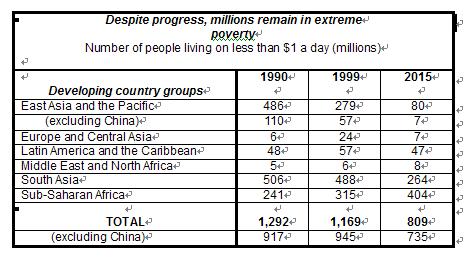
little to reduce the crushing poverty in Africa, where the number
of poor is likely to climb from 315 million in 1999 to 404 million
in 2015, and in the Middle East where poverty is also on the
rise.
The new report a large and detailed collection of data from
international and national statistics agencies tracks the progress
by poor countries toward reaching the Millennium Development Goals
(MDGs). The goals, agreed by the international community in 2000,
aim to reduce income poverty by 2015 and spur big improvements in
education, gender equality, health care, and in overcoming hunger
and environmental degradation.
"Many developing countries have made great progress in recent years
in achieving faster growth and managing their economies better,"
says Nicholas Stern, the World Bank's chief economist and
vice-president for development economics. "But growth alone will
not be enough to halve poverty by 2015. Developing countries need
to ensure that all people, and especially poor people, have access
to education, health care, and put in place the right investment
climate to create opportunities, spur productivity and make real
improvements in people's lives. But they can only do that if rich
countries reduce their trade barriers that limit poor countries'
potential to export and grow their economies. We hope that rich
countries will follow through on their aid commitments, and will
also take action on trade, particularly on agriculture, at the
upcoming WTO meeting in Cancun."
The new Bank report points to alarming disparities between the
quality of life in rich and poor countries. While seven of every
1,000 children in rich countries die before the age of five, that
number climbs to 121 of every 1,000 children in the poorest
countries. While 14 out of 100,000 live births in rich countries
result in the death of the motherthat ratio may be as high as 1,000
deaths per 100,000 live births in some poor countries. And while
rich countries have achieved the goal of educating all girls at the
primary school level, progress lags behind in places like South
Asia where only 61 percent of girls complete primary school.
The new report shows that the 1990s witnessed rapid progress in
reducing the number of people worldwide who live on less than $1 a
day, with numbers dropping from 1.3 billion in 1990 to 1.16 billion
in 1999. But these gains occurred largely in China and India. The
number of poor rose in Eastern Europe and Central Asia from 6 to 24
million, from 48 to 57 million in Latin America, from 5 to 6
million in the Middle East/North Africa region, and from 241
million to 315 million in Africa.
Looking ahead to 2015, the report says that if economic growth is
sustained, the number of people living in extreme poverty is likely
to fall in all of the world's regions except Sub-Saharan Africa,
the Middle East, and North Africa, where projected growth will not
be enough to stem the rising number in poverty (see chart
below).
Barriers to Trade
The new Bank report says that if rich countries lower their trade
barriers, it could boost annual growth in developing countries by
an extra 0.5 percent over the long run and lift an additional 300
million people out of poverty by 2015.
"Trade can spur development by expanding markets for developing
country exports," says Stern. "Poor countries are facing huge rich
country barriers in exporting those products that play the best to
their comparative advantage namely agricultural goods and
textiles."
Stern cautions that developing countries also have much to gain by
lowering their own trade barriers. Countries that have integrated
more with the world trade system have on average enjoyed stronger
growth. During the past decade, countries that boosted their trade
grew more than three times as fast as those that did not.
After expanding by 8 percent a year in 1990-2000, global trade grew
by only 1.2 percent in 2001. High-income countries, which account
for more than 75 percent of global trade (exports plus imports),
experienced the greatest slowdown, with trade growing by only 0.3
percent in 2001. But trade by low-income economies grew by 6.4
percent, almost twice the average rate in 1990-2000.
Although trade in services has grown rapidly, trade in merchandise
primary commodities and manufactured goods continues to dominate.
Exporters of primary non-fuel commodities saw their trade volumes
increase, but a continuing decline in their terms of trade left
them with less income. Sub-Saharan Africa was hit particularly
hard.
While trade can boost prospects for the developing world, foreign
aid is also instrumental in giving poor countries the resources
they need to invest in their people. In the past year, there have
been some promising signs that rich countries are living up to
their commitments to increase foreign aid. But Stern urges rich
countries to stay the course.
"Agreements and commitments alone will not achieve the Millennium
Development Goals," he says. "More actions are needed. And more
resources. The cost of achieving the goals is likely to run to at
least an additional $50 billion a year from rich countries over and
above the resources from developing countries themselves.
Developing countries have been improving their policies and
governance, and rich countries their allocation of aid. The result
is that aid is becoming still more productive."
Investing in Health and Education
While trade enables poor countries to export their way out of
poverty, it is strong health and education services that give
people the tools they need to take advantage of opportunities in
the global marketplace.
In
fact, promoting literacy and enhancing health and nutrition often
rank as the most critical measures for the poorest people and those
they value most. But government spending in these areas remain low
in many countries. In 2000, public spending on health in low-income
countries averaged 1 percent of GDP, compared with 6 percent in
high-income countries.
"As rich countries grow older and their working population shrinks,
poor countries have an opportunity to create jobs and increase the
productivity of their growing work force if they invest more in the
health, education, and nutrition of their people," says Eric
Swanson, Program Manager of the Development Data Group. "But the
poorest countries will need help to increase the capacity and
effectiveness of their health and education systems."
Spending on Health
The study finds that in 2000, total (public and private) health
spending in rich countries was 10 percent of gross domestic
product, while low income economies could manage barely 4 percent.
And this does not go very far: rich countries spent $2,700 per
person on health care per capita while African countries spent only
$29 per capita, and some as little as $6 per person. Total health
care spending in the US was $1.3 trillion or 13 percent of GDP and
represented 43 percent of total global expenditures on health.
Low-income economies spent only $45 billion.
Meanwhile, private expenditures on health represent a larger share
of health spending in poor economies than in most rich economies.
In poor countries, 73 percent of spending was from private
resources; in rich countries only 38 percent was private. The
United States is unusual among rich countries 56 percent of health
spending was private; in the European Union 25 percent was
private.

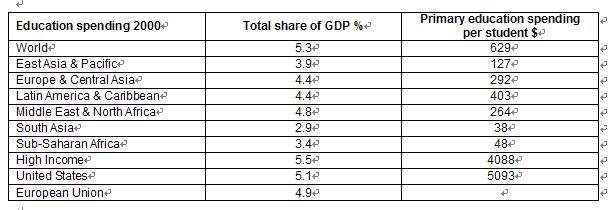
Spending on Education
While health spending falls woefully short in poor countries,
spending on education also pales in comparison to rich countries.
Although global public spending on education amounted to $1.54
trillion per year, 85 percent of that was in rich countries.
Average per capita spending on education was 28 times greater in
rich economies than in developing economies. Public spending as a
share of GDP was somewhat higher in high income economies (5.3
percent of GDP) than in developing countries (4.1 percent of GDP),
but the big difference in total spending is owing to the resources
GDP available to them. Low-income economies spend proportionately
more of their public education budgets on primary education.
These shortfalls in both health and education spending come at the
same time as the world military spending in 2001 is estimated to be
bout 2.3 percent of global income or more than $800 billion a year.
In more human terms, military spending is about $137 per person in
the world. This estimate is based on adopted defense budgets and is
likely to be revised upwards when supplementary expenditures
resulting from the 11 September attacks on the USA and the ensuing
war on terrorism have been taken fully into account.
Investment Climate
The Bank study also points to the need for countries to create
sound investment climates that can encourage job creation and spur
economic growth.
Good macroeconomic management, trade and investment policies that
promote openness, and good-quality infrastructure and services are
all essential. They also need a conducive business environmentbased
on a legal and regulatory system that supports the day-to-day
operations of firms by protecting property rights, promoting access
to credit, and ensuring efficient tax, customs, and judicial
services.
Part of what determines the business environment in a country is
the regulation of new entry and countries differ significantly in
the obstacles they impose on the entry of new businesses. In
Mozambique, for example, entrepreneurs wishing to start up a
business must complete 16 procedures, a process that takes an
average of 214 business days and costs the equivalent of 74 percent
of gross national income (GNI) per capita. In Italy, they must
complete 13 procedures, wait 62 business days on average, and pay
23 percent of GNI per capita. But Canada requires only 2
procedures, and the process takes only two days and costs about 1
percent of GNI per capita.
"The case for creating a good investment climate is simple: an
economy needs a predictable environment in which people, ideas, and
money can work together productively and efficiently," says Stern.
"Small firms and farms suffer most from a weak investment climate.
Countries should focus on improving the investment climate for
domestic entrepreneurs because 90 percent of investment comes from
domestic sources. But a better investment climate will also attract
foreign investors. And countries that receive more foreign
investmentan important conduit for new technologies, management
experience, and access to marketsenjoy faster growth and greater
poverty reduction."
(China.org.cn April 14, 2003)