Premier
Wen
Jiabao talked about increasing transparency while gaining
credibility in his
report
on government work during the recent Third Session of the 10th
National People's Congress. In the past couple of years, government
organizations have sought to be more user-friendly, more accessible
and more helpful.
The State Council Information Office (SCIO) is the architect of
the growing news briefing and spokesperson system that was put in
place to promote this change and help the government create a new
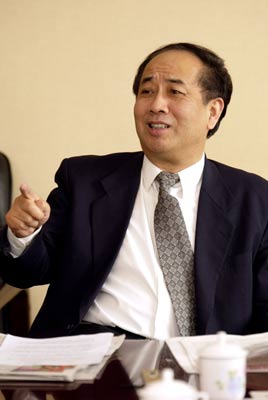
image. In a recent interview, Minister Zhao Qizheng told
China.org.cn how the system has grown and plans for its future.
China.org.cn: The spokesperson and press conference
system is in place in every department of the central government
and at the provincial level. What has SCIO's part been in
this?
Zhao Qizheng: SCIO has had two tasks in this regard. One is the
regulation and standardization of the press conferences held. SCIO
alone gave 60 press conferences in 2004, 20 more than in 2003,
which were highly welcomed by domestic and overseas press. Frankly,
we have paid close attention to improving the quality of our press
conferences because they should set the standard for other
departments.
The second task was to introduce and promote the system. In late
2004 we were happy to announce to the public the first group of
80-odd spokespersons
in the 70 departments under the State Council. In the same period,
20 provincial governments began offering press conferences with
specially designated spokespersons. At that time we could say that
the system has been basically established.
China.org.cn: This is an entirely new concept in China.
Have you had feedback from government leaders and the media about
its effectiveness?
Zhao: SCIO sponsors regular press conferences, inviting
different government department heads to give presentations. We
held only a dozen such press conference eight years ago, but the
number came to 60 in 2004, showing the positive attitude of the
department heads.
Years ago, it was really hard for us to persuade some of the
department heads to mount the SCIO platform because they were so
worried about making mistakes when answering questions, or even
making a slip of the tongue. The situation has changed completely
now, with more and more ministers, department heads and governors
participating. The National Bureau of
Statistics and General Administration of Work Safety hold four
regular press conferences each year at SCIO.
We solicited opinions from the domestic and overseas press last
year. The comments from the foreign press were surprisingly
positive, with most of them saying we are precisely following
international practices. They were satisfied with the time allotted
for opening statements, about five to eight minutes, which is
typical internationally. They commented that the short opening
meant that the senior Chinese officials were open-minded and
confident.
This is really a sharp contrast with the situation many years
ago, when the hosts talked as long as 50 minutes to shorten the
time for questioning while hiding their nervousness and
embarrassment in front of the media.
The overseas press corps especially praised the live TV
broadcasts and online reporting of the SCIO press conferences. They
said that this practice was rarely seen even in Western countries.
A German magazine's CEO once said to me that Chinese ministers are
very brave to let their press conferences be broadcast live. He
said that it indicates that the officials are confident and
competent.
Some foreign journalists found it amazing that Chinese ministers
could quote data and figures whenever necessary without help of
written materials. An AP journalist in Beijing told me that most of
the SCIO press conferences hit their headlines.
China.org.cn: Could you explain how government
spokespersons decide what information to make public? Do they
encounter any interference in their work?
Zhao: The spokespersons prepare with a process that we call a
"production line." They must have a good command of the public
information in their field and? a good understanding of what
the press and the public are interested in.
The spokespersons themselves are senior officials who may attend
the high-level meetings of their departments or local governments,
so they know clearly what the organizations are considering and
what policies they are making. From this information they select
what should be brought to the public soon.
The spokespersons must also follow the interests of the media
and the public to make sure that the information is responsive to
their interests. The spokespersons should keep in contact with the
media after the press conferences, remaining easily accessible to
give them more information while acquiring feedback.
The selection of information for the public is a common practice
of every government. It is not right to regard selection as
interference. Generally speaking, a spokesperson shares identical
views with his boss. He represents the government's stance, and is
not speaking on his own behalf. The content and manner of an
announcement are subject to consideration and approval by his
chief.
As elsewhere, our spokespeople are supported by teams that
prepare files, data and reports and have all these materials
approved before the press conference.
China.org.cn: SCIO organizes the training of
spokespersons at the central and local government levels. What does
their training include? And are there established criteria for
selection of spokespersons?
Zhao: The organizations choose their own spokespersons. They are
usually leaders of a ministry or department's general office. Some
ministries choose spokespersons from the Laws and Regulations
Bureau or research center. Those at the provincial and municipal
levels are usually their secretaries-general or vice
secretaries-general.
The criteria for selection include a good general knowledge
about his department and local affairs, the ability to speak
logically and eloquently and feeling at ease in front of the
media.
The SCIO has enhanced the training of spokespersons at the
central, provincial and city levels. We have trained over 2,000
people in 16 provincial training programs. We are planning to
launch more than 10 such programs this year to increase the number
of trained spokespersons to 4,000.
The courses given are in relation to politics, mass media and,
in particular, foreign journalism. There is psychological training
in dealing with aggressive and provocative questions. How to
organize a press release in times of emergency such as social
disorder or natural disaster is also an important part of the
training.
Teachers of such courses are senior government press officers,
scholars of journalism and mass communications and senior managers
with leading PR companies.
We have a slogan for spokespersons: expressing China's stance
with an international voice. They should be true to facts and tell
the situation in China honestly. At the same time, they should have
good knowledge and the skills to employ internationally accepted
ways of speech and avoid Chinese clichés.
China.org.cn: The media and the public have far greater
access to authoritative and comprehensive public information now.
However, government responses to some major events have still been
pretty slow. Has this issue concerned you or leaders of other
ministries?
Zhao: In fact, government departments now announce emergencies
much much more promptly than they did before. You may have noticed
that some emergencies are announced hours after they occur, which
has won applause from both domestic and foreign journalists.
But I also have to admit that announcements have been delayed in
a few emergencies for a couple days or even months. Those
departments did not necessarily cover up or deliberately delay the
report. There are many reasons for their slow action.
Sometimes the complexity of the case itself hinders the
information flow. Now we especially encourage local officials to
speak even when the situation is not clear. We told them just to
say what they know. Sometimes the events occur in remote areas
where local governments don't consider press releases serious
matters. When the provincial government of the place where
something happens is not clear about the situation, we cannot be
more informed than the local authorities.
To cope with this situation, an information transmission network
is being designed. With the network, local governments will be able
to report to higher authorities in case of emergencies. We have
drafted detailed rules for establishment of the network, which we
expect to promulgate this year and send to provincial-level
governments. The network will establish responsibilities and
improve the efficiency of the reporting of emergencies.
The emergency response programs the State Council is creating
also include sections on information disclosure. These ordinarily
require organizations first to announce the crisis to the public
and then precisely describe the crisis itself, its scope, the
victims, the government's responses and so forth.
China.org.cn: Premier Wen Jiabao promised recently in
his annual Government Work Report to the National People's Congress
that the central government will improve the transparency of its
work and enhance credibility. Does this provide impetus to your own
work?
Zhao: Yes, it certainly does. That is also the reason why we
will improve and promote the press release system, to increase the
transparency of government affairs.
Although the three-tier press release system is now in place
nationwide, it has not be implemented well in some regions. China
still has some underdeveloped areas. In some provinces, the system
is not well accepted or understood and is not taken seriously
enough. Officials in these areas don't understand that transparency
can be very helpful for government work.
For instance, when something happens, others speak but the
government maintains silence. What can happen is that rumors
spread, misleading the public while tarnishing the image of the
government.
The fact is that the government's policy and crisis management
are usually understood and supported by the people so long as the
government brings the event and its management to light in time.
The establishment of the press release system is very important
because the system can boost the credibility of the government with
the public and improve the relations between them, which are vital
to building a harmonious society.
(China.org.cn by staff reporters Wandi Jiang and Chen Chao April
5, 2005)