It was huge, 3,100 square km till the late 1920s. A lifeline of
the ancient Silk Road, it was first mapped by ancient Chinese
geographers. But the salt lake in the southeastern part of Xinjiang
Uygur Autonomous Region has largely dried up today, with marshes
and small, shifting lakes receiving the channels of the Tarim
River.
It's true, Lop Nur is still there, but at best it can be
described as a marshy depression.
Nature's fury is about to make history repeat itself; this time
in northwest China's Gansu Province as another tragedy. The Minqin
Oasis is still about 1,000 square km, but is shrinking fast.
Scarily, its surrounding geographical features are similar to that
of Lop Nur. It's surrounded by the Tengger and Badain Jaran deserts
and is vanishing at an alarming the rate of 3 to 4 meters a year,
says Gansu Vice-Governor Shi Jun.
Reclaiming of forests and grasslands for agriculture and the
unprecedented dry weather of recent years have been blamed for the
ecological and economic threat. But the National Conference on
Desertification Prevention held in Beijing late last month was
determined to not let it disappear. "No stone should be left
unturned to stop Minqin from vanishing," Shi told the conference,
the fifth of its kind.
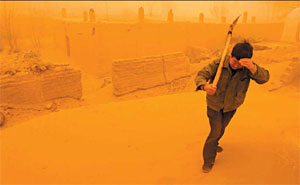
A farmer struggles to
keep his eyes open during a sandstorm in Minqin, Gansu
Province.
That the central and provincial governments are committed to
saving the country's ecology became evident at the conference when
governments of 12 provinces and autonomous regions signed
agreements with the State Forestry Administration (SFA) to fight
desertification.
Desertification disrupts the lives of 400 million people and
causes direct economic losses of 54 billion yuan (US$7 billion) a
year, SFA figures show. That's the reason why the efforts of the
governments of Hebei, Gansu, Shanxi, Shaanxi, Liaoning, Jilin,
Heilongjiang and Qinghai provinces and the Inner Mongolia, Ningxia
Hui, Xinjiang Uygur and Tibet autonomous regions are so important.
These governments will allocate special funds during the 11th
Five-Year Plan period (2006-10) to prevent desertification and
fight sandstorms, with their contributions increasing in proportion
to the annual revenue growth.
The threat of desertification in China is one of the worst in
the world. The country already has 174 million hectares of deserts
or arid land, that is, about one-fifth of the total land area. It
has been fighting to check the spread of deserts for the past few
years and has launched six major forestry projects to:
Protect natural forests
Convert land claimed for agriculture into forests and
grasslands
Prevent sandstorms in the Beijing-Tianjin rim
Build shelter belts in North, Northeast and Northwest China
Protect wildlife, and
Plant commercial forests
These efforts have borne fruit, for China's deserts have shrunk
by 1,283 square km annually in the past five years, instead of
expanding by 3,436 square km a year as they did till the late
1990s, according to SFA data. In fact, 2001 was the first year the
trend was reversed since the People's Republic of China was
established in 1949.
The country began a green movement after floods claimed more
than 1,000 lives and rendered about 1 million people homeless in
Sichuan Province in 1981. Every person above the age of 11, except
the old and physically challenged, were asked to plant three to
five saplings every year or contribute equally in some other way to
save the environment. More than 12 billion trees have been planted
since 2001, which means an average person has planted 10 trees in
five years.
But the government's fight against desertification and damage to
the environment is not confined to planting trees. It has banned
tree felling and logging along major parts of the Yangtze and
Yellow rivers and converted more farmlands into forests and
grasslands.
But despite all this, "the fight against desertification is far
from over" SFA Director Jia Zhibang says. Grazing, logging, timber
smuggling and collection of firewood still pose a threat to the
environment and contribute to global warming. The government needs
to improve legislation to check desertification, he says, and deal
with those harming the environment most severely. It should
strengthen global cooperation, too.
China joined the United Nations Convention to Combat
Desertification in 1994 and has since encouraged international
cooperation on the issue. "China has made tremendous achievements
to fight desertification," says the UN convention's executive
secretary Hama Arba Diallo. "We hope more countries can share
China's successful experience," Xinhua has quoted Diallo as
saying.
"Regaining lost land is too expensive. Prevention is the only
solution for developing countries." Israel is an apt example of
what a country can do to regain land lost to the desert. But the
cost has been too high.
Desertification has been spreading like cancer. In fact, it is
referred to as the "cancer of the Earth" and affects about a fifth
of the world's population. The loss of crops across the globe
because of degradation of land is about $42 billion a year, says
the UN Environmental Programme that declared 2006 a year of focus
on deserts and desertification.
UN has urged countries, especially the developing ones, to
integrate more desertification prevention measures into their
economic policies to ease the effects on agriculture, economy,
health and society. China implemented the Desertification
Prevention Law in 2002 to curb harmful human activities, including
illegal tree felling, overgrazing, random plucking of medicinal
herbs and over-exploitation of water resources.
The measures were taken to reduce the economic loss of billions
of yuan a year. Droughts and sandstorms reduce agricultural
production and cause damage to infrastructure like railways and
roads. Sandstorms in North China not only disrupt normal life, but
also bring industrial production to a standstill and cover
agricultural land with sand and dust. The huge amount of silt they
deposit in rivers and other water bodies affects marine life and
biodiversity and creates a big problem for water treatment.
The government spends 2 billion yuan (US$260 million) every year
to fight desertification, but it's difficult to reclaim all the
"curable" land by the targeted year of 2050. The cost of that would
be about 240 billion yuan (US$31 billion), SFA Deputy Director Zhu
Lieke said last May. More than 530,000 square km of "controllable
deserts still lie untouched", Zhu said, because of lack of
funds.
The onus to save the environment, however, is not only on the
governments be they central, provincial or at the lower levels. The
public, too, has a big role to play in that, hence Zhu has asked
the governments at all levels to promote environment awareness
among the people.
Experts concede that checking the spread of deserts is a
complicated process. It needs interdisciplinary review of available
technologies. "Since drought and semi-drought areas have a very
fragile biodiversity, scientific programming and use of land and
water resources becomes the core issue," Chinese Academy of
Forestry professor Ci Longjun says.
Different measures should be adopted for different areas,
depending on the type and degree of land degradation. For instance,
the large-scale shelter forest belts built to protect arable land
in the plains of Northeast and North China, the upper reaches of
the Yellow River, the Hexi corridor in Gansu and oases in Xinjiang
have increased grain output by over 8 million tons a year.
The shelter belts in the mountainous regions of North, Northeast
and Northwest China have helped farmers reclaim 1.4 million
hectares of arable land and 10 million hectares of grasslands. A
national sand control project started in 1991 has turned 5.4
million hectares of arid land into 600 integrated development zones
that today house orchards, timber forests and other commercial
plants.
The forestry project in Beijing-Tianjin rim has added 1.8
million hectares of forests, increasing the area's green cover to
about 30 percent and reducing sandstorms that occur mainly in March
and April.
Thanks to the afforestation projects in the nearby regions,
including Hebei and Inner Mongolia, sandstorms are less of a
problem for Beijing today. Hebei has started a series of measures
to check desertification in the areas around Zhangjiakou and
Chengde, a major source of sandstorms that hit the capital every
year.
More than 200,000 hectares of arid and sandy land around Beijing
and Tianjin has been converted into forests and grasslands in the
past five years, according to the Hebei forestry department. The
province, a major source of water for the capital and Tianjin, has
spent heavily on afforestation and sand control. The result: better
water quality in the three major reservoirs of Miyun, Guanting and
Panjiakou. Guanting's annual sand content, for instance, has come
down from 9 million tons a year before 2000 to 2 million tons
today.
A drive as powerful and dedicated is needed to save the Minqin
Oasis and all other places and things, big and small, important for
our and children's survival.
(China Daily April 3, 2007)