Why and How the CPC Works in China
 0 Comment(s)
 Print
Print E-mail
China.org.cn, June 30, 2011
E-mail
China.org.cn, June 30, 2011
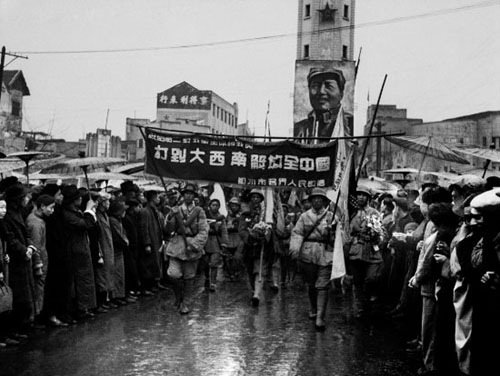
"Do not hit out in all directions"
The stabilization of prices and unification of the nation's finance and economy were achieved in just a few months, creating the necessary conditions for the recovery of the national economy. But with regard to the recovery of the national economy, where should the government begin? What steps should be taken? What policies should be implemented? How long would it take? In order to get clear answers to these questions, comprehensive planning was necessary.
Early in March 1949, when the Chinese Civil War was still going on, the CPC leader Mao Zedong instructed all the party members: "If we are ignorant about production, cannot quickly learn it and revive the country's production and develop it as quickly as possible to improve the lives of the workers, and then to improve the lives of all the Chinese people, we cannot maintain political power, much less consolidate our position." It was thus clear that the CPC had a clear understanding of the importance of restoring and developing the economy. A month later, Mao Zedong proposed an economic policy called "Four Sides and Eight Parties." The "Four Sides" were the public and private, labor and capital, urban and rural, and domestic and foreign sides, among which each side included two parties, so together they made "Four Sides and Eight Parties." The economic policy was one that should handle well relations of the four sides and eight parties, taking into consideration both the public and private interests, carrying out mutual assistance between town and country, and exchanges between home and abroad.
On September 29, 1949 the "Common Program," which bore the nature of a provisional constitution and was adopted by the Chinese People's Political Consultative Conference (CPPCC), determined that the policy of "Four Sides and Eight Parties" be the fundamental principle of the PRC's economic construction. The CPC proposed to spend about three years achieving the basic recovery of the national economy.
The four sides of "public and private," "labor and capital," "urban and rural" and "domestic and foreign" in the policy of "Four Sides and Eight Parties" were, in fact, the four pairs of contradictions that existed in China's economic and social development. Whether or not these problems could be properly solved had a great deal to do with China's social stability and future.
Failure to handle properly the public-private relationship might cause the loss of the country's economic base; poor handling of labor-capital conflicts was likely to make class conflicts more acute; failure to properly handle the relationship between urban and rural areas had a bearing on the consolidation of the worker-peasant alliance; and improper handling of internal and external relations would make China more isolated internationally and retard its economic and trade development. The policy of "Four Sides and Eight Parties" was in line with China's level of productivity and the characteristics of its economy at that time. It was a good solution to the relationship between different economic sectors and other relationships, which mobilized the enthusiasm of all sides, forming joint forces that promoted economic and social development.
However, in practice, the "Four Sides and Eight Parties" faced many obstacles, and was a major test for the CPC leadership. Because of war damage, the various segments of the country's population all encountered some difficulties both in production and life. First, the national bourgeoisie, struggling to keep production going amid a shortage of materials, were ambivalent about the new government. Unemployed workers and intellectuals and some artisans also had complaints against the CPC. The fruits of liberation seemed long in coming. Before the land reform had been completed the peasants also grumbled about the new order.
Meanwhile, inside the CPC there was a fierce debate about whether the state sector of the economy should be allowed to squeeze out the private sector, or the two be allowed to exist side by side. These phenomena were contrary to the policy of "Four Sides and Eight Parties," and greatly hampered the work of promoting financial and economic reform. In view of this, in June 1950 Mao Zedong proposed the policy of "Do not hit out in all directions." He said that too many people had been targeted as enemies before. All parties that could be united should be united, and the policy of "Four Sides and Eight Parties" should be adhered to. He also proposed specific initiatives like rational adjustment for industry and commerce, solving the unemployment problem, implementation of rent and interest reduction and land reform, and finding ways to employ small artisans and similar workers.
The policy of "Do not hit out in all directions" clarified the objects to be attacked and the forces to be united and relied on, organizing a sturdy team for the basic improvement of finance and the economy. For example, in respect of the supply of raw materials, labor-capital relations, markets, prices, and internal and external exchanges, the state economy and private economy were given equal treatment, and after the work of the adjustment of industry and commerce got into full swing, the national bourgeoisie not only surmounted the hurdle of economic stagnation, but achieved fairly rapid development as well.
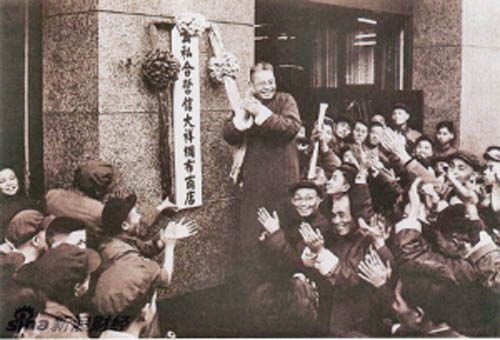
Compared with 1950, the number of national private industrial businesses in 1951 had increased by 11 percent, and their GDP by 39 percent. The profits acquired by private businesses from orders from state-owned enterprises were higher than those of any year during the rule of the KMT. They began to accept the leadership of the CPC and the state economy, and their psychological fear of socialism was initially eliminated. Again, for the more than six million government employees left over by the KMT government, including those from bureaucratic capital enterprises, the CPC adopted a "guaranteed-employment" policy. At that time the state had financial difficulties, but the CPC declared that it would rather "share a meal for three people with five" than abandon the former employees. Although this far-sighted measure brought a huge financial burden to the country, it increased the cohesion of the CPC politically, bringing great order across the land and winning the party popular support.
The focus of the policy of "taking into consideration the four sides and eight parties instead of hitting out everywhere" was the recovery and development of the economy. Even after 1950, when the Korean War, a conflict that lasted from 1950 to 1953 between North Korea and South Korea, broke out, the CPC also firmly seized the key work without vacillating. Funds for economic construction accounted for 25.5 percent of the entire state budget in 1950, 29.5 percent in 1951 and 45.5 percent in 1952. Investment in economic construction maintained a certain level of growth each year. While fighting a war as well as beginning the work of construction in the country, the CPC's fiscal deficit did not increase much more than it had before, which was a great achievement. Funds for economic construction accounted for a higher proportion of the state budget than under the rule of the KMT.


