Coming back from a short business trip to Hong Kong, Clare Hu opened her purse and found that she had unintentionally spent half of her monthly salary while browsing through shops and department stores there.
"There are a variety of goods there, and they are much cheaper," says Hu, a media worker in Shanghai. Her colleagues bought even more. The buys ranged from 2, 000-yuan cameras to a box of milk tea.
Mainland tourist shopping sprees in Hong Kong are becoming a tradition, but such behavior has become much more reckless as yuan has risen in value, increasing its purchase power.
China's currency, the Renminbi or yuan, has appreciated 20 percent against the U.S. dollar since it was unpegged from the dollar in 2005. The Hong Kong dollar, which is still pegged to the U.S. dollar, has weakened from 1.06 to 0.88 to the yuan.
INCREASED PURCHASING POWER
"With the rapid growth of the Chinese economy, the outbound travel market is expanding," says Grace Pan, head of travel and leisure research at Nielsen.
Chinese travelers spend on average 2,597 to 3,506 U.S. dollars on an overseas trip, with the amount varying by region, according to the Nielsen China Outbound Travel Monitor report.
Not only are mainland residents traveling abroad to take advantage of the rising yuan, they can sense the change in the domestic market. Prices of imported vehicles, which have been high for years, have been falling slowly for the first five months this year.
According to National Development and Reform Commission monitoring data on consumer product prices in 36 large and medium-sized cities nationwide, the prices of imported vehicles dropped 1.95 percent in May from the previous month,
China imported 171,000 automobiles in the first five months, up 59 percent compared with the same period last year. In 2007, the volume of automobile imports saw an annual rise of 37.9 percent. Part of the reason is that international automobile giants made stronger efforts in China this year to make up for reduced sales in the North American market. Chinese consumers, with a currency that is becoming stronger daily, are believed to be becoming more open to buying imported cars.
The market of imported snacks and other foods has been rising at an annual rate of 15 percent in the past five years, according to report on the industrial website sponsored by China National Food Industry Association (CNFIA).
EXPORTS PAINS
In contrast to consumers, exporters have been hurt by the appreciation, which has eroded their profits to crisis point.
"In only half a year, our export cost was pushed up by 10 percent and profit reduced by 40 percent," says Shen Yaoqing, vice president of Shangtex Holding Co., a major Shanghai-based textile manufacturer that exports about 2 billion U.S. dollars worth of products annually. "Our company is on the brink of failure."
The problem of Shangtex reflects the dire situation suffered by the export-oriented processing trade that employs up to 40 million people.
Exports have been hailed as one of the country's three economic growth engines, together with consumption and investment. But the engine is slowing with reduced overseas orders. China's monthly trade surplus dropped to 20.2 billion U.S. dollars in May, down 10 percent from the same month last year, according to the General Administration of Customs.
CHANGE BEHIND THE SCENES
The reverberations of the rapid appreciation of the yuan are deep and complicated. The change was not as simple as a boost in buying power or a squeezed trade surplus.
Behind it lies a shift in the country's overall economic strategy, driven by recognition that the current export structure won't support economic development the way it used to.
"China's currency had been kept in an undervalued state since the 1997 Asian Financial Crisis, and the government in effect used it to finance the imports and exports sector at the cost of its non-trading industries," says Professor Pan Yingli, of the Shanghai Jiao Tong University management school.
A large profit margin was then created between low production costs paid in undervalued yuan, and the high revenues reaped by selling these products to international clients.
This brought prosperity for the country, but took a heavy toll with high pollution and energy consumption. Too much labor-intensive industry with low-efficiency and little added value stretched supply by demanding evermore manufacturing materials, which pushed up upstream prices. The heavy reliance on overseas markets was detrimental to the establishment of an overall balanced industrial structure in China.
It also created a persistent gap between the well-developed coastal east, which thrived by trading with the outside, and the poor central and western regions in China.
"The structural conflict has accumulated to a stage that demands a solution," says Pan. "Strengthening the yuan is the rational choice as it helps stabilize inflation and leads to the optimization of industrial structure."
Studies in east China's Jiangsu Province found the composition of exported products started to change with appreciation. High-tech goods, machinery and electronic products started to take a greater share at the expense of labor-intensive products, such as textiles, garments and toys.
In the Pearl River delta area, 2,331 shoe makers have gone out of business, and 2,428 remain. Shoe exports were down 15.5 percent to 1.35 billion pairs in the first five months compared with the same period last year, but the value gained 9.4 percent to 3.97 billion U.S. dollars.
WHERE IS THE END
This year, the appreciation has accelerated, breaking through the 7-yuan mark against the dollar in early April before it weakened slightly on a stronger dollar in May. However, it soon regained strength and broke through the 6.9-yuan mark to hit a record 6.8919 to the dollar on June 17. By then, it had appreciated almost 6 percent in 2008 alone.
As China's currency became increasingly stronger, Liu Yuhui, researcher with Chinese Academy of Social Sciences noticed a dangerous undercurrent of money flows. Observation of statistical data showed that "hot money," or international short-term speculative funds, is speeding up its flow into China in the first quarter, which was closely related in an anticipation of faster appreciation of the yuan.
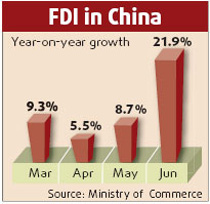
No official figures was released concerning the "hot money", but analysts smelt a rat from the strange phenomenon that combines a ballooning forex reserves and declining current-account surplus and reduced expenditure of foreign investment in China.
During the first five months of 2008, forex reserves increased by 18.7 percent year-on-year, or 268.7 billion U.S. dollars, SAFE figures showed. Jiang Zheng, a macro-economist at a Beijing-based securities firm, has discovered that there was an unexplained 147.9 billion U.S. dollars in the forex reserve increase figure after deducting the trade surplus and the FDI from it.
The concentration of international speculative fund in China's domestic market would pose major threats to a stable exchange rate of yuan, and also rob a country of effective control of its macroeconomy, says Liu.
Given the complexity of the situation, opinion is divided over whether the appreciation will continue, or whether there will be a one-off appreciation to end the uncertainty. Guesses are made at the so-called ceiling of the yuan.
Central bank governor Zhou Xiaochuan says China would gradually expand the elasticity of the exchange rate, sending out the signal that Beijing would let the yuan fluctuate rather than rise unilaterally.
The fast appreciation of the yuan in the first half might not continue, and the concern over possible fallback of foreign trade could weigh against continuous further appreciation, says Peng Xingyun, of the Chinese Academy of Social Sciences.
"There are many factors in the market that affect supply and demand, which, if changed, would sway the exchange rates," says Peng.
(Xinhua News Agency October 1, 2008)