|
|
|
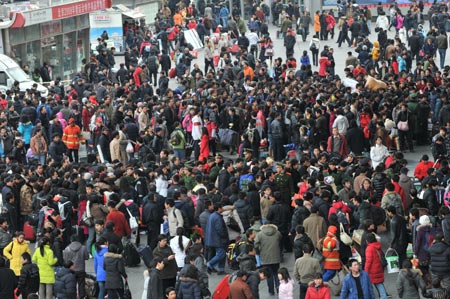
Travelers wait to enter Beijing West Railway Station in Beijing, capital of China, on Jan. 16, 2009. The passenger flow in 40-day Spring Festival transportation, or Chunyun in Chinese, run up as the Chinese lunar New Year draws near. The Spring Festival, or the Chinese lunar New Year, falls on Jan. 26 this year. [Fan JiashanX/inhua] |
Outside a temporary waiting room at the Guangzhou Railway Station, a rail hub in south China, a man sat with his mother and daughter on a duffel bag.
Ahead of the three-generation family was a 1,250-mile journey from the coastal area to their rural inland hometown of Hechuan, Chongqing.
They were making some of the estimated 2.32 billion trips that will be taken during the Spring Festival, the Lunar New Year holiday, for family reunions. This year, the holiday falls on Jan. 26.
Lots of baggage
Wang, who would only give his surname, and his relatives looked more like they were relocating than going on a holiday. Besides their three shoulder bags, they also had a TV, a fan, three electric rice cookers, four buckets and a shoulder pole for Wang to carry more bags than their hands could hold.
"I probably won't be back after the holiday, like in previous years," said Wang. He worked for eight years on construction sites in Guangzhou, capital of China's export heartland Guangdong Province, which is next to Hong Kong.
The economic boom of the past decades benefited huge numbers of farmers like Wang, who left the countryside for a better future in the city. Wang said he could earn more than 1,400 yuan (about 205 U.S. dollars) per month at his construction jobs.
That was much better than toiling on the farm. According to Chen Xiwen, a top agricultural expert, Chinese farmers' per capita net income stood at 4,700 yuan (688 U.S. dollars) on average in 2008, less than one-third of that of urban residents.
Financial crisis hits home
Wang's world fell apart in the second half of last year, as the financial crisis gripped the world economy and crippled demand for made-in-China products.
Since October, export-oriented factories in Guangdong and other parts of the country have cut back on overtime, fired staff or closed as their orders were cancelled and payments delayed.
Wang's last employer in construction was affected as well, cutting jobs and wages.
"Given that my pay has fallen by about half, my family and I can no longer afford to live here," Wang said. "But we hate to leave these things behind, so we decided to take them home."
Elsewhere at the station, there were many homebound migrant workers carrying more baggage than usual. They, too, were probably leaving for good, or at least a long time.
Guangdong, which accounted for more than a quarter of China's foreign trade last year, had some 26.7 million migrant workers, one third of the country's inter-province workers, according to the provincial government.
Different this time
Year after year, at Lunar New Year approaches, Chinese people go on the move in the "chunyun," or Spring Festival travel rush, recognized as the world's biggest human migration.
During chunyun, hundreds of millions of people squeeze into cars, buses, trains, ships and planes to go home and then return to where they work or study.
This year, the entire transportation sector is expected to provide 2.32 billion trips during the 40-day chunyun, which started this past Sunday, 15 days ahead of Lunar New Year.
This means 58 million people,about the population of Italy, will be on the move every day.
Each year, the migration leads to familiar, striking scenes: frustrated and tearful passengers, endless lines, packed stations, people crawling into trains through windows, sardine-like conditions and frantic staff.
Every year, this human tide puts the transport system to a formidable test, in particular the rail network, which often has difficulty coping.
This time, these difficulties are exacerbated by the human fallout of the financial crisis, which has had an unprecedented impact on chunyun.
Going home earlier
The Wangs were not among the initial wave of homebound migrants. Some of his fellow townsmen went home as long as eight weeks ago, when their factories laid them off or shut down entirely.
A report by the Chinese Academy of Social Sciences has said more than 4 million migrants nationwide had so far gone home earlier than usual. An investigation by the Ministry of Agriculture showed 6.5 percent of the country's 130 million migrants, or about 8.4 million, had gone home early.
In one dramatic case, four migrant families (including children) who could no longer to eke out a living in Shantou, on the Guangdong coast, went home with their belongings on three-wheeled motorcycles. The 1,875-mile journey started Nov. 18 and took more than two weeks.
These homebound trips by migrants got chunyun off to an early start this year. Usually, the travel season only begins about two weeks before the Spring Festival.
Cao Jianguo, vice general manager of Guangzhou Railway Group, said rail travel volume rose earlier and faster this year as factories let workers go ahead of time amid the economic woes.
In November and December, Cao's organization transported more than 6.48 million outbound passengers, up more than 20 percent from the year-earlier level, a growth rate more than 10 percentage points higher than in recent years. Many of them were migrant workers.
Wang Yongping, spokesman with the Ministry of Railways (MOR), said the same developments have been seen nationwide.
Early this month, major rail hubs such as Guangzhou in the south, Shanghai in the east and Beijing in the north have seen passenger numbers rise earlier than in previous years.
MOR also attributed the earlier-than-usual travel rush to an aberration of the calendar: this January has the fewest workdays, leaving 14 days off for people across the country.
In addition to the three-day New Year break, Chinese are also expecting a week-long Spring Festival holiday, which prompted many homeward people to leave early to take advantage of the cluster of holidays.
System under pressure
Even with the early departures of millions of migrants, the transport sector said the estimated 2.32 billion trips that would be taken during chunyun represented a 5-percent rise from last year.
Xu Yahua, deputy director of the road transport section at the Ministry of Transport, said the roads would carry nearly 2.1 billion passengers, up 3 percent from last year.
The MOR estimated it would serve 188 million passengers, up 8 percent over the year-earlier level, which spokesman Wang said would put the over-stretched rail network under huge pressure.
"We are expecting more passengers, not fewer. We will face even tougher pressure this year," Wang said.
As of end-2008, China had more than 79,000 kilometers of tracks in operation, nowhere near enough to meet demand, according to the MOR.
During major holidays like the Spring Festival, the network has always been strained. At such times, many trains are overcrowded because they are cheaper than planes, safer than road transport and serve far-flung areas.
But there is still a wide gap between what the rail system can deliver and what passengers want.
Guangdong an example In Guangdong, the provincial transport system is expected to serve more than 140 million passengers during chunyun, a record high. Most of the burden will fall on trains.
According to Wang, in recent years 30 percent to 40 percent of migrant workers stayed in Guangdong during chunyun. Demand was strong, and they could earn extra money. This year, he said, far fewer workers would stay.
Also, many of the 13 million migrant workers who spent the last Spring Festival in Guangdong after the transport system was immobilized by a long spell of heavy snow and ice were determined to go home this year, he added.
The Guangzhou Railway Group said about 2,540 Guangdong-based enterprises had booked some 765,000 group tickets for their homebound workers, a significant increase over recent years.
Zheng Qiang, an official with Sichuan's liaison office in Guangzhou, said about 1.5 to 2 million of the 5 million migrant workers from Sichuan were expected to return home for the Spring Festival. In previous years, the number was less than 1 million.
Uncertain future
Migrant worker Wang has no idea of what he'll do after chunyun. Others said they might try their luck in other cities. And that uncertainty has created further complications for transportation authorities.
Every year, the system pulls out all the stops to handle the chunyun rush. MOR spokesman Wang said the flow of migrant workers had followed regular patterns in recent years, but this year will be more difficult to plan. In part, that reflects a change in the school calendar, with many Chinese schools planning to re-open later than usual.
Mostly, though, it reflects uncertainty in the lives of migrants.
"Migrant workers will make new choices. Some of them will return as usual, while others will hesitate. Those who worked in coastal regions before might look for new jobs inland," he said. "We have to monitor the situation closely."
(Xinhua News Agency January 17, 2009)