China exercises a proactive employment policy, and has established the employment principle of "workers finding their own jobs, employment through market regulation and employment promoted by the government." The Chinese government has persisted in promoting employment by way of developing the economy, adjusting the economic structure, deepening reform, coordinating urban and rural economic development, and improving the social security system. It has adopted various effective measures and done everything possible to increase job opportunities, expand the scope of employment, and keep the unemployment rate within a socially tolerable range.
Developing the economy, adjusting the structure and actively creating job opportunities
? Expanding employment through developing the economy. The Chinese government has always regarded promoting employment as a strategic task for socio-economic development. It takes controlling unemployment rate and increasing job opportunities one of its principal macro control targets and incorporates it in its plan for economic and social development. It adheres to the principle of expanding domestic demand, exercises a proactive fiscal policy and a stable monetary policy, maintains a steady and fairly rapid development of the national economy, actively adjusts the economic structure and enhances the motive power of economic growth in driving employment.
? Expanding the capacity of employment by developing tertiary industry. The Chinese government takes persistently the development of the service industry as a major orientation for the expansion of employment and encourages the development of community services, catering, commercial and trade circulation, tourism, etc., for the purpose of creating more job opportunities in these industries.
In 2002, the Chinese government enacted the policy to support the increase of job opportunities by vigorously developing tertiary industry, broadening employment avenues in the traditional service sector and striving to develop tourism, with the emphasis on creating posts for the public good in neighborhoods and communities and assisting the reemployment or employment of laid-off and unemployed persons and those who have difficulties finding jobs.
? Encouraging the development of an economy with diverse forms of ownership, and broadening avenues for employment. The Chinese government has paid great attention to exploiting its advantage in labor resources, and actively developed labor-intensive industries and enterprises that have relative advantages and whose products enjoy market demands, particularly private and self-employed businesses and medium and small enterprises with big employment capacity. These industries, businesses and enterprises have accounted for about 80 percent of the new employment in urban areas. In August 2002, China promulgated the "Medium and Small Enterprises Promotion Law," which has further standardized and pushed forward the development of medium and small enterprises.
? Developing flexible and diverse forms and increasing avenues of employment. The Chinese government encourages laborers to seek employment through flexible and diverse forms, and actively develops labor-dispatch organizations and employment bases to provide services and assistance for flexible employment. The government has put in place a medical insurance policy for part-time employees and temporary workers and enacted regulations in respect of labor relations, wage payment, social insurance, etc., to promote and protect the legitimate rights and interests of those who obtained jobs in a flexible manner.
Improving the public employment service system, and fostering and developing the labor market
? Establishing a market-oriented employment mechanism. The Chinese government actively fosters and develops the labor market and has gradually established the enterprises' status as the major employers and the laborers' status as the major labor suppliers. Simultaneously, it has coordinated and propelled reform in the social security system, the residential housing system and the household registration system. The environment for labor market development has been noticeably improved, and the market mechanism is now playing the fundamental role in the allocation of labor resources.
? Developing and improving the public employment service system. Since the late 1990s, the Chinese government has made great efforts for scientific, standardized and modernized building of the labor market, and established a public employment service system. Currently, at both city and district levels in large and medium cities and some small cities that have the necessary conditions, comprehensive service premises with public job agencies as their key service have been widely established.
Cities at the prefectural level and above have, by and large, set up organizations to provide labor security work in local communities, and improved the network of employment service organizations at the grass-roots level. Almost a hundred large and medium cities in the country have launched websites providing information on the labor market, and ensured inter-connection between computers of the city and district employment service organizations.
In some cities, the information websites can be accessed in local neighborhoods and communities. There are 89 large and medium cities that provide to the public, on a seasonal basis, analyses of information concerning supply and demand of the labor market by different categories of jobs. This service plays a guiding role in the promotion of the rational allocation of labor resources and the development of occupational training.
The government also encourages and has standardized the development of job agencies run by non-governmental entities. By the end of 2003, there were, all told, 26,000 job agencies of various types, of which 18,000 were public job agencies founded by government institutions in charge of labor and social security at various levels. The public job agencies provide employment services to some 20 million people each year, and have found jobs for 10 million people successfully.
? Improving the unemployment insurance system. In the mid-1980s, an unemployment insurance system was established in China to provide unemployment relief and medicare subsidies to the unemployed, facilitate the administration of and services for the unemployed, and give full scope to the role of unemployment insurance in promoting employment and reemployment.
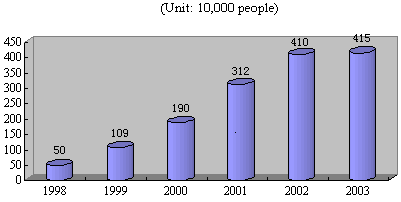
In January 1999, the Chinese government promulgated the Unemployment Insurance Regulations, which further improved the unemployment insurance system. According to statistics from the Ministry of Labor and Social Security, in 2003 the income of the national unemployment insurance fund was 24.9 billion yuan, while the expenditure was 20 billion yuan, with an accumulative balance of 30.4 billion yuan. By the end of 2003, 103.73 million people throughout the country had underwritten unemployment insurance policies and 4.15 million people received unemployment insurance pay by the year.
Getting Laid-off persons back into the workforce
Against the background that the supply of labor in China has for a long time exceeded the demand and due to continued adjustment of the economic structure, a large number of workers have been laid off from traditional industries. From 1998 to 2003, the accumulative total number of persons laid off from state-owned enterprises was 28.18 million.
In recent years, the Chinese government again has formulated a set of policies for promoting the reemployment of laid-off persons: vigorously creating job opportunities, improving reemployment services, increasing financial input for reemployment, strengthening skill training for reemployment, and actively guiding laid-off and unemployed persons to change their attitudes toward employment. From 1998 to 2003, the central budget put aside a total of 73.1 billion yuan for basic subsistence and reemployment of laid-off workers from state-owned enterprises.
In 2003, with the concerted efforts of governments at all levels throughout the country, jobs were found for 4.4 million laid-off persons, of whom 1.2 million were men over 50 years of age and women over 40 years of age, who had been considered as having difficulties finding reemployment.
? Establishing reemployment service centers. The Chinese government has mobilized the resources of all circles to establish reemployment service centers in state-owned enterprises that have laid-off workers to provide basic subsistence allowances and pay old-age and medicare insurance premiums on their behalf, and to provide them with one job consultancy, three employment information service offers and one vocational training opportunity free of charge.
? Instituting the supportive policies of reducing and exempting taxes and administrative charges, and extending small security-backed loans. For laid-off persons who set up their own businesses, small security-backed loans are available, and the relevant taxes and administrative charges are exempted for three years over these businesses. The government has established a security fund for such loans, and provides loans at discount interest.
? Implementing the policies of social insurance subsidies, and tax reduction and exemption. Various service enterprises and commercial and trading enterprises shall be provided with social insurance subsidies by the government if they employ laid-offs from state-owned enterprises for newly created posts.
To encourage them to recruit more of the laid-off persons, small processing-type enterprises in service, commercial and trading enterprises and labor employment service enterprises as well as small enterprise entities of a processing nature in neighborhoods and communities shall enjoy relevant tax reductions and exemptions for three years if formerly laid-off people make up 30 percent or more of their new recruits of the year.
? Helping those who have difficulties finding jobs through reemployment assistance. Laid-off men over 50 years of age and women over 40 years of age, who have difficulties finding new jobs but have working ability and a wish to be employed, should be regarded as major targets for employment assistance and promptly provided with offers of posts and other kinds of help.
For posts for the public good developed with government investment, priority shall be given to those having difficulties finding new jobs because of their disadvantaged age. Regarding posts for the public good developed by neighborhoods and communities for former laid-offs from state-owned enterprises who have difficulties finding new jobs because of their disadvantaged age, the government will extend social insurance subsidies and post subsidies.
? Encouraging large and medium state-owned enterprises to make flexible arrangements for their surplus workers. Large and medium state-owned enterprises are encouraged to make arrangements in various ways for their surplus workers by way of separating the principal production from the side occupations and through restructuring the side occupations. An enterprise that has completed restructuring and set up economic entities to absorb its surplus workers at a certain ratio can be exempted from enterprise income tax for three years.
? Improving employment services for laid-off and unemployed persons. Public job centers at all levels should provide a "one-stop" service ranging from registration of laid-off and unemployed persons looking for jobs, to giving job consultancy, offering jobs, and social insurance coverage, and provide gratis job briefings and skill training.
Modern information networks should be employed to provide timely and accurate employment information to laid-off and unemployed persons. Wherever the conditions are right, a special office should be set up to provide a "coordinated process" service covering industrial and commercial registration, taxation procedures and labor protection matters, to laid-off and unemployed persons who have set up their own businesses.
Training for reemployment should be organized and conducted at various levels and in diverse forms, in order to enhance the employment qualifications of laid-off and unemployed persons. Those who are able to set up their own businesses should be offered the relevant training and guidance, and provided with consultancy, follow-up assistance and other services. Through training these people as pioneers in starting businesses, more people should be encouraged to seek employment on their own initiative.
Improving the social security system, and maintaining harmonious and stable labor relations
? Establishing the "three guarantees" system. In 1998, the Chinese government established the system of "three guarantees," namely, guarantee of basic subsistence allowance for laid-offs from state-owned enterprises, guarantee of unemployment insurance, and guarantee of minimum subsistence allowance for urban residents.
Reemployment service centers have been widely established in state-owned enterprises that have laid-off workers. Laid-off workers may obtain funds for basic daily necessities for a maximum of three years from such centers. After the three-year term expires, laid-off workers and other unemployed people who have not been reemployed or employed and who have unemployment insurance coverage and paid the premiums in full are entitled to unemployment insurance pay for a maximum of two years (see Chart 6).
If the average income per head in an urban residential household of a laid-off or unemployed person is lower than the local minimum subsistence standard, that person is entitled to the minimum subsistence allowance for urban residents. Due to the "three guarantees" system, the subsistence allowance, social security and reemployment for laid-off persons are now closely connected.
Chart 6. Changes in the number of people drawing unemployment insurance money
 |
? Strengthening social security services. The Chinese government has taken various measures and actively explored the possibilities for the establishment of a social security system independent of enterprises and public institutions, and has diversified fund sources, a standardized security system, and socialized management and service.
Since 1998, a system of continuation of social insurance relations for laid-off and unemployed persons has been in place, which helps promote the reemployment of laid-off persons and the employment of unemployed persons. When a laid-off person leaves his or her enterprise, the payment of his or her social insurance premiums and personal insurance account will remain valid. When reemployed, the worker will continue to pay the insurance premiums as required, and the former and current terms of premium payment should be added together.
For laid-off persons who get reemployed in a flexible form, such as a part-time job, temporary job and flexible working-hour job, a preliminary social insurance and labor management system suited to their job characteristics has been established.
? Establishing a new labor relations regulatory mechanism. The Chinese government has actively promoted the establishment of a labor relations regulatory mechanism characterized by "autonomous consultation by both parties and regulated by the government according to law," and promoted the introduction of the system of establishing labor relations through labor contracts.
The labor contract system has been implemented extensively in various types of urban enterprises. The government encourages enterprises to continuously strengthen the functions of the employees' representative conference and the trade union, improve the system of democratic participation by the employees, and actively explore and popularize the system of conclusion of collective contracts through consultation on an equal footing.
By the end of 2003, 635,000 collective contracts had been concluded throughout the country, covering 1.27 million enterprises and more than 80 million employees, of which the number of enterprises that signed specific collective contracts concerning salaries and wages totaled 293,000, covering 35.79 million employees.
A consultation mechanism between three parties, namely, the government, the trade union and the enterprise, suited to the actual conditions of China has been launched in an all-round way for the purpose of communication and consultation on major issues involving labor relations.
At present, 30 provinces, autonomous regions and centrally administered municipalities have successively established the system of holding three-party labor coordination meetings at the provincial level, as well as 5,062 three-party consultation mechanisms at various other levels. At the same time, China has also established a labor dispute mediation, arbitration and litigation system, whereby to handle labor disputes in accordance with the law.
? Protecting laborers' right to employment. Chinese law stipulates that workers must not be discriminated against in the matter of employment because of ethnic identity, race, sex or religious belief. Chinese law strictly prohibits the employment of people under the age of 16. The state strictly investigates and deals with the illegal use of child laborers and the recommendation of children for work.
The Chinese government has, by intensifying law enforcement and supervision, urged enterprises to earnestly implement the stipulations specified in laws and regulations concerning equal employment, rectified all acts of discrimination in the labor market, and banned all employment advertisements containing discriminating content in the media.
Simultaneously, the Chinese government strives to enhance the laborers' awareness and ability of protecting their own rights and to create a sound public opinion environment, supports and encourages laborers to use the law to protect their own employment rights and interests.
The Chinese government has continuously improved the state, industrial and local standards in respect of job safety and hygiene. It promulgated the standards for the job safety and hygiene administrative system in 1999, and carried out certification work in an all-round manner. In 2003, the State Council promulgated the "Regulations Concerning Insurance for Work-related Injuries," which became effective as of January 1, 2004.