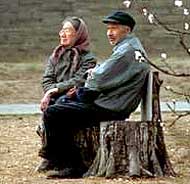
 The aging of China’s population is accelerating. Zhu Zhixin, director of the National Bureau of Statistics and head of the Leading Group for the National Census of the State Council, made this announcement in March.
The fifth national census reveals significant changes in the structure of the Chinese population. Accounting for 22.89 percent of the total population are newborns to teenagers of 14 years of age, a decrease of 4.8 percentage points compared with the 1990 census, while people over 65 years of age account for 6.96 percent of the total, an increase of 1.39 percentage points. With the elderly making up 6.96 percent of the total population, China faces challenges associated with the problems of aging.
Accelerated Aging
Generally speaking, the criterion for an elderly society is when people over the age of 60 make up more than 10 percent of the total population and people over 65 make up 7 percent.
According to data from the fifth national census, people over 60 in China number 132 million, or 10 percent of the total population. It is predicted that in the next 50 years, China’s elderly population will grow by an average annual rate of 3.2 percent. By 2040, the number of elderly people over the age of 60 will reach 400 million, or 26 percent of the total population. That means in average there will be one elderly person among nearly every four Chinese. In big cities, there will be one senior citizen among every two to three people.
Compared with Western developed countries, China has a population that is aging fast, so fast that it has outpaced industrialization and modernization. Such a large proportion of elderly in a population is unprecedented in human history, which forms enormous pressure in regard to socio-economic development, industrial structure, forms of retirement and the social security system.
Concerns of Old Age
Along with an aging population come worries over the quality of life in old age. Currently, there are severe financial problems with pension funds. On one hand, as revenues fall short of expenditures, pension funds have been bogged down in a financial crisis. On the other hand, individual pension accounts worth 199 billion yuan are now empty.
He Ping, director of the Social Security Institute under the Ministry of Labor and Social Security, has been participating in the design of China’s pension system. According to He, the main causes for shortages in pension funds are the accelerated aging of the population and accounting on a cash basis.
China began to put money aside for pension funds in the 1980s, but this did not cover all employees at first, such as those in rural enterprises. Beginning in 1995, the management of pension funds changed from accounting on a cash basis to partial accumulation, that is, the employees’ pensions were no longer fully paid by the government. Instead, when a person started work, he or she would have an individual account for accumulating his or her pension. As there are more and more retirees, and most of them have accumulated no pension, the pension funds under unified management are inadequate for the payment of pensions. Since the funds under unified management are mixed with individual accounts, when the funds under unified management fall short, overdrafts are made from individual accounts, thus resulting in lots of empty individual accounts.
To alleviate the pressure over pensions, He suggests that the financial budget should appropriate capital equivalent to 5 percent of financial revenues to fill the shortage in pension funds. He proposes that the Central Government clarify this fiscal policy in legislative form. According to his analysis, there is no major problem generally, but some difficulties do exist in poor and backward areas.
Second, efforts should be made to expand social security coverage. Enterprises with more young employees and fewer retirees should be urged to participate in the social security system in order to pool as much money as possible.
Third, the base of the social security fee paid by various work units, as well as the number of people paying the fee, should be audited in an all-round way to ensure accuracy.
Four, the plan to postpone the age of retirement should be decided as soon as possible. It is estimated that with the age of retirement being put back a year, the pension funds under unified management would increase by 4 billion yuan, which could help reduce expenditures by 16 billion yuan and reduce the shortage in the pension fund by 20 billion yuan. He disagrees with the practice in some areas that allows a large number of employees to take early retirement. He argues that as those who retire early do not stop working, the practice of early retirement actually cannot alleviate the local pressure of unemployment. It only puts more pressure on the pension fund, which early retirees continue to draw on.
In addition, worry over the elderly is also demonstrated by the weakened capability of rural families in providing for the aged. Chinese families are usually known for their strong cohesion. When the elderly encounter difficulties in life, their children and spouses are their main supporters. To a large extent, the family shoulders the responsibility of providing for the elderly in China. This is particularly true in rural areas, where people believe that they raise children to care for them in their old age. During the past Chinese New Year, remittances by rural workers in Shenzhen to their hometowns all over China totaled 1.3 billion yuan, while millions of rural laborers working in Zhejiang Province remitted a total of 1.1 billion yuan to their hometowns.
However, there is a new tendency in Chinese society: family functions are weakening while the size of the family becomes smaller and smaller. Young people are becoming increasingly aware of their own interests and their own small families. Therefore, the function of the family in providing for the elderly is on the decline in rural China. Yet, the current pension system has not been extended to the elderly in the countryside.
Incomplete Social Security Measures
An “empty nest” family is one with an elderly person living alone or with his or her spouse. The children have left home like birds flying away from the nest, and the elderly are left behind lonely and without the care of their children.
According to data provided by the Chinese Association of Senior Citizens, more than 25 percent of the elderly people in China live in such “empty nests.” Moreover, the figure is still on the rise.
Experts say that there are mainly two reasons for the increase in “empty nest” families. First, with improved housing conditions, more and more elderly people live separately from their children. Second, more and more people are living to an advanced age and some of them live alone after the death of their spouses. The combination of an accelerated aging of society and the evolution of the family structure has resulted in a substantial increase in the number of “empty nest” families. It is estimated that by 2005, “empty nest” families will account for more than 50 percent of the elderly families in China.
Yet, corresponding social security measures lag far behind. According to statistics from relevant departments, less than 1 million elderly people live in homes for the aged with relatively complete facilities, which comprise a tiny portion of the total number of senior citizens. In some homes for the aged with comparatively fine conditions and facilities, the occupancy rate is only 30 percent. Influenced by Chinese tradition, most elderly people, especially those with children, are unwilling to spend their later years in a home for the aged. They believe that living there is disgraceful because it indicates that their children have no filial piety.
However, the incomplete social security system and a deficiency in old-age community care services have aroused concern from the general public for the elderly in “empty nest” families, especially in apartment buildings in urban areas, where neighbors have little communication. In some communities, there are no services especially targeting elderly families. As a result, some senior citizens have been found dead days after their death.
Some people thus conclude that changes in the population structure have brought about many new headaches for social security undertakings, which will produce negative effects on China’s economy and society. They suggest that China should borrow the experience of developed countries in old-age care to establish a system of services for the aged on a community basis and seek practical countermeasures as soon as possible.
A New Industry
With the rapid growth in the number of elderly, the aggregate volume of consumption by senior citizens will also increase, which will probably form a new industry.
Statistics show that in China, the population over 60 is increasing at an annual rate of 3 percent, while the population over 80 is increasing at an annual rate of 5 percent. This means that each year, China will have 3.8 million more elderly over 60 and 500,000 more elderly over 80. According to data provided by relevant authorities, the annual income of the elderly population is between 300 billion and 400 billion yuan. This includes their pension, income from re-employment and endowment from relatives and friends. Between 2025 and 2050, the potential purchasing power of the elderly is expected to be as high as 5 trillion yuan, which will make the market catering to elderly consumers a large part of the future national economy.
Yet at this point, the elderly-based industry is still at the stage of understanding and startup. Its level of industrialization falls short of the demands of the aged population. Zhang Wenfan, president of the China Association of Senior Citizens, said that social services based on public welfare and family services find it hard to meet the demands of the rapidly growing senior population. If mechanisms of socialization, marketization and industrialization are introduced to transform potential advantages into a realistic market, the elderly-based industry may become a new growth point in the Chinese economy in the 21st century.
Zhang Ning, a member of the Beijing Municipal Commitee of Chinese People’s Political Consultative Conference, said that research in this regard is rare at the moment. Insurance, tourism and some other sectors still shut elderly people out of their services. For instance, some types of insurance refuse to deal with people over 70, and some travel agencies refuse to organize travel groups composed of people of advanced age. Insurance programs, travel packages and medical care programs especially designed for the aged are very rare.
It is predicted that the following businesses will enjoy prosperity in the future:
• Household help. Workers with special skills in keeping the elderly company, nursing and care-taking will be well-received.
• Property development targeting the elderly. The current housing design and interior decoration take little account of the special needs of the elderly. The doors are usually small, sometimes even too narrow for a wheelchair. Residential quarters for the elderly should put more emphasis on the ecological environment and space for exercises and recreational activities.
• Slow-paced tourism emphasizing leisure and rehabilitation, as well as relevant recreational goods.
• Community services, education, recreational activities, sports, and medical care and nursing for the aged.
Starlight Program
In early June this year, the Ministry of Civil Affairs announced that China would launch a nationwide campaign of community service for the elderly called the “Starlight Program” as a measure to cope with the aging population.
Under the program, departments of civil affairs from the central to local levels will use the majority of funds raised through welfare lotteries over the next three years to aid in the construction of community service facilities and exercise sites for the elderly in urban areas and homes for the aged in rural areas.
The Starlight Program is a major move by the Chinese government to cope with the challenge of an aging population. It means that in a short period, a community service system covering residential quarters with relatively complete facilities in large and medium-sized cities will take form, which will be of far-reaching significance in the country.
The Starlight Program is expected to involve an investment of more than 10 billion yuan. The funds will primarily come from local governments and public sources. The Ministry of Civil Affairs and departments of civil affairs at the provincial level will use 80 percent of the welfare funds in their control to aid the program in the next three years.
China started to issue welfare lotteries in 1987. By the end of last year, a total of 50.07 billion yuan worth of welfare lottery tickets had been issued, raising 12.63 billion yuan of welfare funds, which has aided nearly 100,000 social welfare projects. Covering all of China, these projects have helped hundreds of millions of especially challenged groups including the elderly, the disabled and orphans.
(Beijing Review 07/16/2001)