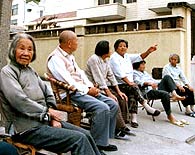
 According to internationally recognized standards, if people aged 60 and above account for 10 percent of the population of a country or region, that community is considered an ageing society.
In 2000, one in every 10 Chinese was 60 years of age or older. Those beyond 65 made up more than 7 percent of the national population. This phenomenon is expected to continue for decades.
This is a sign that China is already an ageing society.
The increasing proportion of old people in the Chinese population has profound economic implications for society and thus calls for corresponding policies and measures.
Although the economic impacts are still not palpable, we have to move fast to evaluate the situation and come up with appropriate countermeasures.
First, such demographic development will affect the pattern of labor supply.
As the proportion of elderly people rises in the overall population, the proportion of older workers will grow.
In 1999, among the active labor force, those aged 45 or more accounted for 24 percent, up from 19 percent in 1990. It is projected that the figure will soar to around 37 percent by 2040.
The paramount challenge for an ageing community is how to support and care for these vulnerable people. This will affect the present pattern of welfare for the elderly.
In China, the tradition still prevails whereby old people are cared for in the family home. But this tradition will face stronger challenges in the near future without more complementary measures.
The sharp decrease in the birth rate since the mid-1970s has resulted in a huge number of one-child families. By around 2010, the parents of these single children will be getting frail or senile, and the children will have to support their parents.
As senior citizens live longer, the extremely old will depend on their daughters or sons, who will also become old.
Such changes will place considerable pressure on care in the family home.
Moreover, the number of retired people is expanding rapidly and expenditure on pensions is growing even more quickly.
In 1978, there was one retired person for every 30.3 employees. In 1999, the ratio had soared to one retired person for only 3.7 employees. If the current retirement ages remain unchanged at 55 for women and 60 for men, the ratio may climb further to one retired person for 2.4 employees by 2030.
At that time, the social-security fund for the elderly will be unable to make ends meet.
An ageing population also has potential implications for consumption and savings patterns.
Based on the life-cycle theory, when the process of ageing reaches a certain degree, the proclivity to save money will decrease and people will be more inclined to consume. As families are one of the major sources of capital accumulation, this tendency will somewhat erode the supply of funds for manufacturing.
In China today, however, people still tend to save for old age. The penchant toward consumption among the elderly will be restrained to some degree.
To offset such negative effects, it is imperative to tackle the issue from different perspectives.
First, the whole of society should foster a social environment that champions respect and care for the old.
The elderly are still precious assets of society. They are still a driving force behind social development.
In the long term, any policy in favor of the aged will eventually benefit the younger generation and the middle-aged.
In addition, the legal system protecting senior citizens' interests and rights should be perfected. It should cover such issues as the payment and distribution of pension funds, fund management and supervision, enterprises' responsibilities for retired employees, individual endowment policies, and medical services for the old.
Yet the basic prerequisite for dealing with the negative effects of an ageing population lies in maintaining economic growth.
At present, the major cause of the so-called social-security crisis in some Western countries is not the expansion of the number of people who rely on a pension. The real culprit is slow economic growth coupled with high unemployment.
The cash pinch on social-security funds can be relieved by rapid economic growth.
In China, which is still a developing country, maintaining rapid and steady economic growth is vital.
With abundant human resources and comparatively small social burdens, the first decade of the 21st century is a golden time for the country to get ready for the peak of the ageing population.
In tapping human resources, training opportunities should also be provided for the old and middle-aged.
Under China's special circumstances, care in the family home should remain the basic mode of care for the elderly.
Such a tradition has been preserved throughout East Asia. Under the huge pressure of an ageing population, even industrialized countries have realized the flaws of solely relying on the social-security system for elderly care and begun to encourage more families to take part.
However, social services will gradually take responsibility for many functions still carried out in the family home.
In big cities, the combination of care in the family home and community-based services will help the urban-based old to live with ease and enjoy the love and care of both their family and community.
However, the basic security umbrella for the old should still be a social-endowment insurance network.
Based on the experience of developed countries, the government has a responsibility to build a social-security system. But this alone is inadequate to support the old.
A multipolar security network -- including a government-operated public pension fund, compulsory individual savings and a complementary voluntary endowment policy -- will be the best approach for an ageing society.
This will help to divert the risks of complete dependence on the social-security fund and make the fund sustainable.
(The author is an assistant researcher with the Macroeconomics Research Institute under the State Development Planning Commission.)
(China Daily March 28, 2002)