In the eyes of archaeologists, the Quren Ruins of Yunyang County, Chongqing Municipality is really an enigma. It is rarely seen in China to settle an archaeological site in a county, but this time a Han Dynasty (206 BC - AD 220) county proper is expected. Though the truth hasn't been fully revealed yet, surprises have come out one after another.
"Cupid" unearthed
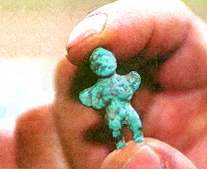
An unexpected gain for archaeologists working at the Quren Ruins is a little bronze man.
Its height is between three and four meters. The face of the old sculpture has been blurred, but it could still be judged at first glance to be a naked man with wings. The man seems to be wearing a hat, with a distinct, straight nose and slightly protruding eyes, totally different from a yellow race. The striking wings are well stretched behind his shoulder, while his arms overlap in the front. His sexual organ is obviously seen, and his curled legs look charmingly na?ve.
Obviously, the bronze man should belong to the West. It is either Cupid of Roman legends or the angel of European oil paintings in the middle ages. However, it appeared in China about 1,500 years ago.
The discovery brings people many mysteries and surprises. Archaeologists say it dates back to the Han Dynasty. What does it represent? What's the function of it? Is it a product of Chinese civilization or from Western envoys? And how does it appear in the ancient stratum of the Three Gorges area? All these remain mysteries.
Numerous discoveries
In fact, the bronze "Cupid" is only one of countless discoveries in deciding the county proper of the ancient Quren. In 1998, Heilongjiang Archaeological Research Institute undertook the excavation of Yunyang old county proper and found many ruins and relics of the Han Dynasty. The next year, Jilin Archaeological Research Institute took over the project and worked on it till today.
The old county proper of Yunyang is a scenic spot. Among the rugged mountains there is a rare broad platform. Houses with black tiles and white walls are set off by banana, bamboo and orange trees. Cock-crowing and dog-barking are heard in the forest, while white geese swim in the pond. The rectangular blue bricks carrying diamond designs used in building pigpens, fencing walls and roads demonstrate the long history of the village. People can only imagine how prosperous a place it must have been about 2,000 years ago.
According to Wang Hongfeng, a leading official of the Jilin Archaeological Research Institute, his team is now making strenuous efforts to find the walls of Quren, for most Han Dynasty cities in the Central Plains were surrounded by city walls. Now they haven't found the walls, but many other articles relating to metal smelting such as bronze casting model, moulds and furnace remnants.
People tend to believe that the Three Gorges area was left behind by the Central Plains in the civilization process before the Han Dynasty. This discovery has proved that two cultures had begun merging with each other at that time. Archaeologists for the first time found from the casting mould that Three Gorges area produced weaponry of the same style as the Central Plains.
A lot of articles such as a tomahawk-shaped axe, tiles with a rope design, pottery dou (ancient stemmed cup or bowl) and pots were unearthed, which show obvious features of the Ba culture. The co-existence of a Chu-style tripod, rope-design tile, stemmed cup and flower-edged pot reflect the frequency of cultural exchange and collision at that time.
The discovery of an earthen bowl with the Chinese character "Qu" engraved at its bottom and a lute carrying the words "kou jun" provided further evidence of "Quren".
The expanded excavation unexpectedly revealed an area of hundreds of meters for casting bronze, proving this was where bronze ware was made between the Warring States Period (475 BC – 221 BC) and the Han Dynasty. Such a large-scale smelting center was the first of its kind in the Three Gorges area. Since the statesman Shang Yang carried out political reforms in the State of Qin around 356 BC, the salt and foundry industry had been under the centralized control of the central government. Ordinary people were not allowed to privately cast bronze or produce salt. The bronze casting center, therefore, was under the supervision of the county. Experts felt excited over the find because they believed the county proper of Quren could be there.
Further excavation proved to be more puzzling and astonishing. Big eaves tiles with a diameter of 15.6 cm and inscribed with the words "Qianqiu" (meaning "thousand years") and "Wansui Weiyang" (meaning "not ended after tens of thousands of years"), were discovered. The Han Dynasty followed a strict hierarchy system. The imperial palace could have used eaves tiles with a diameter of 20 cm, so the unearthed tiles here might have belonged to higher-ranking officials. The discovery helped advance experts' belief that this was the exact site of Quren County. And they needed more work to understand how the county proper looked so exalted.
Later, the archaeological team unearthed a large patch of houses, looking like a group of large-scale buildings. However, the streets were hard to distinguish. Based on so many discoveries, experts think that Quren County might have had no city walls, nor regular planning nor streets. So the working team is now trying to find its administrative offices, thereby confirming the existence of Quren.
The Quren County, seemingly sitting beside, is unwilling to fully show itself up. In some unexpected moment, it gives out a mysterious smile.
Wang Hongfeng said that they haven't found any key clues to the Quren County to date. What often came to them were interesting cultural relics, among which was the winged bronze little figurine.
Not like "Cupid"
Wang continued to say that his team supposed the bronze figurine be a "yuren" (flying god or goddess) as recorded in history books. However, scarce recordation did not say what a "yuren" was exactly like.
According to him, never before has an item like this been excavated. It was worth research whether it was made by the Han Dynasty Chinese or came from the West. On the back of the bronze, naked, winged figurine, there is a button. "It may probably be an ornament for clothes," Wang said, "Seen from the direction of the button hole; it should not be used for hanging things. A thread through it makes the figurine lie sideward."
There were legends and images of winged man in ancient China. In Qu Yuan's Chu Ci (The Poetry of Chu), there was a poem entitled Yuan You (Wander Afar), saying, "Therefore I preferred to live in ever-bright places as people with wings, which are the hometowns of immortals." Besides, Shan Hai Jing (Book of Mountains and Seas) has records of "winged people's kingdom", calling them "people of immortality".
During the Warring States Period, the Ba and Chu people in south China believed in wizards, so supernatural beings or heavenly horses were often found in their literature. By the Han Dynasty, the state had been unified and society made stable, so the government carried policies beneficial to rehabilitation and people sought enjoyment and preserved their health. As a result, the stories about immortals were very popular. The ends of these stories were usually when a person got wings or wore feather clothes to fly up to heaven. Those who had achieved immortality could even bring their fowl and dog to heaven. For this reason, flying horses or winged men were often seen in Han cultural relics. Out of religious consideration, however, the winged men before often had a beast's head, pointed mouth and ears and were kneeling down. None of them could compare with the na?ve angel unearthed in Yunyang.
Experts will make further research on it after all the excavation work is completed.
Second "Silk Road" of Three Gorges?
The discovery of the naked "cupid" naturally associates the Han Dynasty and ancient Greece and Roman Empire.
The opening of the "Silk Road" in the Han Dynasty connected China with nations of West Asia and Mediterranean Sea. The earliest exchange between China and the Roman Empire, the two most influential powers in the world at that time, began. Besides sending envoys to each other, non-governmental trading between the two countries was also alive.
Historians from both China and other countries were focusing their studies on the exchange and relationship between the two countries. A piece of news in the 1990s that descendants of a lost expedition team from Ancient Rome were discovered in northwest China's Gansu Province created a furor among historians and is still in dispute today.
History records show there was not simply one "Silk Road" which passed the Hexi Corridor, by Xinjiang and finally reaching Central Asia. Zhang Qian, first envoy of the Western Han Dynasty to kingdoms in Western Regions, also found a second way to the outside world -- taking a route to Sichuan, going to Myanmar and the Silk Corridor in South India then transferring to a sea route. Also at that time, the central government put great effort in building roads and left many famous plank roads along the cliffs. Can you imagine then the Three Gorges area also being a second "Silk Road"?
The History of Eastern Han, The Biographies of Western Foreigners depicts that in 120 AD, the King of (Burma) Myanmar sent an envoy to Chang'an to pay their respects to the Chinese emperor, who brought with him a thousand Roman musicians and vaudeville artists. Did they pass by the Three Gorges? The History of Eastern Han, The Biographies of Western Regions, recorded that in 166 AD, Antony, emperor of the Roman Empire sent envoys to China by way of the sea. They arrived at today's central Vietnam first and then to Chang'an. Maybe it was they who left the little figurine in the Three Gorges area as a witness of cultural exchanges between China and ancient Rome, 1,800 years ago.
Another possibility could be that the defeated or captured Roman soldiers stayed in China and lived the same life as people in the Three Gorges. The naked man relief on a Han Dynasty symbolic sentinel, rarely found in other places, further shows the influence of ancient Greek and Roman arts.
People have to wait for archaeologists and historians to solve the mystery about the little naked bronze figurine.
(Beijing Youth Daily translated by Li Jinhui for China.org.cn, September 21, 2003)