There is a saying in China that you don’t know how big the country is until you come to Xinjiang. Another says you can’t believe how important a contribution the Corp has made until you visit Shihezi City.
The Corp is the Xinjiang Production and Construction Corp. Shihezi City is the manmade oasis in the desert where the Corp first began its work.
October 7, 2004 marks the 50th anniversary of the Corp. Back in 1954, the state entrusted it with the dual roles of developing the land and guarding this rugged frontier area. Over these 50 years, it has left its pioneering footprints all across northwest China’s Xinjiang Uygur Autonomous Region, the largest of China's autonomous regions, provinces and municipalities.
Since its founding, the Corp has guarded the borders but more than this it has reclaimed desert land for productive use and worked tirelessly for the well-being of the people of all the various ethnic groups in Xinjiang.
The enterprise shown by the Corp backed up by its pioneering efforts, have seen it setting up a number of modern industrial, mining and commercial enterprises, together with schools, hospitals and other institutions. It has made a highly significant contribution to the modernization of Xinjiang. What’s more, it has played a very important role in promoting unity among the region’s many ethnic groups, in maintaining social stability and in consolidating border defenses.
On the eve of the 50th anniversary of the Corp, reporters from china.org.cn visited Shihezi City. Situated about 150 km northwest of Urumqi, this is not only the birthplace of the Xinjiang Production and Construction Corp but also a lasting symbol of the contribution China’s military personnel have been making to the cause of land reclamation.
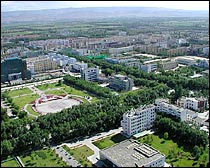
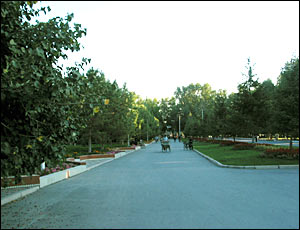
After three and a half hours on the plane from Beijing to Urumqi, capital of Xinjiang, then two hours by car we arrived in Shihezi City. People call the city “a shining pearl in the Gobi desert." First-time visitors to Shihezi City never fail to be surprised at seeing such an expanse of green in a city in China’s dry northwest. Walking on clean tidy streets in the midst of all the greenery of the trees and with the flowers in bloom it really is hard to associate this green city with the Gobi desert.
Shihezi lies below the northern foothills of the Tianshan Mountains on the southern fringe of the desert in the Junggar Basin. Some 50 years ago, there was little here but a vast stretch of desert. Then it was home to just a handful of families eking out a living, mostly by herding.
The year 1949 saw Xinjiang’s peaceful liberation. The People’s Liberation Army stationed units in Xinjiang. Their mission was to consolidate border defense and accelerate Xinjiang’s development. To reduce the economic burden on the local governments and people, they started work on large-scale production and construction projects.
In October 1954, the Central People’s Government ordered that most of the PLA units in Xinjiang be redeployed to civilian duties in the area. They were separated out from the mainstream of the national defense forces to form a production and construction Corp. They would cultivate and develop the area while keeping the borders secure.
The Corp as a whole has eighteen divisions each looking after a designated reclamation area. Including its stockbreeding facilities, it operates no fewer than 174 regimental farms.
Shihezi City is the locus of the Agricultural 8th Division. With its 18 agriculture and livestock farms and 2 water conservancy centers, it is the largest division in the Corp accounting for a quarter of its personnel and economic output. Greenery now clothes 42 percent of the city’s 460 square kilometers, which are home to some 620,000 people. With its wealth of trees and flowers, it is well known as a garden city and highly regarded for the care it devotes to the ecology. In 2000, it won the Dubai International Award for Best Practices in Improving the Living Environment. It is the only city to have been awarded this honor not just in Xinjiang but also in the whole northwest of China.
The people who reclaimed Shihezi from the desert
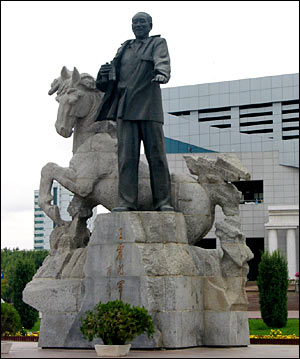
A statue stands to the south of the city’s central square. Called “The First Plough of the Military Reclamation”, it was erected in 1985 to commemorate all the many military personnel who put down their weapons and turned to the plough to make the area productive.
Shihezi is a typical migration city. The past 50 years have seen three waves of incomers arrive from all over China to roll back the desert and reclaim the land for the people. With them came their different cultures. Over the years, these have created a unique multi-cultural blend as they merged into and enriched the local ethnic customs and the military culture of the Corp. The first two phases of inward migration were mostly of army men and young university students who came to join in the construction of this border area. Later incomers in the third group tend to be better educated.
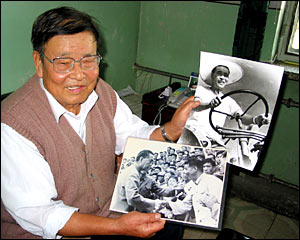
Hou Zhenyuan, 76, a native of northwest China’s Gansu Province, came to Xinjiang with the army in 1948. He is one of the first generation who came to take part in the military reclamation in Shihezi. The unforgettable experience of being involved in building Shihezi is still fresh in his memory.
“When I first came here with the army, there were only ten families living in the single street that was Shihezi in those days. We had no place to stay. We made makeshift pit shelters using reeds as our building material. When winter came, the temperature dropped to 40 degrees Celsius below zero. We had to dig deeper and deeper into the ground to try to keep warm. We used to fetch our water from places dozens of kilometers away. Sometimes, when our army rations couldn’t get through, seven or eight people might have to share a single plate of beans,” recalled Hou. “While we were doing our best to adapt to the harsh climate, we also had to stay alert for fear of the wolfs and other wild animals that might attack us at anytime.”
“At first the kantuman (an old Xinjiang farming implement) was all we had to till the land. We reclaimed the wasteland without tractors,” he said.
In those days, the local people called Hou Zhenyuan the “Kantuman Hero” for every day he ploughed one mu, or one-fifteenth hectares, of land all on his own. When the Corp bought its first batch of tractors, they chose Hou Zhenyuan to learn to drive them.
Hou Zhenyuan showed us photographs of himself driving the tractor and one special picture taken when he met late Premier Zhou Enlai in Shihezi.
“I felt very proud,” said he. “I worked 14 even 15 hours a day without a break. Once I didn’t sleep for four days and nights,” he recalled. “Whenever I felt tired, I thought of the day when I would live in a comfortable building with electric light and a telephone. Many other young soldiers like me kept this thought in front of them to give them the impetus they needed to overcome all the many hardships we were encountering.
“At that time, it took three months for a letter to come from my hometown. I could never have imagined that one day I would even be using a computer to keep in touch with my sons,” said Hou.
Hou Zhenyuan is only one of the thousands upon thousands of people who devoted the best years of their lives to building up today’s oasis city from nothing. Many of the ambitious young intellectuals who came from all over the country to help in the development of the border areas also made significant contributions to the new city. Academician Liu Shouren, now 70, was one of these early pioneers.
He used to say, “The best fine-wool in China is in Xinjiang, and the best fine-wool in Xinjiang is in the Corp and the best fine-wool in the Corp is in my hand.”
Liu spent 47 years here, researching and breeding China’s merino fine-wool sheep. They are on a par with Australian fine-wool sheep. His research ended China’s absence from the fine-wool market and helped create profits approaching the two-billion-yuan mark.
Wang Xiaoying, former gardener-in-chief of Shihezi, is a native of southwest China’s Sichuan Province. She came to Xinjiang in the 1950s with the army. Over dozens of years she and her colleagues planted 10 million trees. The people of Shihezi are well aware of the difficulties of planting trees in the harsh Gobi desert. They cherish the trees just like their lives. Their strong tradition of care for the environment is now being passed on from one generation to the next.
During the past half century, many more unknown heroes played their part in the peaceful military campaign to defeat the desert. With an indomitable spirit and the ambition to create a better life for themselves, their sweat and blood has transformed the original face of Shihezi. Together they built irrigation canals, planted trees and grew grain, they set up factories and finally they established a new city in the Gobi desert.
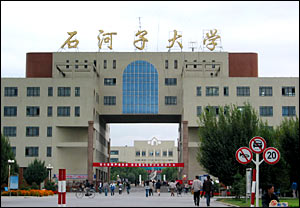
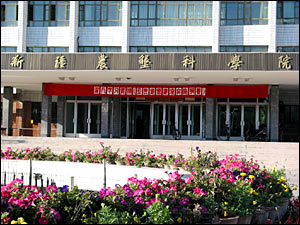
Shihezhi is also a city of science and culture. It is home to one national key university, Shihezhi University, together with 39 scientific research institutions including the Xinjiang Academy of Agricultural Reclamation Sciences, and 1,022 health organizations. Among every hundred people in Shihezi, six are members of the scientific and technological professions. In addition, this young city already has 14 large-scale cultural facilities including the Military Reclamation Museum and the Hall of the Poet Ai Qing.
Shihezi’s modernization
According to Hu Jiguang, section director of the Information Office of the Publicity Department of Shihezi, the farms here use methods that are typical of irrigation agriculture. Today the industry is 85 percent mechanized and Shihezi has become an important center for the production of grain, cotton and oil yielding plants. Notable among these crops is Yinli cotton, which enjoys a good reputation both at home and abroad. The output of cotton from the oasis city accounts for one ninth of the total for Xinjiang as a whole. A national production facility for natural-colored cotton has been set up in Shihezhi.
Agriculture served as a sound base on which to develop other industries and Shihezhi has now become an important center for the plastics, chemical and light textile industries. Today there are advanced telecommunication links and a number of major highways together with the northern Xinjiang railroad pass through the city.
The Shihezi Economic and Technological Development Zone is located in the east of the city on a 16.1 square kilometer site. It is the only state-level economic and technological zone in the western areas of China to have been established other than in one of the regional or provincial capital cities. It serves as Shihezi’s gateway promoting its opening up to the outside world. Shihezi has benefited from increased investment as one of the main avenues for trade between and among China, Russia, and the countries of Central Asia.
“More than 400 enterprises have already registered in the development zone. It is sure to provide a renewed economic impetus for the future development of Shihezi,” said Zhao Haizhong, director of the Publicity Department of the Development Zone.
As a city designed and built by the army, Shihezi is a successful example of best practice in developing and protecting a border area by stationing troops there with a mission to cultivate and develop the area as well as guarding the frontier.
During its long years of development, the Xinjiang Production and Construction Corp has become a successful human mosaic and its people are drawn from 37 ethnic groups, including the Han, Uygur, Kazak, Hui and Mongolian.
By 2003, the population of the Corp had grown to 2.54 million with 299,000 from minority ethnic groups. Its output had reached 26.87 billion yuan and the average annual income of its employees was 10,781 yuan.
(China.org.cn by staff reporter Wang Qian, October 3, 2004)