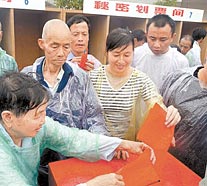
Thirty-two-year-old Li Xiaoyan is the first woman to chair the Yantouzhai Village Committee in Guzhang County, central China's Hunan Province. She recently got her hands on a book, the first of its kind, that guides rural women in running for village elections.
"I wish I had had it before I took to campaigning for the position of village head three years ago," says Li.
The Guidebook on Women's Participation in Villagers' Self-Governance came off the press in August. Conceived by the Ministry of Civil Affairs in 2003, the book was written by a group of experts based on studies of rural affairs under the auspices of the ministry. It is designed to cultivate rural women's interests in politics and give them the tools to win positions of power.
After publishing the book, the ministry invited Li and 20 other women -- the first rural readers of the book and all winners of their community election campaigns -- to represent their villages in Beijing at a seminar on rural democracy last month.
"It took us a year to complete the book," said Fan Yu, an official at the ministry whose brainchild the book was. "We hope it will serve as a survival guide for women in rural political arenas."
The book uses vivid images and colloquial language throughout its 250 pages to offer tips on how to deal with the most common problems these budding rural leaders are likely to face as women in politics. How should they respond to objections from the family? How can they get along better with their fellow villagers? How can they draft campaign strategies?
"The book comes at the right time as women have obviously become the key to China's rural democracy," says Professor Dong Jiang'ai of Shanxi University.
The Ministry of Civil Affairs says that since 1998, when the law on village autonomy was formally enacted, female representation on village committees has plummeted from 30 to 16 percent, with only 1 percent of village chiefs being women. In contrast, however, womanpower accounts for 60 percent of China's gross agricultural output value, as more men migrate to urban areas to seek better pay.
Many scholars are aware of the imbalance between women's contributions to agricultural production and their involvement in decision-making. But research indicates that the traditional bias against women in management is not the only problem: many women are simply not interested in politics, and many that might be lack the skills.
"As women have become the majority of our rural population, their political invisibility, if allowed to last long, will hamper China's rural democracy," says Zhan Chengfu, deputy director of the Department of Construction of Grassroots Government and Community under the Ministry of Civil Affairs. "So the guidebook is really necessary to warm rural women up."
Zhan says the advancement of China's rural autonomy system, which features democratic elections, decision-making, management and supervision, is at a crossroads.
"Before, our focus was on straightening up the election procedure. Now it's time to pay attention to the people," he says. To push forward post-election democracy, he says, women must be mobilized.
The ministry has also reached out with training programs. Since 2002, it has been cooperating with a variety of domestic and international organizations, including the All-China Women's Federation and the Ford Foundation of the United States, to run training workshops for rural women.
Li Xiaoyan, a capable farmhand, is one of the beneficiaries of these programs. She says the training has freed her mind and raised her confidence about participating in village affairs. Many local women have followed her lead in reading newspapers or listening to TV news, and are now more boldly voicing their opinions at villagers' meetings.
But the problems do not stop with learning the theory.
When Li started preparing to set out on her first campaign trail in 2001, she had to bear the full fury of her family and village gossips who were stuck in a feudal mindset that says good women are submissive housewives and little more.
"Why are you humiliating the family?" her husband would growl.
"But I was born rebellious and hate to bend to others," she says, and stuck to her guns.
She gives high praise to the new guidebook.
"Its tips are very practical," she says. "Like in seeking support from fellow women villagers, especially from the grassroots women's federation, or striving to become a member of the Communist Party of China to become more visible and reputable."
Assistant researcher Tong Zhihui of the Tsinghua University's NGO Research Institute echoes Li. He explains that the die-hard gender preference in favor of males in many rural communities has reduced women to subordinate positions. This subordination gets worse when they marry, often to someone in another community where they are little known beyond their husbands' homes. Estrangement like this may compromise votes in elections, he says.
The book also provides guidance on solving problems through proper channels, a serious issue for both male and female village leaders.
A chemical plant near the village of Tuonan in north China's Hebei Province was illegally spilling toxic waste into local farmers' orchards, jeopardizing their crops. Negotiations to find a solution failed, and some farmers resorted to force to stop the pollution of their land.
Li Dongju, deputy secretary of the Tuonan party branch, nipped the problem in the bud by encouraging the farmers instead to file a complaint with the county government and local legislature. An investigation was conducted and the plant was eventually demolished.
"It's essential that potential rural leaders, men or women, learn how to handle disputes within the framework of the law," she says.
Only 6,000 copies were produced from the guidebook's first printing, far short of the demand from the country's 660,000 village committees, says Fan Yu. "So we distributed the book among promising women rural leaders first and will see the impact grow through them," he says.
Although the unsatisfactory representation of women in decision-making is associated with the deep-rooted patriarchal culture in many rural communities, Zhan Chengfu says that there are also loopholes in the modern system. For one thing, while China's Constitution provides for universal gender equality, the 1998 Organic Law of the Villagers' Committee refers in only the most vague terms to guaranteeing the proportion of women members.
"Without clear-cut figures and punitive articles for violations, such a clause has no teeth," says Dong Jiang'ai.
Dong was authorized by the Ministry of Civil Affairs last year to head a team in drafting an amendment to the 1998 law. At the August seminar in Beijing, Dong expressed the opinions of rural women participants like Li Xiaoyan and Li Dongju about the draft, which submits that women should fill at least one-third of committee seats.
The proposal largely drew positive responses from the participants, although a few had some reservations. Lang Youxing, an associate professor at Zhejiang University, doubts whether there are enough qualified women in villages to fill the quota, and fears that a rigid figure might prolong the election process.
But Li Xiaoyan is confident: "As long as women are given the opportunity, their qualifications need not be questioned."
"The issue of women's representation in village autonomy is not their qualifications, but their access to power," Dong says.
Hunan, Henan and Gansu provinces and the Tibet Autonomous Region have already amended their local laws to guarantee there is at least one woman member on their village committees. In Tanggu District, Tianjin, where a trial quota system was introduced to village elections in June, female representation has increased from less than 5 percent in previous years to 28.6 percent.
"We mean to use a rigid quota to secure women's empowerment," says Zhan, but gave no timetable as to when the draft amendment would be submitted to China's legislature.
"We are not dealing with a gender issue, as many assume," he says. "We are actually introducing a new perspective to push forward rural democracy. In the future, if necessary, we may take up more issues such as wealth gaps and ethnicity."
Sarah Cook, program officer of the Ford Foundation, hails the quota system as a crucial first step in guaranteeing Chinese women's access to rural autonomy, but warns that this minimum "should not become a maximum and stay there forever."
"We must guard against that," Zhan says.
(China Daily September 9, 2004)