|
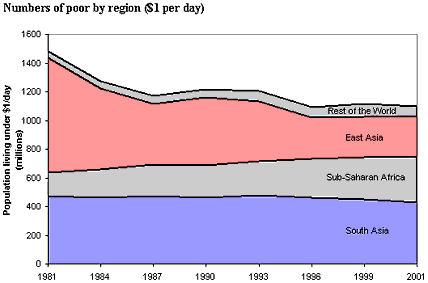
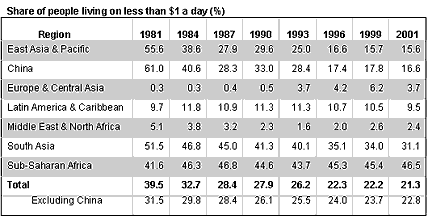
The proportion of people living in extreme poverty (less than $1 a day) in developing countries dropped by almost half between 1981 and 2001, from 40 to 21 percent of global population, according to figures released today by the World Bank. But while rapid economic growth in East and South Asia has pulled over 500 million people out of poverty in those two regions alone, the proportion of poor has grown, or fallen only slightly, in many countries in Africa, Latin America and Eastern Europe and Central Asia.
This uneven progress raises concerns that the eight Millennium Development Goals (MDGs) approved by 189 nations in 2000, the first of which is to reduce the 1990 poverty rate by half by 2015, may be beyond reach for some countries. "Economic growth in China and India has delivered a dramatic reduction in the number of poor,"said Fran?ois Bourguignon, the Bank's Chief Economist. "But other regions have not enjoyed sustained growth and, in too many cases, the number of poor has actually increased. Although we are likely to reach the first Millennium Development Goal of reducing poverty by half worldwide by 2015, much more aid, much more openness to trade, and more widespread policy reforms are needed to achieve all the MDGs in all countries."
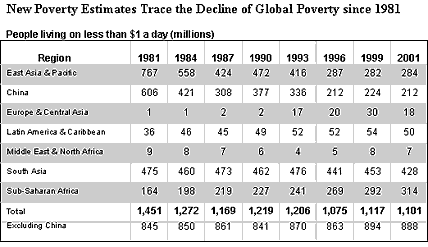
The Bank's annual statistical report, World Development Indicators 2004 (WDI), released today, shows a drop in the absolute number of people living on less than $1 a day in all developing countries from 1.5 billion in 1981, to 1.1 billion in 2001, with much of the progress occurring in the 1980s. Between 1990 and 2001, the global decline in the number of extremely poor people slowed somewhat, falling by about 120 million -- from 1.2 billion to 1.1 billion people -- while the proportion of poor people dropped from 28 percent to 21 percent of the total population.
Gross domestic product (GDP) per capita in all developing countries rose by 30 percent between 1981 and 2001. In East Asia, where GDP per capita tripled, with average annual growth of 6.4 percent, the proportion of people living in extreme poverty fell from 58 to 16 percent, and the absolute number pulled out of extreme poverty since 1981 was more than 400 million.
Dramatic progress against absolute poverty has been made by China, where GDP per capita went up five times since 1981 and the number of extremely poor fell from over 600 million to slightly more that 200 million, or from 64 percent to 17 percent. About half of this progress was in the first half of the 1980s.
In South Asia, a 5.5 percent average annual GDP growth rate in the 1990s helped reduce the proportion of extremely poor from 41 in 1990 to 31 percent. But because this economic expansion coincided with rapid population growth in the region since 1990, the absolute number living on less than $1 a day dropped by just 34 million since 1990, to 428 million in 2001.
In marked contrast to East and South Asia, poverty actually rose in Sub-Saharan Africa. Since 1981, a 15-percent contraction in GDP per capita in Sub-Saharan Africa resulted in a near-doubling of the number of people living on less than $1 a day, from 164 million to 314 million, a rise from 42 to 47 percent of the region's population.
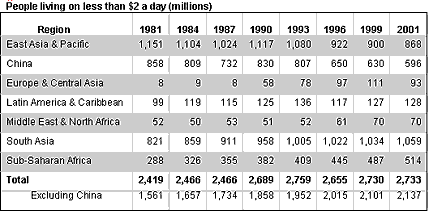
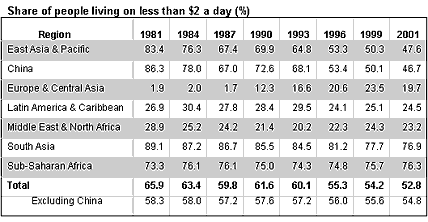
In Eastern Europe and Central Asia, too, high unemployment and declining output in many of the formerly centrally-planned economies drove extreme poverty rates up from near-zero in 1981 to six percent by 1999, but there is evidence of a recent decline in the poverty rate. The number of people living on less than $2 a day in Eastern Europe and Central Asia rose from eight million (two percent) in 1981 to over 100 million (24 percent) in 1999, dropping back to slightly more than 90 million (20 percent) in 2001.
In Latin America and the Caribbean, economic growth rose only slightly through the 1990s, and poverty fell only marginally. The proportion of poor in the region in 2001, including both those living on less than $1 and $2 a day -- 10 percent and 25 percent respectively -- was roughly comparable to that in 1981, when they were 10 percent and 27 percent.
In the Middle East and North Africa, extreme poverty dropped by about half since 1981, from five percent to two percent in 2001, while the proportion living on less than $2 a day was down from 29 percent in 1981 to 23 percent in 2001.
These statistics present a picture of uneven progress in reducing poverty, and strongly suggest that the biggest gains occur where growth and trade coincide with sustained efforts to develop human capital and foster a sound investment climate. But growth, by itself, is no guarantee that poverty will be reduced quickly, as its benefits are often slow in reaching the poor.
Social investments needed to achieve MDGs
"Enhancing security for poor people means reducing their vulnerability to ill health and economic shocks," said Martin Ravallion, manager of the Bank's poverty research program. "To increase the security of poor people, national poverty reduction strategies must support their immediate consumption needs and protect their assets by ensuring access to basic services, including health, education and nutrition."
The urgency with which such strategies are needed is underscored by the fact that, worldwide, an estimated 840 million people, most of them in low-income countries, are chronically undernourished. Even in regions experiencing rapid growth, the quality of life among the poor often remained unchanged, in the absence of adequate social investments. Despite impressive growth in South Asia, for example, that region still registers malnutrition among children reaching almost 50 percent, along with chronically low school enrolment and completion rates. If current trends persist, children in more than half of developing countries will still not be attending a full course of primary education by 2015, as specified in the MDGs.
Such disparities in social indicators outlined in WDI 2004 bear out the finding in the World Bank's World Development Report 2004 that public services in health, nutrition and education often fail poor people. For example, in 20 developing countries with disaggregated data, child mortality rates fell only half as fast for the poorest 20 percent of the population as for the whole population. Worldwide, the under-five mortality rate was at 81 per thousand live births in 2002, down from 95 in 1990. Much faster progress is needed to reach the MDG of reducing it to 32 per thousand births by 2015.
HIV/AIDS has infected more than 60 million people worldwide, with more than 95 percent of them in developing countries, and 70 percent in Sub-Saharan Africa, where it has resulted in a drop in life expectancy from 48 years in 1980 to 46 years in 2002.
The disparities that persist between regions and within countries on life expectancy, child and maternal mortality, school enrolment and completion, gender equity and progress against communicable diseases remain a major obstacle to achieving many of the MDGs. "Continued progress in poverty reduction," the WDI notes, "depends on economic growth and the distribution of income."
Access to markets for sustained growth
To achieve and sustain the levels of economic growth needed to reduce poverty, developing countries need greater access to foreign markets. Although trade accounts for a larger and faster-growing share of developing countries'output than is the case with the wealthy countries, many obstacles remain to developing countries’ realizing their full potential participation in global trade in goods and services. Some 70 percent of the world’s poor live in rural areas and depend directly or indirectly on agriculture, but two-thirds of the world's agricultural trade originates in the rich OECD countries, the WDI reveals. This occurs, in part, because rich countries spend about $330 billion a year to subsidize their agricultural producers. Reduced protection in agriculture would account for two-thirds of the gains from full global liberalization of all merchandise trade, with many of the potential benefits accruing to low-income farmers in developing countries.
While merchandise, including commodities and manufactured goods, dominates developing-country trade, exports of computer, financial, information and other business services are gaining in importance. Also, increased globalization has enabled greater labor mobility, resulting in the growing importance of remittances in reducing poverty.
Meeting the promise of Monterrey
In addition to liberalization of trade by both rich and developing countries, increased aid flows, especially to the poorest countries, are needed to eradicate extreme poverty and achieve the MDGs. Net aid flows to developing and transition countries reached $70 billion in 2002, up from $54 billion in 1997, the WDI reports. More than a quarter of these flows went to Sub-Saharan Africa, where they represent 32 percent of that region's gross capital formation. But middle-income countries, including China, Serbia and Montenegro, West Bank and Gaza, and Pakistan, received about half of total net aid.
To achieve the MDGs, the poorest countries need much more aid in addition to ongoing debt reduction. The WDI reports that development assistance accounted for an average of 0.59 percent of government disbursements among the 22 OECD aid donors in 2002, and 0.23 percent of their gross national income (GNI). Military expenditures in the high-income countries, meanwhile, represented 11 percent of government spending and 2.4 percent of GDP in 1998. In the low- and middle-income countries, military spending occupied even more of the national pie: 12.3 percent of government expenditure and 2.6 percent of GDP in 1999. Total world military expenditure was $794 billion in 2002, more than ten times net aid.
Importance of statistical capacity-building
The Bank's annual World Development Indicators is an important contribution to monitoring progress towards achieving the MDGs. The quality of monitoring, however, depends on increased capacity of developing countries to gather, analyze, and disseminate statistics. Governments, politicians and managers need reliable data. So do citizens, in order to hold governments accountable for their actions. Building such capacity is vital to meeting the commitments made at the Second Roundtable on Development Results in Marrakech in February 2004, to which the World Bank is making an important contribution. This includes support for preparations for the 2010 censuses, establishing international household survey network, and preparing national statistical development strategies by low-income countries by 2006.
"World Development Indicators reflects the strengths and weaknesses of the international statistical system," said Shaida Badiee, Director of the Bank's Development Data Group. "Improving them is not just a technical challenge, but a development issue, because data, statistics and indicators are at the heart of the development results agenda."
Journalists can access the material before the expiration of the embargo through the World Bank Online Media Briefing Center at: http://media.worldbank.org/secure/
Accredited journalists who do not already have a password, may request one by completing the registration form at:http://media.worldbank.org/
The report and related materials will be available to the public on the World Wide Web immediately after the embargo expires at: http://www.worldbank.org/data
Media outlets are encouraged to include this Web address in their coverage of the report.
(China.org.cn April 23, 2004)
|