 Wearing jeans or suits and living in apartment blocks, modern Chinese people are generally very different from the ones that the Venetian traveller Marco Polo saw more than seven centuries ago.
But in the southwest of the country, a group of Chinese people still adhere to the cultures, clothing, language, customs, religions and architecture of 14th-century China.
These people call themselves "Old Hans" and bear witness to the great westward migration that took place early in the Ming Dynasty (1368-1644).
In search of this special group of people, we drove 180 kilometres from Guiyang, capital of Southwest China's Guizhou Province, to the city of Kaili. Then we drove 290 kilometres from Kaili to Jinping County in the southeast of the province. Travellers can take this route by bus for about 30 yuan (US$4).
The "road" between Kaili and Jinping is actually a 2-metre-wide path between terraced mountain slopes, some of which soar 1,000 metres high.
Scattered among the green terraces were ethnic Miao villages, with their distinctive wooden houses with black roofs. Miao people in blue clothes carried giant tree trunks, golden rape blossoms, vegetables and children on their backs.
In Jinping, we hired a jeep and drove about 40 kilometres into the virgin forest, which was made dark by the tall firs. Finally, our jeep circled down a sharp slope and we were in a plain of about two hectares, something rarely seen in the mountainous province.
Across a river through the valley's rice fields was an elegant stone arched bridge, which reminded me of similar bridges in the lower reaches of the Yangtze River in southeastern China, where I come from.
The bridge led to a narrow path, which curved through the rice fields and up a nearby mountain, to end at a fortified stone village called Longli.
The stone gate slowly opened for us at the village surrounded by a stone wall which is 3 metres tall and 2 metres thick.
Before us was a stone-paved alley with courtyards on both sides. The wooden houses in the courtyards had black roofs and white walls and were all built during the Ming Dynasty. Their windows were carved with patterns of flowers, birds and animals. Some big courtyards had stone fortresses in their corners.
It was about four o'clock in the afternoon and we could see women drawing water from wells by the courtyards or washing vegetables and clothes in the water channels.
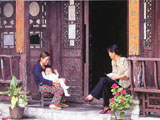
At the courtyard doors, old people sat and chatted, while a few young women leaned against doors and did embroidery.
Through the open doors, we could see a wooden desk in each house and a memorial tablet on the desk that read: "Heaven, Earth, emperor, parents and teacher" (the five most respected things in Confucianism).
The women had coiled their hair into a bun and fastened it with a silver hairpin. They wore blue, green and pale purple robes. They had blue or green cloth shoes with the toe bending upwards and the upper embroidered with colourful flowers and birds. But their feet were not bound into horrible shapes.
Villager Wang Chengyao said: "We are descendants of soldiers and we were always ready to fight.
"Our ancestors moved here in the 13th year of Emperor Hongwu's administration."
In 1381, Zhu Yuanzhang -- founder of the Ming Dynasty and later known as Emperor Hongwu -- sent 300,000 soldiers to Southwest China's Yunnan Province, which had declared independence following a rebellion led by Bazar Garmu, an aristocrat of the late Yuan Dynasty (1271-1368).
Bazar Garmu killed himself after three months of war, and Zhu decided to station the army in southwestern China. Most of the 300,000 soldiers were stationed in Guizhou, which was inhabited by the Miao and Gelao ethnic groups, then at a primitive stage of society.
Many of the soldiers were killed or died of disease in the mountains far from their hometowns in East China's Jiangsu and Jiangxi provinces and Central China's Hunan Province. Only the strongest survived to become farmers in the fortified villages.
The soldiers were forgotten about in historical records after the fall of the Ming Dynasty. Their descendants were mistakenly regarded as a branch of the Miaos in the early 20th century. But the descendants of the forced migrants had actually retained something of 14th-century China despite the passing of time, with pride in their relatively advanced culture.
They believed in Confucianism and Buddhism, and were tightly bound by family ties. The four major families in Longli are surnamed Chen, Li, Wang and Yang. They each have 600-year-old family temples in the village, where family members often gather.
Anthropologists, historians and linguists now visit the less than 100 fortified villages around Guizhou to study their "ancient" contemporaries.
Hu Chaoxiang, an official with the Guizhou Cultural Bureau, said: "The Old Hans speak much more quickly, have more retroflex vowels and consonants in their pronunciation and more 'awkward' phrases in their language. It is said to be the official language and the accent of eastern China during the Ming Dynasty."
The Old Hans have retained their spectacular dragon dance to celebrate the lunar new year. On the 15th day of the new year, about 100 young men hold 10 cloth dragons in five colours -- red, white, blue, black and yellow -- and perform dragon dances around the village.
The dancers have their faces painted in various colours and represent different roles in traditional Han operas. They have to practise kung fu to perform the dance well, said Chen Shunlai, an old villager.
"The soldiers in Longli and their descendants were well-known for shadow boxing and sword fighting," he said.
"Not many young men are interested in kung fu now. It's not as interesting as television serials."
Another heritage of the military pioneers is "earth opera." The performers wear masks and long pheasant feathers, shroud their heads in black cloth, wear suits of armour, hold wooden weapons and sing sonorously. The opera looked quite frightening as we watched it in the evening.
The wooden masks represent ancient generals such as Guan Yu of the Three Kingdoms (AD 220-280). The masks have been preserved in boxes for centuries, and the villagers put statues of naked boys in the boxes to protect them.
"Only two elderly villagers know how to carve a mask. The art may die out when they both die," said Chen.
But it is not only the masks that are in danger. The young women in the village are abandoning the traditional robes and turning to popular modern clothes such as jeans. New brick houses, decorated with mosaics on the outer walls, also stand among the wooden houses of the early pioneers.
"The outside world has had a greater impact on the fortified villages in the past 20 years than in the past six centuries," said Chen.
(China Daily May 19, 2003)
|