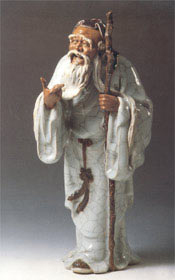
It's no secret that the Chinese have always cherished exquisitely prepared, thoughtfully presented and delicious food. In China business has long been conducted over banquet tables and every Chinese friend will tell foreigners that no meeting or social gathering is considered complete without a good meal.
Food has been and remains a conduit to successful relationships between people at all levels, as well as a living metaphor that implies power and responsibility over others. Less than a hundred years ago, the old Chinese government still called the job of the chief executive “making adjustments to the tripods” because a tripod in Chinese refers to a cooking utensil. This term implies adjusting the flavors of the dishes being cooked in order to please diners' palates – and just like a capable diplomat the talented cook uses talent and technical skills to ply his trade.
|
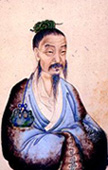
Yi Yin, a famous cook and also known as China's first prime minister |
Not surprisingly, clever cooks creating tasty food have had unusual access to power throughout Chinese history. One of the most renowned examples was Yi Yin, who is known as China's first prime minister. He ultimately assisted Emperor Tang, ruler of the Shang Dynasty (C. 1600 BC–C. 1100 BC), to destroy Jie, the last ruler of the Xia Dynasty (C. 2100 BC–C. 1600 BC). Yi Yin had been a famous cook and a slave known as Ah Yeng before he became prime minister. This remarkable man actually won his ruler's trust through his skill at cooking great food. Tang became persuaded of Yi's diplomatic and social abilities after eating his dishes.
Throughout the centuries there have been other Chinese cooks who also took on political functions. Peng Zu, known as the founder of Chinese cooking, was chef to Emperor Yao around the beginning of the 21st century BC. Another capable chef, Yi Ya, became very close to his leader during the Qi State in the Spring and Autumn Period (770 BC–476 BC) - Prince Huan of Qi trusted him because he was good at cooking and identifying flavors. Shao Kang, the seventh emperor of the Xia Dynasty, had formerly been an official in charge of the kitchen service for Youyushi before the Xia Dynasty was founded.
Peng Zu, known as the founder of Chinese cooking, was chef to Emperor Yao around the beginning of the 21st century BC.
But not all chefs used their power benignly; some had nefarious motives. Zhuan Zhu of the Wu State served as an assassin in the late years of the Spring and Autumn Period. In order to support Prince Guang's rise, he learned a special technique of "roasting fish" from a famous chef. Through his culinary deftness, he was able to meet Prince Liao of the Wu State, the enemy of Guang, and assassinate him.
During the Song Dynasty female chefs became extremely popular. Known as Chu Niang these women charged higher fees than their male counterparts while serving the imperial family, nobility, scholars and wealthy patrons. At one point female chefs were in such high demand that a school was established solely to graduate female culinary artists. The school taught manners, presentation, organizational tactics and conduct along with culinary skills.
Sometimes these women directed enormous banquets and thus acted as a conductor does while directing a symphony. One renowned female chef, Song San Niang, sat at a desk while she presided over a "Thousand Guest Banquet" for Premier Wang Zeng. With her staff of over eighty assistants this remarkable woman used little colored flags to give orders. She hoisted blue, red, yellow, purple and white flags to indicate to her staff in matching uniforms when to start steaming, boiling, frying or cooking something. Not only did she effectively and efficiently put out the food but also she put on a great dramatic display for the premier's guests.
Not just in China - anywhere in the world making food is much more than just a job for a man or a woman: it's a pursuit that is crucial for human survival. Sex is the only other vital activity that humans engage in with as much enthusiasm as cooking and eating. Kao Tzu, a Warring States-period (475-221 BC) philosopher, said that the urge for food equals the desire for sex in humans.
But making food and making love are quite different from each other. Humans tend to be more bestial when it comes to sex; culinary pleasures have more variation and more refinement than simple procreation activities. Moreover, the types of food and how it is prepared defines a specific culture, going beyond the parameters of simple survival.
The way food is categorized, preserved, prepared, displayed, as well as the amounts eaten, the way it is eaten, who eats it and when – all vary among civilizations. Furthermore, inside each culture are sub-categories for food: eating differences covering economics, religious, age, time and seasons, even occupations and physical health. Most anthropologists and culinary historians assert that China undoubtedly has the widest range of all these categories regarding the production and consumption of foodstuffs.
Chinese cooks and chefs throughout history, despite how they cook, or who they cook for, or what kind of cuisine they prepare, or the season they prepare a dish, always adhere to the one overriding concept: food as medicine. This ancient theory best highlights Chinese culture and its cuisine in view of other culinary dynamics, modern and ancient.
While Confucianism was concerned with the social and aesthetic aspects of food and dining, texture and appearance, the Taoists, seeking longevity and health, were developing hygienic rituals for food and cooking. The principle objectives of this philosophy carried a wish for longevity and a desire to promote health.
For centuries the Chinese have cultivated food as medicine and used cooking as a conduit to bring out the medicinal vales of various foodstuffs. Western thought uses food to provide energy and nutrition, with medicine as a separate category to treat illness. But Chinese feel that all food has a unique capacity to aid in promoting and retaining health. The way food is cooked and combined, along with the amount, the time of year and the person eating it – all combine in a positive way to support health. It can be suggested that Traditional Chinese Medicine (TCM) originated in the kitchen and has never really left. Ancient chefs, such as the aforementioned Yi Yin, preached the value of a diverse diet and devised specific preferences that each internal organ needed to remain healthy (heart & mind -- bitter taste; the liver--sour; the lung--pungent; the 'spleen' -- sweat; and the kidneys, reproductive and adrenal functions -- salty). He and others were regarded as more than purveyors of food; rather they resembled a combined sort of physician/magician, making chefs greatly revered.
Emperor Shen Nong studied the healing properties of plants and first established the theory of yin and yang.
Using food and herbs as medicine is a very ancient idea. Emperor Shen Nong, known as the legendary father of agriculture, lived sometime around 3000 BC. He studied the healing properties of plants and first established the theory of yin and yang. This model was later adopted by the Taoists, who made it part of the basic foundation of Chinese culture, philosophy, medicine and culinary arts.
Yin and yang are opposing, yet complimentary forces of the universe that balance each other out to create universal harmony. Everything is classified as either yin or yang, and everything is influenced by their constant ebb and flow. This vital tenet evolved into fundamental Taoist principals that classified food as either 'hot' or 'cold' with reference to the influence each food has on body function rather than simply relying on taste. The Taoist view became firmly ingrained centuries ago when Tao Hong Jing (456-536 AD), among others, advocated using hot food to warm up a cold body and vice versa.
It is still respected highly today. Ordinary Chinese will assert that imbalances in the body and food intake can cause disease just as westerners count calories, fat grams and carbs to remain healthy and fit. For Chinese, to maintain equilibrium foods, classified as yin, yang, or neutral depending on their effect on the body, are ingested accordingly. Yin foods calm, yang foods provoke hyperactivity. Yang foods include eggs, fatty meats and pungent spices; they are strong, rich and spicy. Yin foods: raw fruits and vegetables and seafood, are bitter, salty and light.
The Chinese also have another set of categories for foodstuffs: sweet (earth), bitter (fire), sour (wood), pungent (metal), and salty (water). Each type has influence over human organs and each also corresponds to a different season of the year. Salty foods are best in winter; they help the kidneys and bladder work well. Sweet, earth foods, for summer's end, get rid of inertia and calm the stomach while bitter foods, eaten in early summer influence the small intestine and heart. Sour, wood foods, meant for springtime, impact upon the liver and gallbladder and contrast with aromatic, metal foods that are eaten in the fall and have power over the large intestine and lungs.
Chinese chefs have through history used their ancient esoteric philosophy to choose between insufficiency and excess. Matching taste with an organ is an application of the 'five elements' concept in Chinese culture; it was incorporated with medicine and cooking simultaneously, along with taste, color, weather, and temperament.
Color also holds great import regarding the ingestion of food and/or medicine: red colored organic matter affects the heart, green the liver, yellow the 'spleen,' white the lung and black the kidney. Even today Chinese people prefer to eat a porridge of many colors and many pulses "for good luck" during the holidays because a) the colors are varied and so a better choice for overall health and b) the grains together act as a tonic to promote longevity.
Traditional Chinese Medicine purports that diet and exercise play a significant role in maintaining good health by contributing to an optimum balance of vital life energy, or Qi. With diet, heredity and environment as the three sources of Qi traditional Chinese medicine states that foods we eat directly influence physical excesses and deficiencies. In order to be accomplished as a cook Chinese people educate themselves along these guiding principals; TCM doctors are experts in foods, tonics and herbal remedies, among their other skills.
To be a chef anywhere in the world today is an unusual, exciting occupation. Those that rise high now carry the status of celebrities; a few may even have the ear of their national leaders. Chinese chefs, viewed through the lens of Chinese history and Chinese philosophy, clearly take the prize for their historical influence, power, creativity and knowledge. To be a Chinese cook one must be diplomat, an artist, a philosopher and a chemist, blending flavors, nutritional potentials and beauty into a series of elegant dishes that delight and nourish their guests. Using food to promote good relationships, using food as a diplomatic art form, along with traditional means of communication, is crucial more than ever to preserve world stability.
(China.org.cn by Valerie Sartor January 8, 2008)
In the series:
Vegetarian diplomacy
In recent years foreign media has been praising China for opening to the West and stimulating the world economy but actually the country has been going global for centuries...