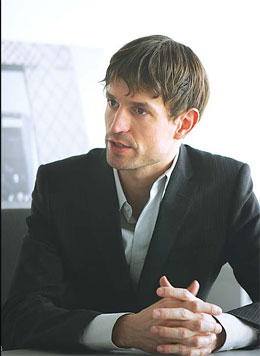
Ole Scheeren, the German architect of the new CCTV headquarters in Beijing. Guo Yingguang
China Daily (CD): What are some of the challenges of the project? Did you have to change or adapt the original vision behind the building?
Ole Scheeren (OS): The original vision of the project has remained entirely intact. Every process of architecture entails further definitions as it moves along. But this definition in a way, is a kind of incremental increase in depth and precision.
The project itself really has remained completely unchanged from the very early design, even to the point where the geometry of the building has not been altered by a single centimeter.
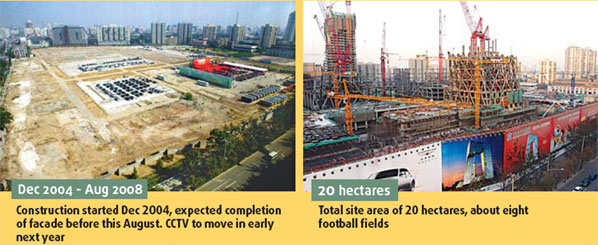
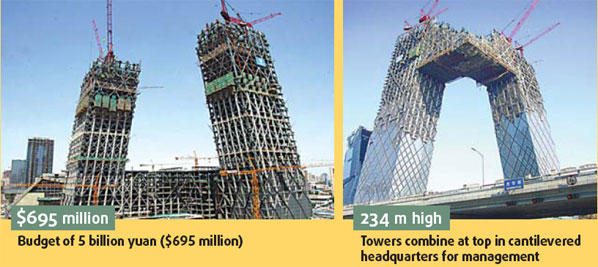
Obviously, connecting the overhang was the greatest milestone in the process of the construction of the building. The moment of joining the two towers, both symbolically and technically, was the most meaningful moment and maybe also the most specific moment to this project, as it is quite unusual for any building to consist of a number of different systems that ultimately join into one single whole.
The connection was executed in the early morning of Dec 8 as initially planned. It could essentially be done only in the early morning because at the moment of connecting the two systems to each other, we had to ensure both would be in as relaxed a state as possible.
In other words, no specific tensional forces should be within each of the structures, because the moment we joined them, these forces would be joined into the overall system as a whole.
So we had to make sure that the sun was actually absent for a maximum period of time for both towers to be at equal temperature, before we connected them. And this process was started on Dec 8, when seven beams were hoisted in place and then linked the two towers first at the inner portion of the connection.
Also , in terms of the organizational ambition or social ambition for this project, that has really not changed at all. It has remained a very explicit mix of technical installation interspersed with a series of social spaces that range from the formal to the informal - gathering spaces, meeting rooms, lounges, canteens, many corners or places in the building where staff can meet and exchange ideas.
In a way, this vision of bringing the entire staff and all divisions involved in the process of television-making into this one single structure was really the driving force behind the project, the primary intention being to seek for the three-dimensional construct that could ultimately accommodate this joining of all different parts.
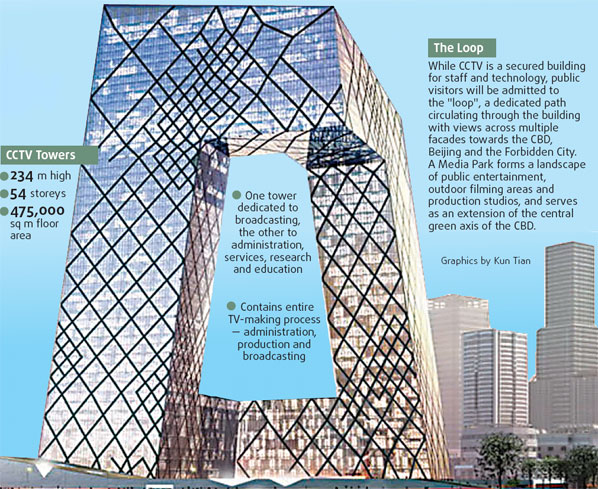
The loop of the building tends to really express that. It forms this geometrically folded tube in space that is ultimately inhabited by the joint presence of anything that contributes to television making - news, broadcasting, program production, post-production, research and training facilities. The offices, the management, and all of that again mixed with canteens to feed 10,000 people at a time. Sports facilities, basketball courts and huge recreational areas and gardens that are there for the staff as a whole, more than for any exclusive component of the building.
Also, the top of the building is no longer occupied by the senior management, but actually accessible to the entire staff in a staff forum.
So all these spaces have been very strategically delegated to avoid the conventional, hierarchical systems inherent in so many buildings - especially the skyscraper, with its pure verticality which seems to expel a very banal construct of hierarchy where the top obviously, is the best and the bottom, the worst. We literally kind of folded this vertical line and reconnected the top and bottom to each other, in a way to solve those really simplistic mechanisms of hierarchy and reconnect everything into a equally treated whole.
CD: This "Visitors' Loop" that is being opened to the public, in terms of allowing them to see the whole process of TV-making, at least confined to an area, how does that work?
OS: We felt it would be an incredible opportunity since for the first time probably in history, there is that amount of coherence in a special organization of a TV station and the presence of all these parts at once to expose and make those accessible to the public.
So we cut into the building a specific trajectory, what we call the Visitors' Loop, a path of circulation that again follows the circuit of the building and moves in parallel to the staff circulation, but it's for visitors and for tourists that are interested to see the inner makings of the building.
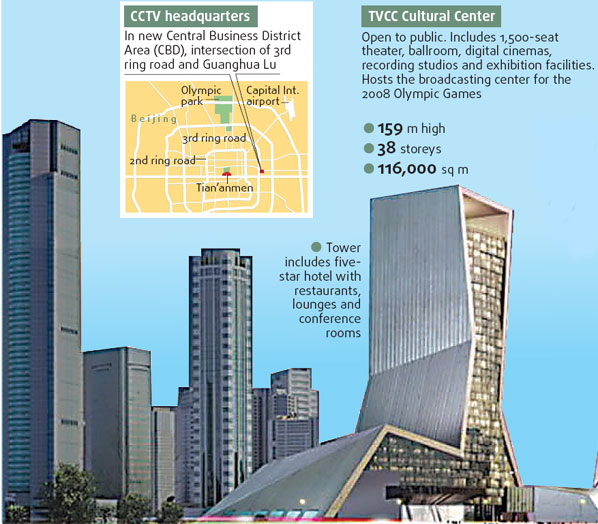
And along this path people have the opportunity to look into production studios, see the physical reality of how screen images are being produced, to view on monitors close by and to understand the relationship between the real and the virtual. Elevators also bring people into the lowest floor of the overhang, where we have a big exhibition space, a media museum, a large viewing deck to take in views across the CBD and Beijing. There are also circular glass floors where you can enjoy the pure 160m vertical void beneath.
There was, from the very beginning, a very explicit desire for the client to be somewhat more present vis-a-vis the public and more accessible. We translated that further into the accessibility and transparency of television making.
CD: Does that mean that a project of this nature and scale could only have been done or carried out in China, in Beijing?
OS: I think that it would be fair to say that there is probably nowhere else in the world that could have generated a project like this. It's really the mix of several factors.
Maybe most importantly, it was a very particular moment in history. With its economic growth - it had joined the World Trade Organization - it was clear China would emerge as one of the key players on the world stage. Being awarded the Olympic Games in 2008 exacerbated a lot of things that were already happening and really acted as a catalyst for a more focused moment of ambition.
It defined a point in time, a deadline at which the world will look at China and China will present itself to the world.
So in that sense it was a very symbolic moment on a big level. But at the same time, not only on a macro, political scale of identity, but also really down to the level of the individual. It translated into a sense of personal pride that I found really moving.
When I was here in 2001 and 2002, people in the streets came up to you spontaneously as they saw you were a foreigner and said, "You know, we won hosting the Olympic Games, what do you think about that?" and when you said it's great, you could feel that there was so much pride and happiness in them.
It was really a genuine moment of excitement and enthusiasm, which was largely responsible for what is now possible.
You can see it is not only the leadership that prides itself with certain things, even when you go onto the construction site, I've never been on a site that has a better mood and a better aura than ours here, where workers are consistently in high spirits, although they work under extremely challenging conditions.
You feel a genuine happiness and pride in them, of what they are doing. It's a really fascinating energy that is there and I think that would have probably been impossible to find anywhere else in the world.
CD: How would you compare the CCTV project to other buildings gathering similar attention now like the Bird's Nest and Water Cube?
OS: It's less a matter of comparison but more an issue of acknowledging the simultaneous presence of all these projects. It manifests a very clear intention and ambition on the side of Beijing to produce a series of architectural pieces that go beyond the realm of pure commercial interest, where many other cities have long pursued trajectories that have commercialized architecture to a point of an almost entire loss of identity.
Here, there is a very obvious interest and a very obvious will to go beyond that, to produce a series of significant buildings as a contribution not only to an image but maybe also to the life of the city ultimately.
I think what is important is that while the building stands in clear relation to the Olympic Games - CCTV is the main broadcaster and obviously the building will play a key role this August during the Olympics - The CCTV building is technically not an Olympic project, it is not primarily conceived for this single moment, but it is really built for the future operations of one of the largest media organizations in the world with an enormous potential for development and growth.
In that sense, where the Olympics for other buildings are almost an end, for CCTV it is only the beginning of a very long period of existence, of something that is very much focused on CCTV as a company and their own trajectory rather than a larger event.
CD: As you mentioned, there has been no precedence for a building like this. People who know you are behind this project have been wowed by the fact that you are relatively young for something of this scale. What do you have to say to that?
OS: The moment you want to revert to the seemingly secure, when you have to find someone who has enough experience, who is at least 50 or 60 years old, or when you have to find someone who has built something of a similar scale, someone who has ran a team of 60 to 100 people, someone who has built something like that in China - very quickly you realize not even a single one of this criterion you can so easily find anywhere.
It was a challenge that was much more based on inventing a new set of possibilities and new ways of working, in an environment that did not have fixed schemes to offer.
So I really tried to compose a team and a process that would ultimately allow managing a design team running across three continents.
Not only the technical challenge of bringing all of this together, but much more importantly, a sense of cultural coordination, to embed the project in a dialogue between West and East. To bring the European or generally Western thinking from our own background and perspective together with the actual locale of the project and to the very strong cultural presence that is here. So the sense of collaboration was one very crucial to the project from the get-go.
Already, during the design competition, we had a series of Chinese staff in our team with whom we discussed very intensely on anything from local sensitivities to the meaning of things - this continued throughout the design stage.
I had made it a contractual agreement with our client that our Chinese partners would join the project from the very beginning.
(China Daily by Alexis Hooi February 20, 2008)