| Tools: Save | Print | E-mail | Most Read |
| Controversial Plan to Tap Tibetan Waters |
| Adjust font size: |
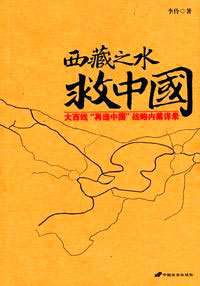
The card of 73-year-old Guo Kai bears witness to his achievements. As well as being vice director and secretary-general of the Shuotian Canal preparatory committee and board chairman for the Beijing Shuotian Consultancy & Development Co, the Shuotian Canal proposed along the Great Western Route was Guo's brainchild, making him the project's initiator and chief designer. During the "Cultural Revolution" (1966-76) Guo was kept in a detention center. One day from the garbage heap he happened to find geologist Weng Wenhao's China Geography in English. Intrigued by Weng's theories on the Tibetan hydrographic net, Guo who had audited hydrology courses at Tsinghua University began to wonder as to the possibilities of diverting Tibetan rivers. He calculated that if water from the Nujiang, Lancang, Jinsha, Yalong and Dadu rivers in Tibet were diverted through the Aba divide, a solution could be provided to the crippling water shortage felt in north and northwest China. After his rehabilitation, he consulted with experts from the Ministry of Water Resources and the Chinese Academy of Sciences (CAS). He also persevered in making his own on-the-spot investigations. For Guo, the "Great Western Route" held the key to all the water shortage and desertification problems facing north-northwest areas, as well as being vital to the country's strategic security. Quoted in the Southern Weekend on July 27, Guo also stated that the opening of the Qinghai-Tibet Railway signified that the 230,000 engineering staff attached to the project could now turn their attention to extending its branch line to Shuomatan on the Yalu Tsangpo River to pave the way for the start of the project. In 1988, Guo's Great Western Route first caught the attention of the military. Events progressed quickly and one year later, Zhang Jinong, then the minister of water resources, established the preparatory committee for the Shuotian Canal. Since its founding, the committee has been headed up by army generals including Xu Guangyi, Gao Cunxin and Wang Dinglie. "During the 1934-36 Long March after we trekked through the grassy swamps in Sichuan Province and finally arrived in the Gansu Corridor, we had nowhere to find water," recalled General Wang, 88, former air force vice commander. "After liberation I stayed in Xinjiang for five months, and further experienced the hardships of life caused by water shortage in western China." The project, which has obtained support from a total of 118 generals so far, has a large backing among the NPC (National People's Congress) deputies and CPPCC (Chinese People's Political Consultative Conference) members with military backgrounds. In the 90s, 208 NPC deputies and 118 CPPCC members came out with proposals supporting the project, six and ten times respectively. With its estimated investment of over 200 billion yuan (US$25.1 billion), the Great Western Route project is revealed in great detail in Save China Through Water From Tibet, a book published by Li Ling in November 2005, after having worked on it for 17 years. The book met with immediate success, with 10,000 copies having been ordered by various central government ministries and commissions, among which the Ministry of Water Resources alone bought 100 copies at a time.
The book Save China Through Water From Tibet has been widely circulated among senior officials.
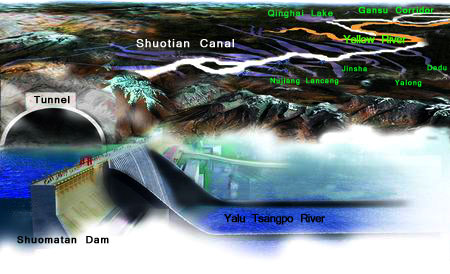
Highlighting the project's importance, Han Shouwen, formerly Deng Xiaoping's personal secretary, stated that: "On February 4, in the midst of the Spring Festival, the State Council instructed the Ministry of Water Resources, the National Development and Reform Commission (NDRC) and the general office of the South-to-North Water Diversion Project to carefully pore over the schemes outlined in the book." Han is also a member of the Shoutian Canal preparatory committee. In fact, prior to the book's publication, Guo Kai had already been invited to Zhongnanhai, the seat of the central government. On August 2, 2005, he was first invited to the Policy Research Office of the Central Committee of the Communist Party of China (CPC), to give an account of his Great Western Route plan. "From then till this June we had met 11 times altogether to discuss the issue," Guo said. 'Shuotian Canal' The first official field survey of the planned Great Western Route took place between May 18 and June 22, 1999. The expedition was comprised of experts from CAS, the State Development Planning Commission (predecessor to the NDRC) as well as from the ministries of water resources, railways, forestry and land resources. Naturally, Guo Kai as the project's initiator, was a member of the expedition. After a 13,600-kilometer long journey, the team's report showed that 600 billion cubic meters of water, or a water volume equal to 12 Yellow Rivers, was being wasted annually in Tibet. By building a dam at Shuomatan, a total of 200.6 billion cubic meters of water could be channeled from the Nujiang, Lancang, Jinsha, Yalong and Dadu rivers through Aba in Sichuan and into the Yellow River. Through Inner Mongolia, the water could then reach Beijing and its ultimate destination, Tianjin. Though commonly known as the "Great Western Route," Guo prefers to refer to the scheme as the "Shuotian (Shuomatan-Tianjin) Canal."
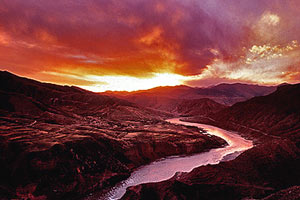
The Lajia Gorge on the Yellow River in Maqin County, Qinghai Province.
One of the problems posed is that the Yellow River could not accept such an influx of water at one time. This would require the building of a reservoir at the Lajia Gorge in Maqin County, Qinghai Province. According to Guo's plan, water from this reservoir could be sent to north China to relieve drought conditions as well as keeping the Yellow River flowing during its habitual low-water seasons. The next step would be the excavation of a canal connecting the reservoir to the Qinghai Lake, enabling 60 percent of the water retained to flow into the freshwater Erhai Lake nearby. Given the Qinghai Lake's higher elevation than neighboring areas in Xinjiang and Inner Mongolia, both of whom are experiencing severe drought conditions, Guo has proposed the construction of three watercourses all starting at the Erhai Lake. The first one would link up with the Gaxan Nur (nur means "lake" in the Mongolian tongue) in Inner Mongolia to the north, changing the Badain Jaran Desert, a major source of Beijing's sandstorms, into an oasis replete with water and lush pasture. The second would ark out to the northwest and the Junggar Basin, supplying the cities of Urumqi and Karamay with water. The final one would head west to the Tarim Basin, with the goal of irrigating the arid Qaidam and Tarim basins, and the Lop Nur, a former salt-lake but now a desert. The total length of tunnels needed for this endeavor is expected to reach 56 kilometers, with the longest one extending for 20 kilometers. Currently, approximately 2 billion mu (some 333 million acres) of land in north and northwest China has undergone desertification due to severe water shortage. With the construction of the Shuotian Canal, only ten years would be needed to irrigate 1 billion mu of sandy waste and turn it back into fertile land, according to Guo. In addition, due to the tremendous drop of elevation, the electric power production could reach six kilowatt-hours per cubic meter of water, making the project's total generated energy potential tenfold that of the Three Gorges Dam on the Yangtze River.
Sketch map of the Shuotian Canal project.
Coordination and cooperation between all countries concerned is critical to the project under discussion. An analysis of historical hydrological data indicates that a diversion of 200 billion cubic meters of water will not significantly influence the downstream rivers; instead, it could help reduce flood damage suffered in India and neighboring countries. After listening to the expedition's report on October 7, 2000, General Zhao Nanqi said: "Even if we do not begin this water diversion project, the next generation will. Sooner or later it will be done." Voice of opposition However, in the same year, the Chinese Academy of Engineering (CAE) published its "Strategic Study on Sustainable Development of China's Water Resources in the 21st Century," under the tutorship of academicians Qian Zhengying and Zhang Guangdou. The CAE report highlighted two potential areas of error in the proposed Great Western Route scheme: Firstly, the project only plans to channel water into the Yellow River, disregarding all inland rivers in north and northwest China. Furthermore, it is hard to determine whether the Loess Plateau is deficient in water resources. Since the croplands are mostly located on high slopes, the local farmers cannot afford to have the water pumped up from the rivers in the valleys. The report stated: "For the Yellow River's source area, protection is the foremost task. In no way should any arbitrary and impractical decisions be made that would damage this task." Secondly, northwest China has always been made up of arid or semi-arid zones, while areas south of the Yangtze River are wetlands, each containing their own adaptive ecological environments. To attempt to force a reproduction of the lush southern scenery in the northwest, as promised by the project, would "violate the laws of nature," the report stressed. Former minister of water resources and supporter of the Three Gorges Dam Project, Qian Zhengying told the State Council in July 2000 that in the near future, there would be no feasibility, technical or economical, for the Great Western Route scheme. "Grand as Guo's scheme sounds, it may prove to be a castle in the sky," CAE academician Wang Hao said. According to the plan, a 300-meter-high dam would have to be constructed on the Qinghai-Tibet Plateau at an elevation of over 4,000 meters, which is technically impossible. In addition, earthquakes, rock falls, mud flows coupled with the lack of oxygen in high, cold zones will render the work massively difficult. Wang also thought that Guo had greatly underestimated his plan's cost. "Given the complexity and magnitude of the project, water diversion on the Great Western Route would demand an investment of closer to 1 trillion yuan (US$125.4 billion) than 200 billion yuan," he said. Wang Shucheng, current minister of water resources and thus a powerful influence on the project, directly referred to Guo's plan as "impractical and fantastical." "This is purely non-professional advice," he said. "Solving west China's water problem by means of a man-made eco-environment is impossible and will only lead to increased trouble in the future. As for the building of a reservoir at the Erhai Lake, this could well lead to the diverted water being polluted by the saltwater content of the nearby Qinghai Lake." "The project has shortcomings in its theory, and will not work in reality," he concluded. Chen Chuanyou, research fellow at the CAS' Institute of Geographic Sciences and Natural Resources Research, highlights another problem area for the project. The biodiversity along the Yalu Tsangpo River valley is an ecological marvel, attained after millions of years of evolution. "If human activities caused damage to the evolutionary process of organisms in the area, the loss to the whole natural world would be incalculable," warned Chen. Despite these major flaws with the plan, Guo dismissed Chen's worries as unnecessary. He said that water retained after a dam would inevitably destroy some organisms through flooding but that the major ecological advantages brought about by the Shuotian Canal would surely outweigh its disadvantages. Besides, Guo added, despite the fragile ecosystem on the plateau, the Yalu Tsangpo River valley is favorable to the growth of wildlife, given its warm and humid climate that brings an abundance of rain each year. Therefore, any harm caused to the local ecosystem by construction work would not be permanent, since the valley benefits from a strong environment in which to rebuild its ecosystem. According to Guo, following their meeting in Beijing this June, Qiangba Puncog, chairman of Tibet Autonomous Region, thought that the project would benefit rather than harm the plateau's ecological environment. At a meeting held at the CPC Party School on June 23, Wang Shucheng stated that solutions to the country's water shortage problem lay in developing a water-sustaining society instead of building water diversion projects. His view was echoed by Wang Hao who regarded trans-provincial water diversion as the last choice, since it is not only costly but may also trigger ecological and relocation problems. "We are now conducting the South-to-North Water Diversion Project simply because we have no alternative," he said. "But we should bear in mind the lessons of the past and learn to avoid water diversion as we have learnt to avoid war." Xiangshan conference Despite the force of the above criticisms, they fell upon deaf ears with Hu Zhenyi, vice general manager of the China Railway Construction Corporation. Hu's company recently completed the construction of the Qinghai-Tibet Railway, which opened to traffic on July 1. Comparatively to that undertaking, the Great Western Route project is an easy job for the railway engineering corps who have lain down tracks at sites higher than 5,000 meters, he said, adding, "We have gained a great deal of experience in building dams, digging tunnels, protecting local eco-environments and resisting various altitude sicknesses." He estimated that the project could be completed within six to eight years at most.
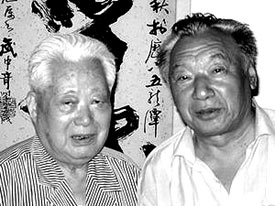
Guo Kai (R), initiator of the Shuotian Canal project, and General Liu Zhenhua (L), a warm advocate of Guo's plan.
Given each expert's inflexibility, CAS academician Ma Zongjin called on over 40 experts and officials to attend a conference on June 30, 2005 in Xiangshan (Fragrant Hill) in the western suburbs of Beijing to weigh up the project's options. "At the meeting, all attendees agreed that water shortage is fast becoming an issue of national security, requiring urgent and immediate action," said Ma. A strategic perspective, the Great Western Route offers a tentative plan for the solution of the water shortage problem. However, neither side is able to present convincing data based on meticulous field surveys. Ma added that "without accurate data, no one can fairly approve or reject the project." Guided by the State Council and with joint participation from all ministries and commissions concerned, an investigation mission was called for in the conference's final bulletin, enabling further preparations and deeper study for the project. "Circumstances permitting, another Xiangshan conference will be held later this year to discuss the program's feasibility as well as to investigate vital issues of international cooperation," said Ma. (Southern Weekend, translated by Shao Da for China.org.cn, August 8, 2006) |
| Tools: Save | Print | E-mail | Most Read |
 |
| Related Stories |
|
Product Directory China Search |
Country Search Hot Buys |
