国内精品一区二区三区最新_不卡一区二区在线_另类重口100页在线播放_精品中文字幕一区在线

Home Tools: Save | Print | E-mail | Most Read
Part 5
Adjust font size:

The Parlung Tsangpo River Canyon


Bomi’s beauty is quiet and peaceful. Here it feels like being in a delightful paradise. But the appeal of the Parlung Tsangpo River Canyon lies in its majesty. The Great Bend of the Yarlung Tsangpo River, where the Yarlung Tsangpo and Parlung Tsangpo converge, is particularly majestic and is regarded as symbolizing the world’s biggest canyon. 


The road from Pelung Village southward to Zachu Village is an important route to the Great Bend.  It follows the course of the Parlung Tsangpo River Canyon.


To some people the Parlung Tsangpo River Canyon is a warm-up exercise for explorers prior to entering the Yarlung Tsangpo Great Canyon itself. Here is a canyon several thousand meters deep, with a roaring river, endless vegetation and magnificent mountains and waterfalls. Once physically and psychologically accustomed to the exploration of the Parlung Tsangpo River Canyon, one can go on to show one’s skills in the Yarlung Tsangpo Great Canyon. But it’s worth noting that access is possible only on foot, because of the rugged nature of the roads and the need to cross the Parlung Tsangpo River. They’d better wear high mountaineering boots with thick, deep-grip soles, so as to keep a safe footing. 


The route from Pelung to Zachu runs parallel to the Parlung Tsangpo River, a tributary of the Yarlung Tsangpo. We walked along the path, which for the most part runs through the dangerous Parlung Tsangpo River Canyon.  The track between the two places is only 36 kilometers long, but it is a narrow winding footpath, zigzagging down the valley and makes hard going. We crossed the roaring Parlung Tsangpo River on a steel suspension bridge. On the way there was nobody but our survey team and porters.


There are steep cliffs at each side of the Parlung Tsangpo River. We went along a path running through the high mountainside and at some spots the cliff edge was some 500-600 meters high over the river; just looking down brought on dizziness. The bottom of the canyon is narrow, there are big disparities in the flow and the currents are naturally violent. The river went roaring past us like a train. It was awe-inspiring.  Sometimes, at places where the cliffs were wider apart, the roar was not so loud; even so, the noise, sometimes high sometimes low, was still scary.


That said, the views here are very beautiful indeed. The 1000-meter-deep canyon looks like something that has been split by a giant mountain-cleaving axe. It extends ever southwards, its awesome precipitous mountains covered by endless vegetation, the type of vegetation dependent upon on how high up the mountain it is growing. Shrubs and broad-leaved trees predominate at the bottom, and the mountainside are covered with conifer trees. The valley is full of great vitality and at the same time it has beautiful views of morning mist, like those often seen in mountainous areas of Jiangnan, south of the Yangtze River.


Mr. Chen Yuansheng told me in Beijing about his previous experience in exploring the Parlung Tsangpo River Canyon. The first thing he did in the morning was to vigorously exercise his knees and feet to check the flexibility of the joints. He always laced his boots up properly before setting out, this facilitating walking comfort and stepping precisely on the footmarks of the teammate ahead of him. His Japanese teammate Shin Nakamura, a well-known mountaineer who had climbed both Jomolangma and Namjag Barwa, fell and hurt himself. Nobody knew what caused his sudden fall at a place full of scattered pebbles and moss. Fortunately, he was stopped by a tree two or three meters down. His teammates ran down to him, and found that his left cheekbone sunk in and his nose bleeding.  They were afraid he might have serious cerebral concussion.  Cerebral concussion can adversely affect one’s balance, which is essential to prevent oneself from falling while climbing high mountains.  Nakamura was physically stronger than most of us, and although he was still getting occasional nose bleeds a few days later he insisted on pressing ahead with the rest of the group. Then they discovered that he was having to force himself on, and, with no way of knowing the extent of any internal injuries, they persuaded him to turn back.  So Nakamura had to return prematurely to Japan for medical treatment. 


Crossing landslide areas is very dangerous.  Between Pelung and Zachu there are several landslide spots and although each is only about 30 or 40 meters wide, crossing them makes one tremble. The danger lies in the fact that one side you have the roar and running billows of a torrential river, and on the other a sheer slope.  Apart from a string of footprints, there is no path across at all. 


The Tiger’s Mouth (Laohuzhui) is a danger spot. The local Monpa people have dug out a meter-wide path here.  This path also makes a sharp bend on the edge of the cliff.   And it would be all too easy to fall over the cliff while walking on the path that perches on top of it.  But precisely because the way is so risky to walk, the outside world has had little influence here and it has remained a magical place.


Exploration should be undertaken with great care and safety ropes should be used when passing through these dangerous areas.  Explorers, particularly those with heart conditions or fear of heights, should hold on to the safety rope tightly to avoid accidents.


We crossed four chain bridges suspended on steel cables, the bridge decks formed of planks. The bridges had no protection railings apart from some wires on both side, tied to the cables.  But the wires were so widely spaced they were useless in terms of providing protection.  The plank decks of the new bridges were well made, while those of the old bridges has voids here and there.  Walking across these bridges, travelers are often frightened by the roaring river below. Even so, one must take his time about it for fear of stepping into a gap and falling. As soon as one steps onto the bridge, it starts swinging left and right, and in this case one must immediately sit down or lie on one’s stomach so as to reduce the vacillation and stop oneself being thrown into the river.  Three of the four suspension bridges are between 60 and 70 meters long, and the fourth is a massive 180 meters.  Sometimes local people replace broken planks with new ones, often with the bark still on. The new planks are slippery and when walking on them, one must take care not to slip and fall.


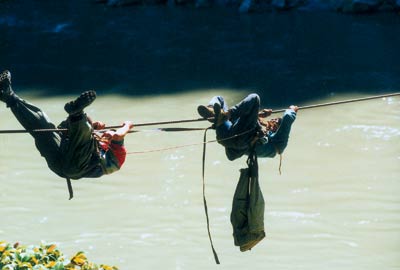
In fact, we were fortunate. In the past there were no suspension bridges across the Parlung Tsangpo River, and expeditions had to cross the river by means of a steel cable. They had to suspend themselves onto the cable, facing skyward, and feel their way across, hand over hand.  


For us, the most testing section between Pelung and Zachu was the tortuous path near to Zachu. Its elevation is between 600 and 700 meters. It was near noon when we climbed the path and was so hot we were soon sweating and gasping for air. Luckily the elevation was not very high and the plentiful vegetation there provided sufficient oxygen, otherwise some of us would have been worn out.


Then we came to a hill covered with green wild plantains, which looked very charming under the snow-capped mountains. We were jubilant because we could see Zachu from there.


At noon we saw a village with fields of rapeseed, fences and flocks of sheep. We finally reached Zachu, our destination point at the end of the Great Bend of the Yarlung Tsangpo River. I asked a teammate to take a picture of me, exhausted, pale-faced, baggy-eyed and bent, with one hand on the knee, hardly able to stand.  What it cannot show is the pride I felt. This is a place that many people have long dreamed of, a place of many unexpected nice surprises!


The journey from Pelung to Zachu had taken us two days. On the first day, while choosing a campsite we found several hot springs. It was an unforgettable experience.


In fact, there are many hot springs in the canyon area, owing to its large and deep fissures. The springs differ both in size and the temperature of their water. The sulfur content is so low that the water at most of the springs can be drunk. At some, the water flows softly from the pebble-covered bottom; at others it spurts right up.  Green grass and azaleas surround the springs and in the distance are the sacred ice peaks under white clouds.


We left Pelung in the morning. After climbing over a mountain we continued walking until five in the afternoon. We were very tired and hoped to find somewhere to pitch camp. My teammates ahead saw a stretch of sandy beach left of the riverbed and we erected our tents there. Some teammates discovered a hot spring nearby, a discovery that delighted everyone; it meant we could relax in the spring after a hard day. I dashed off to check it out; there was a rock face three or four meters high with a large red stone in the same color as that of the stones on the beach; the water was emerging from a small cave below the cliff. There was a pool four or five square meters in area and half a meter deep and two of the team were already having a soak in it. The water running through the pool formed a stream, which flowed about five to six meters and rushed off south, finally, emptying into the Parlung Tsangpo River 200 or so meters away.  I asked my teammates about the water temperature. They told me it was fine for bathing and urged me to join them.


Though I had seen commercially-exploited hot springs, I had never come across one in the wild. First I put my feet in; the water was so clear and warm I could not help throwing myself in. At once I felt relaxed.


Two more teammates followed me in and so as to make space for them I moved a little to the left. Suddenly I felt the water was a little cooler and the more I moved the lower the water temperature dropped. I realized there were two different springs, one warm and the other cold, with less than a meter between them.  Their water mixed into a stream. I was afraid of catching cold from bathing in cold water, which at plateau level might well turn into pneumonia, so I shifted toward the entrance of the hot spring cave. A noxious smell from the cave assailed my nostrils, so, fearing it might be harmful to health, I hurriedly drew away from the cave.


When my teammates enjoyed bathing in the hot spring, I noticed the color of cliffs on both sides of the hot spring cave was pink and that of the cobblestones at the bottom of the flowing stream yellow. When the water was stirred it became muddy. After a while the water was clear again. I thought of the red cobblestones on the beach in the lower reaches of the stream. The different colors aroused my interest. I wanted to know why the cobblestones were red. I put on my underwear and walked in the warm stream to its lower reaches. I noticed the stone on the bottom of the stream and on the banks was seriously eroded. There was a stone in the midst of the stream. It was about 10 cm. above the waterline and looked like the surface of a turtle’s back. There were yellow, pink, light-blue and light-green lines on it as a result of water erosion. This was a creation by Nature. I took some pictures of it with my camera.


As to why there were red stone in and around the spring, I think this was caused by microelements. At the same time I saw lines made by erosion on the middle and upper parts of the stones half-meter above water. I realized at last that the patterns of turtleback and the lines in various colors were made by erosion and that the lines on the stone high above waterline were made by overflowing water from the stream thousands of years ago.


Soon afterwards, we found a larger hot spring not far from there. This spring was a little different from the one in which we bathed. The flow of the first one was gentle, while the second one spurted water into the air and thus had a water drop of less than one meter. Because of the drop, water flew down our hands when we bent over to get it. Besides, this spring’s temperature was about 50 degrees centigrade, a little higher than that one.


The sandy beach campsite was beautiful. There were mountains, springs, white sandy beach, and lush and green forests. Besides, on the other side of the river was a waterfall dozens of meters high falling from the cliff. It was unexpected that all beautiful scenes gathered together before our eyes. The site was between Pelung and Zachu. When more people are attracted toward the Big Bend of the Grand Canyon of the Yarlung Tsangpo River, the sandy beach can be made into a tourist-transfer station.  If scientists prove the hot spring is good for health, tourists can bathe in it while appreciating the splashing waterfall opposite the river and floating clouds in the sky.


There are four hot springs in a distance of 36 km. between Pelung and Zachu. One is at Tongmey with temperature of 80 degrees centigrade, another is near to Zachu and the other two are at the sandy beach campsite.


According to experts, when subterranean water infiltrates the depth of earth crust, it goes upwards because of rising temperature and becomes a fluid in which hot water and steam as main contents mixed with magma. The fluid goes through the chinks in crust to earth-ground. The heat goes out by two ways: geysers and hot-water explosion. The geysers are hot springs that spout water at more or less regular intervals, and the hot-water explosion means hot ponds and lakes emerging as a result of ground collapse owing to underground holes made by hot water extrusion.


The hot springs and ponds of the Himalayas are mainly in the river valleys north to the Himalayas and south to the Gangdise (Kailas) mountain range. The Shiquanhe River and the Yarlung Tsangpo River’s deep and big faults and the two vertical faults on its both sides concentrate the heat of the earth’s interior.  So the place is called the Himalayas’ terrestrial heat zone.  In density and kinds this place’s terrestrial heat is second to none in China and even in the world.  There are about 70 kinds of ways to give the heat out, including geysers and other hot fountains, springs and lakes.  Tibet has 600-odd hot springs. The reason why the heat is concentrated at the place from Tongmey to Zachu is that this place is located at where the Indian plate and the European-Asian plate collided, pressed and stroke each other, and magma activities are frequent.  Many hot springs in Tibet have not been exploited yet but the day will come when the valuable resources bring benefit to mankind.

Crossing a steel rope suspension bridge

Crossing the river on a ropeway

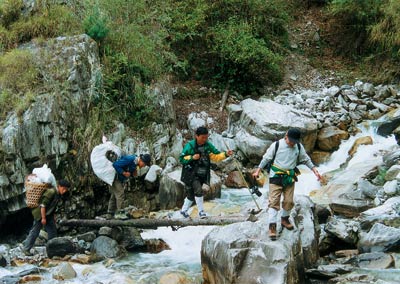
Fording a stream

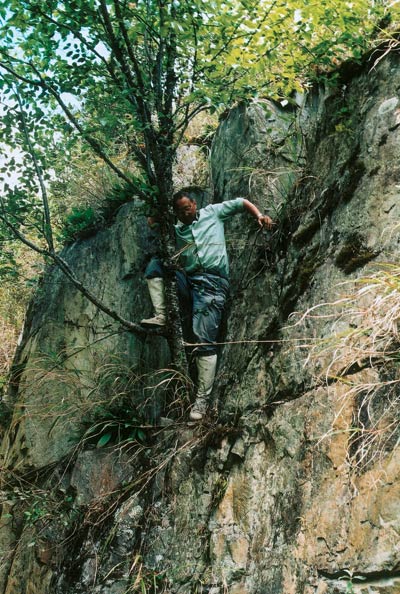
Surveying the cliff

Tools: Save | Print | E-mail | Most Read

Related Stories
SiteMap | About Us | RSS | Newsletter | Feedback
SEARCH THIS SITE
Copyright ? China.org.cn. All Rights Reserved ????E-mail: webmaster@china.org.cn Tel: 86-10-88828000 京ICP證 040089號
国内精品一区二区三区最新_不卡一区二区在线_另类重口100页在线播放_精品中文字幕一区在线
国内精品伊人久久久久av一坑| 亚洲成人在线网站| 中文字幕av资源一区| 中文字幕不卡在线观看| 中文字幕综合网| 亚洲最新视频在线观看| 日韩黄色片在线观看| 色婷婷综合久久久中文一区二区 | 亚洲一区电影777| 亚洲福利一二三区| 免费成人美女在线观看.| 国产一区二区三区日韩 | 洋洋成人永久网站入口| 午夜精品123| 国产精品一区二区免费不卡| 成人av影视在线观看| 欧美午夜精品一区二区蜜桃| 精品动漫一区二区三区在线观看| 国产精品久久久爽爽爽麻豆色哟哟| 亚洲一区中文日韩| 国产麻豆精品视频| 欧美在线观看一区| 久久精品人人爽人人爽| 亚洲电影一区二区三区| 丰满岳乱妇一区二区三区| 欧洲av一区二区嗯嗯嗯啊| 精品成人一区二区| 亚洲图片欧美色图| 懂色av一区二区夜夜嗨| 9191国产精品| 中文字幕第一区第二区| 美国十次了思思久久精品导航| 成人激情视频网站| 欧美成人女星排行榜| 亚洲一区二区三区爽爽爽爽爽 | 亚洲精品国产精品乱码不99| 韩国v欧美v亚洲v日本v| 欧美日韩色一区| 日韩一区欧美小说| 国产伦精一区二区三区| 7777精品伊人久久久大香线蕉超级流畅| 日本一二三不卡| 国产成人丝袜美腿| 国产精品伦理一区二区| 久久99深爱久久99精品| 欧美精品一级二级三级| 一区二区在线观看免费视频播放| 国产精品自在欧美一区| 精品少妇一区二区三区在线播放| 亚洲国产成人tv| 欧美在线观看一区二区| 亚洲欧美激情插 | 欧美日韩大陆一区二区| 亚洲美女一区二区三区| 94-欧美-setu| 综合亚洲深深色噜噜狠狠网站| 粉嫩绯色av一区二区在线观看| 亚洲精品一区二区三区蜜桃下载| 青青草精品视频| 日韩欧美一二三四区| 日欧美一区二区| 制服丝袜av成人在线看| 日本三级亚洲精品| 91精品国产一区二区三区香蕉| 亚洲成人精品影院| 91麻豆精品国产自产在线观看一区| 亚洲成a人v欧美综合天堂| 欧美午夜影院一区| 日本大胆欧美人术艺术动态| 欧美一级日韩不卡播放免费| 丝袜美腿亚洲综合| 欧美一级黄色大片| 久久精品国产99| 国产欧美1区2区3区| 99久久精品国产导航| 一区二区三区四区激情| 欧美精品在线一区二区三区| 久久精品国产精品亚洲红杏| 国产亚洲一区字幕| 97精品超碰一区二区三区| 亚洲在线观看免费视频| 欧美精品日韩精品| 国产乱淫av一区二区三区| 国产精品美女一区二区| 国产精品美女久久久久久| 一本色道久久综合亚洲aⅴ蜜桃 | 欧美白人最猛性xxxxx69交| 韩国视频一区二区| 亚洲欧洲日本在线| 欧美日韩国产精选| 精品一区二区三区欧美| 国产精品妹子av| 欧美日韩久久不卡| 国产精品一区免费视频| 亚洲女人****多毛耸耸8| 6080亚洲精品一区二区| 懂色av一区二区三区免费看| 亚洲成人av一区二区三区| 久久日韩粉嫩一区二区三区| 日本精品一区二区三区高清| 久久精品国产亚洲aⅴ| 一区免费观看视频| 欧美大片在线观看一区二区| 99re6这里只有精品视频在线观看| 首页欧美精品中文字幕| 国产精品美女久久久久久久| 69av一区二区三区| 成人99免费视频| 麻豆精品国产91久久久久久| 亚洲人成精品久久久久| 精品国产乱码久久久久久闺蜜| 色综合视频在线观看| 国产一区二区精品久久| 日韩经典一区二区| 亚洲男人的天堂在线观看| 久久久蜜臀国产一区二区| 欧美日韩国产精品成人| 91在线看国产| 国产91精品免费| 老司机免费视频一区二区| 亚洲综合视频在线| 亚洲日韩欧美一区二区在线| 久久视频一区二区| 欧美一三区三区四区免费在线看 | 国产乱对白刺激视频不卡| 一区二区三区四区在线播放| 国产精品理论片在线观看| 精品国产免费人成在线观看| 3751色影院一区二区三区| 欧美视频一区二区在线观看| 97久久精品人人做人人爽50路| 国产成人av一区| 经典三级视频一区| 久久9热精品视频| 麻豆成人av在线| 久草中文综合在线| 精品无人码麻豆乱码1区2区 | 欧美高清在线视频| 国产三级欧美三级日产三级99 | 亚洲国产精品久久人人爱蜜臀 | 亚洲欧美怡红院| 亚洲黄色录像片| 一区二区三区四区视频精品免费 | 亚欧色一区w666天堂| 亚洲网友自拍偷拍| 亚洲风情在线资源站| 午夜av一区二区| 五月婷婷综合激情| 奇米影视在线99精品| 美女视频黄 久久| 精品中文字幕一区二区小辣椒| 久久99精品国产.久久久久久 | 欧美日韩成人在线一区| 欧美一区二区福利视频| 精品少妇一区二区三区在线播放 | 91美女片黄在线观看| 91丝袜高跟美女视频| 欧美影视一区二区三区| 欧美日韩精品系列| 日韩精品一区二| 国产日韩欧美精品综合| 亚洲欧洲日韩女同| 午夜国产精品影院在线观看| 美女精品一区二区| 成人小视频免费观看| 欧美亚洲图片小说| 精品久久久久99| 中文字幕综合网| 免费看日韩a级影片| 成人性生交大片免费看中文| 色婷婷狠狠综合| 精品欧美一区二区久久| 国产精品人成在线观看免费| 亚洲一区日韩精品中文字幕| 久久99蜜桃精品| 色综合久久66| 久久综合给合久久狠狠狠97色69| 国产精品久线在线观看| 日韩不卡一区二区三区| 成人妖精视频yjsp地址| 欧美一区二区三区日韩| 国产欧美精品区一区二区三区| 亚洲成人免费在线| 成人午夜视频在线观看| 日韩丝袜情趣美女图片| 亚洲精品老司机| 国产不卡视频一区| 欧美一区二区视频网站| 亚洲女与黑人做爰| 国产一区二区三区免费播放| 欧美熟乱第一页| 国产精品福利av | 夜夜精品视频一区二区| 国产成人综合视频| 欧美日韩国产成人在线91| 中文字幕中文字幕一区二区| 男人操女人的视频在线观看欧美 | 久久国产人妖系列| 欧美午夜一区二区三区免费大片| 久久九九久久九九|