|
According to legend, the Great Wall was built by the first emperor of the Qin Dynasty, Qin Shi Huang (Reigned 221-210 BC), though historical records trace the true origin of the wall to defensive fortifications built in the fifth century BC From the statement "Square walls surround the Kingdom of Chu," we can trace walls with a total length of 500 kilometers in what is now Henan Province dating back to the Eastern Zhou Dynasty (770-256 BC). In addition to Chu, the kingdoms of Qin, Qi, Wei, Zhao, Han and Yan all had their own separate defensive walls spread about through the Yellow and Yangtze River basins, running in different directions and beginning and ending abruptly. The walls of this period bear little relationship to the wall of today with its predominantly east-west configuration.
In 221 BC, the armies of Qin conquered the abovementioned six kingdoms and unified China. Qin Shi Huang ordered the demolition of the walls separating these kingdoms and rebuilt a new "Great Wall," based on the walls protecting the northern frontiers of Yan, Zhao and Qin. According to the Records of the Historian (shiji), written approximately 100 BC, "General Meng Tian mobilized 300,000 laborers and built a great wall which followed the contour of the land, taking advantage of natural defenses." This wall extended more than 6,000 kilometers from Lintiao (in Gansu Province) to Liaodong. Thus the general plan of today's Great Wall was laid down during the Qin Dynasty (221-206 BC).
During the Han Dynasty (206 BC- AD 220) Which followed the Qin, in addition to making improvements in the Qin wall, the Han emperors constructed a separate outer wall north of the Yinshan Range with a total length of 10,000 kilometers. This was the longest single wall built in ancient China. After the fall of the Han Dynasty, the wall gradually decayed into ruins. In 1368, the founding year of the Ming Dynasty, Emperor Taizu commanded his general Xu Da to direct the reconstruction of the Great Wall. Beginning at the Juyong Pass, the work went on for more than 100 years. Based on the general dimensions of the Qin Wall, the Ming wall stretched from its westernmost point at the Jiayu Pass more than 6,000 kilometers east to the Yalu River. The section, which lies between the Jiayu and Shanhai, passes remains in good condition today and is known throughout the world as the Great Wall of China.
Setting out from Beijing, the most popular destination for visiting the Great Wall is Badaling. Both trains and buses go to the northwest of the city proper in a deep mountain-flanked gully 15 kilometers long. In summer, the peaks here are covered with brilliant stretches of leaves and luxuriant flowers. As early as the 13th century, the area was known for its beauty, and was listed as one of the"Eight Great Sights of Yanjing." The name "Juyong" first appeared in the huainanzi, a philosophical work from the second century BC, in the following annotation: "The Juyong Pass is one of the nine great passes in the country."
To the west of the Juyong Pass is a white marble structure called the Cloud Platform (Yuntai), which was built in 1345 to serve as the foundation for a set of three stone pagodas built at the command of Emperor Huizong, the last ruler of the Yuan Dynasty. At this time, the structure was known as the Pagoda Bridge (Guojieta). After the pagodas were destroyed some time around the fall of the Yuan Dynasty (1368), the Great Peace Temple (Tai' ansi) was built to replace them. But the temple was burned down in 1702 during the reign of Emperor kangxi.
The Cloud Platform is pierced by a hexagonal arched gateway. Both the ceiling and facades are covered with Buddhist carvings, including depictions of the Four Heavenly Kings in relief executed with great detail and expressiveness. Texts of Dharani sutras and an inscription entitled "A Record of Charitable and Pious Pagoda Building" carved in six languages -- Lantsha (Nepalese Sanskirt), Tibetan, Phagspa Mongolian, Uygur, Western Xia and Han -- are valuable for the study of philology. The inner roof of the arch is covered with mandala patterns and Buddha images surrounded by flowers, all fine examples of Yuan Dynasty craftsmanship.
The Juyong Pass area contains many relics associated with popular legends. One of these relics, dating back to the Northern Song Dynasty, is the Five Heroes Temple, which commemorates the ostensible digging of the gully by five men of unusual strength. The fanciful name of the Playing the Zither Gorge (Tanqinxia) is derived from the clear and melodious sounds of the river flowing through it.
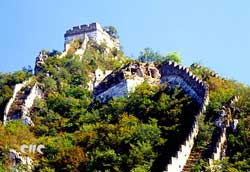
Continuing on from the Juyong Pass, one will arrive at Badaling, the highest point along the entire length of the Great Wall. Between Badaling and Juyong Pass, two Chinese characters Tianxian (Natural Barrier) are carved into a steep and imposing cliff. During the Ming Dynasty, two fortifications were built in this area, the Northern Gate Pass on west and the Juyong Garrison on the east. By climbing up through the pass and looking westward, one will be able to see a chain of mountains stretching away to the horizon with a single defile leading through them. To the north of the ridges near the wall is the platform for Viewing the Capital (Wangjingtai) and on clear days the White Dagoba in Beijing Park can be seen from here. By climbing over another slope and following a flight of stone steps up to the highest point of the southern section of the wall, one can see the dragon-like Great Wall making its way over the mountains.
Strategic platforms were built every 300 to 500 meters along the wall. These platforms served a variety of purposes: for posting patrols and sentries; to serve as observation posts; and as battle platforms for offensive actions and weapon storage. Here there are also reinforcing walls built alongside the wall proper and beacon towers for transmitting military information.
The Badaling section of the Great Wall most frequented by visitors dates from the Ming Dynasty, Constructed of large blocks of granite and bricks, the wall at this point is 6.6 meters high and 6.5 meters wide at its base, narrowing to 5.5 meters on the rampart. It is wide enough to permit five or six horses to stand abreast.
In recent years, the Chinese government has carried out restoration work on the sections of the wall which have collapsed or been eroded by wind and sand. Despite this, the great increase in tourists at the Great Wall in recent years has led experts to suggest the opening of a "second Badaling" to accommodate the great number of visitors. The "second Badaling" is located to the northeast of Beijing proper and can be reached by bus in approximately two hours. Built on the Great and lesser Gold mountains (Jinshan), this section is also called the Gold Mountain Great Wall. According to historical records, the construction of this part of the wall was begun in 1571, and is part of the 1,000-kilometer-long section of the wall between the Shanhai Pass in the east and Changping County in the west, which was the result of cooperation between two famous Ming generals, Qi Jiguang and Tan Lun. In terms of construction it is in no way inferior to the wall at Badaling.
The Great Wall at the Gold Mountain is seven meters high, six meters wide, and built of rectangular slabs of stone. The brick-paved walkway along the top of the wall is four meters wide and the crenellated openings two meters wide. In the merlons (the solid intervals between the crenels) there are small holes for observation and shooting arrows. There are also special openings between the crenels to insert flags for display or signal transmission.
The 158 battle platforms in the Gold Mountain section of the Great Wall were designed in a great variety of shapes-square, circular, oval and multi-cornered. Their interiors are constructed of wood or brick and their roofs are flat, domed or barrel-vaulted. There are also variations in the shape of the archways, which give access to the battle platforms.
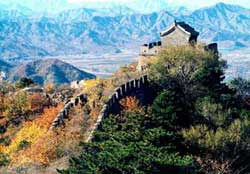
To the north of Tiger Mountain is a huge solitary piece of rock, which has in it an indentation one meter in diameter and 20 cm deep called the Spring of Heaven. The water from this spring flows continuously in both the rainy and fry seasons. Near the spring is a defense tower called the Five Eyes Tower. Unique in design, the body of the tower is made of rectangular stone blocks and the roof of polished bricks. Inside there are two large barrel-vaulted ceilings, three corridors, 10 arched openings and a central octagonal dome supported by four brick columns arranged in a square. The stone columns are decorated with relief carvings of flowers, which add a touch of elegance to this otherwise austere building. Standing atop this tower, one can see the Great Wall winding its way along the contours of the mountains. From this vantage point, the wall appears like a ribbon of jade linking the Wuling Mountain (the highest peak of the Yanshan Range) with the Sleeping Tiger Range near Gubeikou.
Leaving the Five Eyes Tower and proceeding along the wall, one comes to the Tower for Viewing the Capital (Wangjinglou), which sits at a strategic point in Tiger Mouth Peak. The tower commands a panoramic view of the surrounding countryside. Off to the southwest, the mirror-like surface of Miyun Reservoir appears, the outline of Beijing can be seen in the early morning and the city lights become visible at night.
The Mutianyu section of the Great Wall was opened to tourists on May 1, 1986. Located 73 kilometers from Beijing proper, it joins the Juyong Pass in the west and Gubeikou in the east. A new 4,000-meter-long pathway has been constructed from the road. It can also be reached by cable car.
This well-preserved section was built about 1,400 years ago and reconstructed later during the Ming Dynasty. History of Ming Military Affairs explains why it was rebuilt.
When Emperor Yongle returned north and reestablished Beijing as the capital, he was exposed to attack on three sides. Harassment increased after the reign of Emperor Zhengtong, so work was begun to strengthen and lengthen the wall at Yalu River in the east.
The strategic importance of Mutianyu was obvious, as many battles took place there. It is said that during the Three Kingdoms period when Cao Cao exterminated Yuan Shao's regime, his army advanced through Mutianyu. In the mid-Ming years, the noted General Qi Jiguang was transferred from the south. As Military Superintendent of Jizhen, he built observation towers and provided storage areas for military weapons.
The highest observation tower in the Mutianyu section is 540 meters above sea level. Crenels and shooting holes are part of the solid construction. To the east, the Great Wall continues across the mountain ridges, to the west, it enters a point of strategic importance at a peak 1,044 meters above sea level.
Badaling Great Wall
Address: Yanqing County, 70 km from Beijing's city proper;
Entry ticket: 45 yuan/person;
Traffic: Tourist Bus No.s 1, 2, 3, 4 and 5; or Bus No. 919 from Deshengmen Bus Station; or drive along the Badaling Expressway via Madian Overpass;
Tel: 86-10-69121235, 86-10-69121338.
Remnant of the Great Wall at Badaling
Address: Donggou Village, Badaling Town, Yanqing County;
Entry ticket: 50 yuan;
Traffic: Bus No. 919 from Deshengmen;
Tel: 86-10-69120990.
Juyongguan Great Wall
Address: North of Changping, government seat of Changping District;
Entry Ticket: 40 yuan/person;
Traffic: Bus No. 919 from Deshengmen; or Tourist Bus No.s 1-5; or drive along the Badaling Expressway;
Tel: 86-10-69771665.
Shuiguan Great Wall
Address: Badaling, Yanqing County;
Entry ticket: 12 yuan/person;
Traffic: Bus No. 919 from Deshengmen.
Mutianyu Great Wall
Address: Huairou District;
Entry ticket: 35 yuan;
Traffic: Tourist Bus No. 6 from Xuanwumen, Qianmen and Dongsi Shitiao; or take Bus No. 916 from Dongzhimen to Huairou, and then change to a local bus or hire a taxi (17 km);
Tel: 86-10-61626873, 86-10-61626022.
Xiangshuihu Great Wall
Address: Huairou District, 8 km west of Mutianyu;
Entry ticket: 18 yuan;
Traffic: Take Bus 916 (extending line) from Dongzhimen, or take Bus 916 to Huairou and then change to a local bus or hire a taxi;
Tel: 86-10-89602539.
Lianyunling Great Wall
Address: Dazhenyu Village, Huairou District;
Entry ticket: 18 yuan;
Traffic: Take Bus 916 from Dongzhimen to Huairou, and then change to a local bus or hire a taxi.
Huanghuacheng Great Wall
Address: Chengguan Town, Huairou District;
Entry ticket: Not yet formally open;
Traffic: Take Bus No. 916 from Dongzhimen to Huairou and then change to a local bus or hire a taxi;
Tel: 86-10-61651004.
Heituoshan Jiankou Great Wall
Address: Northwest of Huairou;
Entry ticket: Free of charge;
Traffic: Take Bus 916 from Dongzhimen to Huairou, and then change to a local bus or hire a taxi;
Tel: 86-10-61611674, 86-10-61611614.
Bailingguan Great Wall
Address: Toudaogou Village, Miyun County;
Entry ticket: Free of charge;
Traffic: Take a bus from Dongzhimen to Miyun, and then change to a local bus, or hire a taxi;
Tel: 86-10-81022491.
Jinshanling Great Wall
Address: On the border between Beijing's Miyun County and Hebei's Luanping County.
Entry ticket: 30 yuan/person;
Traffic: Take Train L671, which starts at 7:25 AM from Beijing North Railway Station, and get down at Gubeikou; or take a bus from Dongzhimen to Miyun and then change to a local bus or hire a taxi.
Simatai Great Wall
Address: Gubeikou Town, Miyun County;
Entry ticket: 30 yuan;
Traffic: Tourist Bus No. 12 from Xuanwumen and Dongsi Shitiao; or take bus from Dongzhimen to Miyun and then change to a local bus or hire a taxi;
Tel: 86-10-69031051, 86-10-69035025.
(China.org.cn)
|