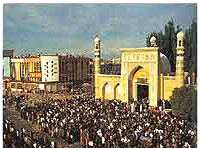
For many Muslims living in Northwest China's Xinjiang Uygur Autonomous Region, they head to the tomb of Thabit Ibn Qays, an ancient Islamic sage, located in the western part of urban Hami, about 600 kilometres east of Urumqi, capital of Xinjiang.
Known by the local Muslim population as "Geys' Mazars," the ancient Islamic missionary is worshipped by an increasing number of Chinese Muslims every June and July.
It is one of the few existing tombs of the ancient Islamic sages, known among Muslims as the "Companions of the Holy Prophet Muhammad."
The tomb is 22 metres long from east to west, 12 metres wide from north to south and 15 metres high.
It consists of a square base, a round arched dome - both inlaid with green glazed bricks - and surrounding corridors with wooden columns and up-turned eaves, indicating a combination of both Arabic and Chinese architectural styles.
Qays was believed to have died in AD 635 on his homebound trip along the Silk Road westward. He was buried by his followers in the Xingxing Valley, to the east of today's Hami.
Years earlier, Qays, along with other Islamic missionaries - the most prominent among them being Sa'ad ibn abi Waqqaas, a maternal uncle of the Holy Prophet Muhammad - paid a landmark visit to the Tang Dynasty (AD 618-907) capital of Chang'an (today's Xi'an, capital of Northwest China's Shaanxi Province), inviting Emperor Taizong to embrace Islam.
The remnants of the original tomb was relocated by Hami Muslims in 1946.
For over 1,300 years, the tomb has stood as a witness to the dissemination and evolution of Islamic culture in China.
Islamic culture
Islam is one of the five major religions in China. The four others are Buddhism, Taoism, Catholicism and the Protestantism.
Muslims take great pride in citing a hadith that says "seek knowledge even it is in China."
It points to the importance of looking for lore, even if it meant travelling as far away as China.
Observing the Prophet's instructions, his followers sent missionaries to China one after another.
Some historians hold that, as early as the Sui Dynasty (AD 581-618) during the revelation of Islam (AD 610-632) to the Prophet, Islam had already appeared in China.
Still, many believe the visit led by Waqqaas and Qays was Islam's earliest contact with China during the caliphate of Uthman ibn Affan, the third caliph.
After triumphing over the Byzantine, Romans and Persians, Uthman ibn Affan dispatched a deputation to China in AD 650, eight years after the Prophet's death.
Waqqaas was said to have died in Canton, today's Guangzhou, capital of South China's Guangdong Province, where he established the Huaisheng, literally meaning "in memory of the Holy Prophet" Mosque, or Memorial Mosque, one of the first Islamic buildings in China and proof of the early communication between the two cultures.
And in AD 713, an ambassador from the Islamic Caliphate was received at the Tang court.
Since then, both overland trade along the silk route and maritime trade via the spice route to the southeastern port of Canton flourished. So did cultural and scientific exchanges.
Many Muslims came to China to trade and they began to have a great economic impact and influence on the country.
Muslims virtually dominated the import-export industry by the time of the Song Dynasty (960-1279).
Some of them later became permanent residents in such prosperous cities as Xi'an, Quanzhou in Fujian Province, Hangzhou in Zhejiang Province, Yangzhou in Jiangsu Province, Hami and Guangzhou, where they built mosques and cemeteries.
For over 500 years, Canton was known in Arabic as Zayton.
One of the most prized Chinese musical instruments, the pluck-stringed pipa, actually originated in the Islamic world and was called barbat, tanbur or mizhar in Arabic and Persian.
And the Chinese word for ball, qiu, was said to originate from the Persian word, gui, the name for the game of polo.
Chinese medicine, both the material and prescriptions, were also influenced by Persia and Arabia, as recorded by Tang Dynasty officials.
A famous Islamic physician Razi (AD 865-925) was even said to have helped Chinese pharmaceutical expert Li Xun study in Baghdad the works of ancient Roman medical master Claudius Galen.
Immigration
In the early 13th century, Genghis Khan, the Mongolian leader and founder of the Yuan Dynasty (1271-1368), launched a large-scale westward expedition.
During the period, hundreds of thousands of Central Asian, Persian and Arabic Muslims immigrated to China, settling mainly in today's Gansu, Henan, Hebei, Shandong, Yunnan and Shaanxi provinces and the Xinjiang Uygur and Ningxia Hui autonomous regions.
Islam took shape in China in the Yuan Dynasty when mosques were erected in almost every city having new Muslim settlers.
Among the most famous ones are the Huaisheng Mosque in Guangzhou, the Niujie Mosque in southern downtown Beijing, which was built in AD 996, and the Holy Crane Mosque in Yangzhou of East China's Jiangsu Province, which was built in 1274 by Buhaddine of Mecca, and is still an important place of worship.
In 1274, Buhaddine died in Yangzhou and was buried by his followers on a foothill facing Mecca.
The place became a cemetery, known as Huihuitang (Islamic yard), for Arab Muslims who died in the Song, Yuan and Ming dynasties.
Yuan Dynasty rulers allowed foreign immigrants to maintain their religious beliefs and during the dynasty, the social status of Muslims from abroad was higher than that of local Han residents.
Islamic religion and culture was allowed further growth in the Ming and Qing dynasties.
One example is that Hui Muslim Zheng He (1371-1435) was assigned by the Ming emperors to be the head of their powerful ocean-going fleet, the largest in the world at that time.
Zheng launched seven maritime expeditions between 1405 and 1433, starting from Taicang, in Jiangsu Province on the coast, to the South China Sea and as far away as the Persian Gulf.
After the founding of New China in 1949, the Islamic faith of the Chinese Muslim were fully respected and protected by the government.
In 1953, the Islamic Association of China was founded and now is run by 16 Islamic religious leaders. It is aimed at helping the spread of the Koran in China.
Also, many nationwide Islamic associations have been organized to co-ordinate inter-ethnic activities among Muslims.
Religious practices
Today, Islam is the dominant religion among 10 Chinese ethnic groups: the Uygur, Hui, Kazak, Kirgiz, Tajik, Tartar, Uzbek, Bao'an, Dongxiang and Salar. China has at least 20 million Muslims.
In Xinjiang, there are 9 million Muslims and 23,000 mosques in the region, two-thirds of the total number in the country.
There are at least 250,000 Muslims in Beijing, who can hold and attend religious services such as Ramadan and festivals or Islamic Eidul-Adha, in 68 mosques in the capital.
At present, there are 35,000 mosques, more than 45,000 Muslim teachers and administrators, and more than 24,000 students in Islamic theological institutes in various regions in China.
Although a number of Chinese mosques were closed during the "cultural revolution" (1966-76), all had been reinstated by the early 1980s.
Chinese Muslims follow the Islamic theory and practice, embracing the five fundamentals of Islam. They differentiate between the forbidden "Haram" and the permissible "Halal."
Local Muslims have also gradually integrated into Chinese society.
One interesting example of this synthesis is the process by which Muslims change their names.
Some male Muslims married Han Chinese women and simply took the name of their wives.
But others took the Chinese surnames of Mo, Mai and Mu - names adopted by Muslims who had the surnames Muhammad, Mustafa and Masoud.
Some Muslims, who could not find a Chinese surname similar to their own, adopted Chinese characters most similar to their name - Ha for Hasan, Hu for Hussain, Sa for Said and so on.
In addition to names, Muslim customs of dress and food have also undergone a synthesis with indigenous Chinese culture.
The Islamic modes of dress and dietary rules are maintained within a Chinese cultural framework.
Many Muslims in different parts of the country learn to speak local dialects and read Chinese, which enables them to better communicate with other Chinese ethnic groups.
The author is a Hami-based, Hui ethnic scholar of local history and cultures.
(China Daily May 20, 2003)