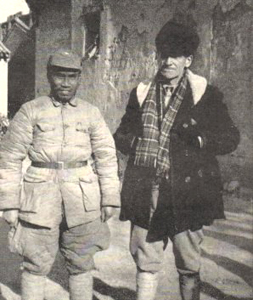
Three old Chinese men were making their way across the green lawns of Arlington National Cemetery. The Potomac glistened in Virginias genial spring sunshine. The men, accompanied by two Americans, searched the rows of tombstones until they reached the one they had crossed the Pacific to find – that of Evans Fordyce Carlson, a former brigadier general in the US Marine Corps.
The three men were Liu Baiyu, a well-known writer and former officer of the Chinese Peoples Liberation Army, Ouyang Shanzun, a playwright, and Wang Yang, a photographer. Fifty years earlier, they had been sent by Chairman Mao Zedong to escort Carlson, who had come to China as a private representative and observer of President Franklin D. Roosevelt, on an 83-day, 1500-mile journey through the north of China.
The experience had made them close friends and comrades. In the spring of 1988, the three men came to the United States at the invitation of the organization of Evans F. Carlson Friends of the Peoples Republic of China to pay their respects to their American friend of so many years ago.
Liu Baiyu recalled that the romantic adventure began in 1938 at the start of the Anti-Japanese War, when the Kuomintang government and the Chinese Communist Party banded together to fight the invaders. One day in May, Mao instructed Liu to form an escort for an American officer who had come to Yanan to tour northern China. His purpose was to observe the Chinese resistance. The group included Liu and other four dedicated, well-educated young men in their early twenties: Ouyang, who acted as interpreter, Wang, Qin Zhaoyie, a journalist, and Lin Shan, a poet.
A Gruelling 83 Days
They started from Yanan, in Shaanxi Province, and covered Shanxi, Hebei, Shandong, and Henan provinces. They had to cross enemy lines three times, and once Marshal He Long ordered his army to raid the Japanese left and right wings so the group could cross the center of an enemy line.
During his trip, Carlson met with Mao, Zhu De, Zhou Enlai, He Long, Deng Xiaoping, Peng Zhen, and other top Communist leaders. While traveling from Yanan to Zhengzhou, in Henan Province, they also penetrated KMT-controlled areas several times and were met by local leaders.
The tour deepened Carlsons understanding of the Chinese people, their leader, and their army. He was especially impressed by the bravery and flexible tactics of the Eighth Route Army against the much more powerful Japanese invaders. He attributed the armys efficiency to its soldiers and officers political knowledge and high ethical standards.
In his 1940 book, The Chinese Army: Its Organization and Military Efficiency, he wrote, "Troops (of the Eighth Route Army) are informed of the reasons why China is fighting Japan. They are taught to be truthful, honest, and selfless. They learn that the patient acceptance of hardship and privation is a form of self-sacrifice, and that self-sacrifice is the price of progress."
Liu said he still remembered the group's first meeting with Carlson: "He measured us with skeptical eyes and said, 'Can you cover 30 kilometers in one day on foot?' During the 83 days that followed, we endured many hardships and shared everything with him."
The journey ended at the Zhengzhou train station. As the whistle blew and the train that would take Carlson to Hankou began steaming out of the station, the your Chinese sang Song of the Guerillas, which had inspired and cheered them many times during the grueling trip. Carlson accompanied them on his harmonica, and tears shone in everyone's eyes.
Carlson later described the camaraderie he shared with the group in his 1940 book, Twin Stars of China: "Only those who have traveled together under severe conditions over long distances can understand the tender fellowship which such an association develops. Nationality and race mean nothing. It is the integrity of the human being that counts, and these sterling companions had proved their loyalty, their courage and their integrity on numberless occasions."
Carlson and China
Destiny linked Carlson with China. As a Marine Corps officer, he visited China four times between 1927 and 1940. On these trips, he met and talked with Chiang Kai-shek, his wife Soong Meiling, Defense Minister Chen Cheng, and other top civil and military leaders. He even attended Dr. Sun Yat-sen's state funeral in June 1929. The report he wrote for his close friend Roosevelt is said to be preserved at the Roosevelt Library in Hyde Park, New York.
But when Carlson first stepped onto Chinese soil, he was an arrogant white man prejudiced by ethnocentrism. In one letter, he told his family, "The most effective policy is to teach the Chinese a lesson."
Ten years later, he had learned the Chinese language, become fascinated by Chinese culture, and developed a profound respect for the Chinese people. In 1940 he said, "For the past decade China has been marching forward---. This nation, with a civilization 5,000 years old, is destined to become a world power in her own right, and if she retains her independence she will become a democratic stronghold in Asia."
When Carlson returned to the United States, he devoted himself to writing and speaking on China. However, his views on the political situation there differed so greatly from the US government's that in 1939 he decided to resign from the Marine Corps.
His activities as a civilian included lecturing on China as well as publishing his two books and many magazine articles in which he predicted the success of the Chinese Communists and pointed out the corruption of the KMT government.
He also criticized continued American sales of scrap steel to Japan after learning in 1937 from Deng Xiaoping that many of the Japanese bombs falling on Chinese cities and villages contained scrap steel supplied by American businesses. He described this conversation in Twin Stars of China: "'Are you sure about that?' I asked. I knew that American sympathy was preponderantly on the side of China, who was the victim of aggression, and during the eight months I had been in the interior I had taken it for granted, when I had thought about the matter at all, that American people would refuse to sell war materials to an aggressor nation. What sublime ignorance!"
"'Yes,' he assured me, 'the information came in a press dispatch from the United States at the end of the first year of the war.' I was distressed, and said that there must have been a mistake in the dispatch. I could not believe that American people would knowingly contribute to the carnage and suffering I had seen here during the past year."
Carlson went on to warn that "The present struggle between China and Japan cannot be of merely academic interest to the people of the United States. It is a struggle the outcome of which will determine whether Eastern Asia will be ruled by a military autocracy, or whether the budding democracy of China will come into full bloom."
"If Japan wins then America must look to her defenses, for the desire of the Japanese military-naval clique to crush America is no less intense than the desire of Germany to crush Great Britain. And yet America continues to provide Japan with the war materials with which to establish this hegemony!"
Convinced that the Japanese would attack the Philippines, Guam, and Wake Island, Carlson rejoined the Marine Corps in 1941. When Pearl Harbor proved his prediction correct, he was asked to form a raider battalion to attack the Japanese lines from behind. In 1942, "Carlson's Raiders," modeled after the Chinese guerillas and using tactics and principles Carlson had learned about from the Eighth Route Army, carried out two of the first successful operations in Japanese-held territories in the Pacific theater of war.
In 1946, during a visit to journalist Edgar Snow, Carlson predicted that the "Chinese problem" would not last for too long. He said the civil war would end either with a coalition government or with a Communist victory.
Liu commented, "Looking back on history, at the same time I was fighting snowstorms and bullets in North China, an American on the other side of the earth had foreseen our final victory."
Grossman's "Archeology"
Charles Grossman, Carlson's doctor and close friend, established and directs the organization named after him. Carlson's personality and zeal for China influenced Grossman so deeply that he has devoted much energy to developing Sino-US friendship.
One of his projects was to locate the five Chinese "boys" who had accompanied Carlson on his North China visit. But the whereabouts of the five were unknown, and the doctor was not even sure whether they were still alive. He made 15 flights to China to look for them, but his only clues were the surnames Carlson had mentioned in Twin Stars of China and a group photograph featured as the book's frontispiece. His 16th trip paid off when he met a friend in Shanghai who knew Liu Baiyu and recognized him in the photograph. Grossman learned that four of the five were still alive–Lin Shan had just died–and living in Beijing. On a February 1986 morning, Grossman met with the four remaining "boys", all of whom had survived the vicissitudes of the war against Japan, the civil war, and the "cultural revolution," and were now white-haired old men in their seventies. Liu Baiyu commented, "Grossman is an 'archeologist' who unearthed us in spite of time and space."
All four remain active in their fields. Ouyang had spent many years working with fruit trees during the "cultural revolution" but then became vice-president of the Beijing People's Art Theater and a professor at the Central Academy of Drama. Wang is president of the Beijing Film Studio and Qin Zhaoyie now works at the Chinese Association for International Affairs. Liu is vice-chairman of the Chinese Writers' Association and a vice president of the Chinese branch of PEN but spends the rest of his time writing: his most recent books are The Second Sun, a novel about post-Liberation China, and Great Ocean, a biography of Zhu De.
Although Qin was not able to take part in the trip, planned to commemorate the 50th anniversary of Carlson's "long march," because of health problems, the other three did. Grossman escorted them to Washington, and to Portland, Oregon, where Carlson lived.
As he was leaving, Liu said, "Half a century ago, when the Chinese people were struggling in an abyss of misery for their salvation and a better future, an American lent his enthusiasm and support. This will never be forgotten by the Chinese people. Now as we pluck the flowers and fruits of Sino-US friendship, we should every now and then trace their origins back to those sowers of years ago."
(Beijing Review by staff reporter Jiang Wandi May 30–June 5, 1988 )