China's Top-Ten archaeological discoveries of 2003 were announced in Beijing on April 12:
1. Niuheliang Ruins in Lingyuan, Liaoning Province. Dating back to the Neolithic Age.
2. City Ruins at Zhengzhou, Henan Province. Dating back to the Dashigu Xia Dynasty (c.2100 BC - 1600 BC).
3. Bronze-ware in Yangjia Village, Meixian County, Shaanxi Province. Western Zhou Dynasty (c.1100 BC - 771 BC).
4. Zhouyuan bronze workshop in Fufeng, Shaanxi Province. Western Zhou Dynasty.
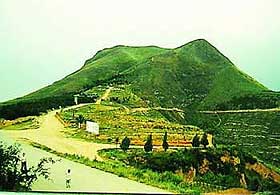
5. Terracotta warrior pits and kilns at Weishan Mountain in Zhangqiu, Shandong Province. Han Dynasty (206 BC-AD 220).
6. Inkstone washing pond and tomb in Linyi, Shandong Province. Jin Dynasty (265 - 420 AD).
7. North Sima Gate, Zhaoling Mausoleum, Shaanxi Province. Tang Dynasty (618 - 907 AD).
8. Khitan Tomb at Tuerji Mountain in Tongliao, Inner Mongolia Autonomous Region. Liao Dynasty (916 - 1125 AD).
9. Jining City Ruins, Inner Mongolia Autonomous Region. Yuan Dynasty (1279 - 1368).
10. Imperial kilns in Zhushan of Jingdezhen, Jiangxi Province. Ming (1368 - 1644) and Qing (1644 - 1911) dynasties.
1. Niuheliang Ruins in Lingyuan, Liaoning Province.
Excavated by: Liaoning Provincial Institute of Cultural Relics and Archaeology.
Team leader: Zhu Da.
Era: Neolithic.
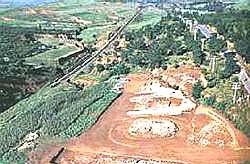
Occupying a central location in the Niuheliang ruins of the Hongshan Culture is Site-1 where ritual sacrifices once took place. Some 4,500 meters southeast is site 16. East of this are Site-13 where large earth and stone buildings stood in antiquity and Site-14 with its silent procession of evenly spaced stone-mound tombs.
New finds made last year include stone-mound tombs and artifacts made and used in the later period of the New Stone Age and in the later Xiajiadian culture of the early Bronze Age.
The stone-mound tombs are the most significant relics of the Hongshan culture. Now twelve of them are well enough understood to have been split into four categories depending on when they were built.
The most important of these is a tomb designated M4. Unlike previous finds of tombs in pits or wind-eroded bedrock, this tomb was cut into the hard granite of the mountainside. It is 3.9 meters long, 3.1 meters wide and 4.7 meters deep. Its south wall is a steep drop while steps have been cut in the sloping north wall. The tomb was backfilled with the same rock that had been excavated during its construction. Close to the mouth of the tomb, ancient Chinese people built a stone structure in the form of a well, polygonal in plan and capped with a stone slab. At the bottom of the tomb they placed a rectangular stone coffin and protected it with 17 layers of stone slabs.
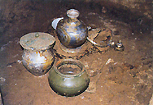
The burial articles included six jade-ware items. Of these a jade figurine and jade phoenix were unlike previous finds. The jade figurine is true to life and of great significance to the study not only of ancient religious and sacrificial activities but also to human posture and form as viewed in antiquity. The jade phoenix has sculptural lines which are at once simple, vivid and elegant. Its location under the head of the deceased points to some ritual significance.
Not only was M4 a large scale construction but its 30 cubic meters of excavation in solid rock must have represented a very considerable expenditure of effort given the methods of these times.
The Niuheliang Ruins have provided rare source materials for research into the Hongshan culture. They are shedding new light on these distant days through the study of the distribution of the stone-mound tombs, their methods of construction and the burial customs. They have brought fresh insight into the use of jade in antiquity and have helped archaeologists place these Neolithic tombs in sequence within a time-line.
2. City Ruins at Zhengzhou, Henan Province.
Excavated by: Zhengzhou Institute of Cultural Relics and Archaeology.
Team leader: Wang Wenhua.
Era: Dashigu Xia Dynasty (c.2100 BC - 1600 BC).
From March 2002 to December 2003, the Zhengzhou Cultural Relics Archaeological Research Institute undertook a salvage excavation at the Dashigu site. It is located in the northwestern suburbs of Zhengzhou, capital of central China's Henan Province. The dig, over an area of 540 square meters, confirmed the site as Bronze Age (21st-17th centuries BC) and belonging to the middle and later periods of the Erlitou culture.
A city wall and moats enclose a level, rectangular site of some 510,000 square meters. The remains of the city wall were generally nearly a meter below today's ground levels. All the relics uncovered were found inside the city wall and moats.
"The remains of the city wall were composed of several different layers of earth, showing that the wall had been renewed or restored again and again in antiquity," said team leader, Wang Wenhua.
Two moats each some 2.0-2.8 meters deep ran parallel with each other.
Remains of foundations, tombs, ash pits and ash ditches together with many other relics were discovered inside the city site. They were mainly of the second, third and early fourth phases of the Erlitou Culture. What's more, the archaeologists discovered a large number of fragments of clay drainpipes in the ash ditches.
Another important discovery was a ring moat of the early Shang Dynasty (16th-11th centuries BC). It lay between the old city wall and the Xia Dynasty moats with which it ran parallel. Unlike the moats of the Erlitou culture, the Shang ring moat was shaped like a trumpet in cross-section, 13-15 meters wide at the mouth and just 1.5 meters wide at the bottom. Its depth varied from 4.0 to 6.8 meters.
An abundance of Early Shang Dynasty remains was discovered inside the ring moat, showing that the city site had survived as an important residential settlement to that time.
The Xia Dynasty, Dashigu city site is the only one of its kind so far discovered in China which can be classified with certainty as representing the Erlitou culture. It helps fill the gaps in the archaeological understanding of the city sites of the Xia Dynasty. It gives us precious reference materials for the study of city development together with state and social structures in the Xia Dynasty. It even casts new light on the very origins of Chinese civilization.
A wealth of discoveries relating to both the Xia and Shang dynasties were uncovered in this city site. These finds will be of great significance to research on the relationship between these two ancient dynasties.
3. Bronze-ware in Yangjia Village, Meixian County, Shaanxi Province.
Excavated by: Shaanxi Provincial Institute of Cultural Relics and Archaeology, Baoji City Archaeological Team and the Meixian County Culture Center.
Team leader: Wang Zhankui.
Era: Western Zhou Dynasty (c.1100 BC - 771 BC).
It was on January 19, 2003 that some rural laborers from Yangjia Village in western China's Shaanxi Province inadvertently uncovered a cellar containing 27 priceless bronze vessels dating back some 3,000 years.
When the province's archaeological departments excavated the cellar and some 300 square meters around it, they found 16 tombs (five of the Western Zhou Dynasty and the others pre-Zhou), one chariot pit and one horse pit.
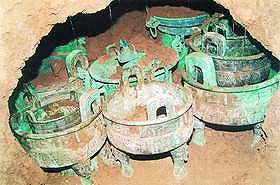
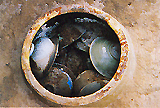
The bronze-ware cellar is composed of a rectangular pit together with a near circular niche. The pit measures 4.7 meters north to south and 2.5 meters east to west. It had originally been dug 2.5 meters deep but over the ages it had become buried deeper and deeper. When excavated, the bottom of the pit was no less than seven meters below today's ground level. To the south lies the niche, 1.1 meters deep and having a diameter of 1.6 to 1.8 meters. The gap between them was sealed up with rammed earth. It was in this niche that 27 well preserved, bronze vessels were found.
The bronze vessels belonged to the Shan Clan, an official family which enjoyed high status in the Western Zhou Dynasty. Never before have so many bronze-ware items of this degree of archaeological interest, attributable to a single family been uncovered together. What's more every one carries an inscription to enrich the historical records surviving from these times.
Most striking is a bronze plate bearing a 350-word inscription. This is longer than any inscription found on any vessel excavated since 1949. Taken together the finds provide the clan with a written historical record running to no fewer than 4,048 words. This is unprecedented for the period. Most of the vessels are magnificent artifacts in their own right and have been much appreciated for their design quality.
Of great significance to broadening an understanding of these far off days are the 12 bronze dings (cooking vessels with two loop handles and three or four legs) for each bears a rare 300-word inscription. These records, kept safe in bronze down all these years, are unique for they list 11 of the 12 Western Zhou Dynasty kings. Only King You, the last of his Dynasty is not included. What's more, the inscriptions record the parallel relationships between eight generations of the Shan Clan and the 12 Western Zhou kings. Not only do they put dates on the Western Zhou but they are also proving valuable in establishing a timeline for the Bronze Age of the Western Zhou Dynasty and the chronology of the Xia, Shang and Zhou dynasties. Meanwhile the inscriptions have been providing important reference materials for understanding the clan history of the Shan family and the relationship between the Zhou Dynasty and northwest ethnic groups.
Further excavations outside the cellar have been adding background information to aid the study of these bronze treasures.
4. Zhouyuan bronze workshop in Fufeng, Shaanxi Province.
Excavated by: School of Archaeology and Museology of Peking University, Shaanxi Provincial Institute of Cultural Relics and Archaeology and the Institute of Archaeology of the Chinese Academy of Social Sciences.
Team leader: Xu Tianjin.
Era: Western Zhou Dynasty.
The excavations took place to the west of Lijia (Li Family) Village of Fufeng County, Shaanxi Province. Two rich sources of bronze treasures were found lying respectively several hundred meters east and southwest of the village. All together, 123 garbage pits, 8 house sites, 2 wells, 35 tombs and 1 chariot pit were unearthed in this 875 square meter site.
The most important finds arising from the Lijia bronze
workshops must be the thousands of pottery moulds of the Western Zhou Dynasty. These were the actual moulds that were used in ancient times to produce such artifacts as ding, gui (round-mouthed food vessels with two or four loop handles), li (tripod cooking vessels with hollow legs), jia (round-mouthed three-legged wine vessels), kettles, vessel lids, small tinkling cart bells, horse curb bits, bronze buttons, bells and tools, as well as some other previously unknown items. The hands of ancient artisans had decorated some of the pottery moulds with intricate designs.
Before this important new find was made, the modern world had only a few pottery moulds from the early Western Zhou Dynasty. These had been found in Luoyang, Henan Province. The Lijia Village discoveries fill a significant gap in what is available for research for not only were so many moulds found but there are so many different kinds and together they span the whole of the Western Zhou Dynasty.
Zhouyuan has been an archaeological treasure trove of bronze-wares for decades, but never before has a bronze workshop been excavated. It has brought a new understanding not only to the study of the settlement at Zhouyuan but also to the techniques of bronze production during the Western Zhou Dynasty as a whole.
5. Terracotta warrior pits and kilns at Weishan Mountain in Zhangqiu, Shandong Province.
Excavated by: Shandong Provincial Institute of Cultural Relics and Archaeology, Jinan Archaeology Research Institute and Zhangqiu Museum.
Team leader: Wang Shougong.
Era: Han Dynasty (206 BC-AD 220).
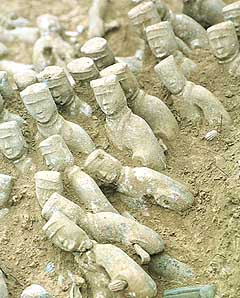
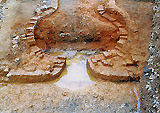
Weishan Mountain rises above the plains in the western part of Zhangqiu in east China's Shandong Province. Here archaeologists found three burial pits in close proximity (there had once been a fourth, but it had not survived) together with 30 tombs and three pottery kilns. The artifacts they discovered included a large number of colored pottery chariot, horse and guard-of-honor figures. All three pits lie on a north south axis.
Pit-1 is 9.7 meters long and 1.9 meters wide. Its terracotta warriors are deployed frozen in time, providing an armed escort for an ancient aristocratic trip. The relics of this scene include 173 pottery figures, 56 horses, 4 pottery carriages and more than 90 shields.
Pit-2 is on a rather smaller scale. It once held eleven wooden boxes of treasures but most of the relics have long since decayed. However four of the boxes have yielded up a pottery carriage, a horse and some human figures, mostly female. This has provided an insight into the construction and use of horse drawn carriages. As a bonus for the experts in the field, these artifacts had been painted and still retain their colors sufficiently to provide important new sources for research into the costumes worn back in the Han Dynasty.
Pit-3 yielded up five pottery chariots, some with one and the others with two shafts. Apart from the axles and canopy poles, the chariots were made from fired pottery which has stood the passage of time well. Ancient chariots could have more than 100 component parts and these are significant finds in the study of Han Dynasty chariots.
Based on a study of the backfill and the materials discarded around them, the experts have been able to confirm that the three kilns were indeed those which were used for firing the chariots, horses and figurines. Broken terracotta warriors and a large number of broken pottery figurines together with the moulds used in the production of the chariots and horses will all provide a further resource of research materials for future study.
Investigations into a tomb on top of Weishan Mountain have revealed information on its shape, structure and scale. On the northern slope of the mountain, the tombs there and the pits that accompany them have also been giving up their secrets. Besides burial goods, many weapons have also been found. These include one particular crossbow in which part of the operating mechanism had been embellished with designs inlaid in gold and silver.
From an analysis of the pottery and funerary objects, archaeologists have been able to conclude that the terracotta warrior pits and earthenware kilns belonged to the early or middle period of the Western Han Dynasty. The materials obtained are of significance to the study of the Jinan Kingdom in the Han Dynasty.
6. Ink-stone washing pond and tomb in Linyi, Shandong Province
Excavated by: Shandong Provincial Institute of Culture Relics and Archaeology and Linyi Culture Bureau.
Team Leader: Zheng Tongxiu.
Era: Western Jin Dynasty (265 - 316).
Wang Xizhi was the greatest and most revered calligrapher in China. The pool he is said to have used for washing his brushes and ink-stones is known as the Xiyan (ink-stone washing) Pool. Many of today's calligraphers, both professional and amateur, find themselves drawn to it along with other admirers of Wang Xizhi.
Early in 2003, residents of Wang's hometown, Linyi County of east China's Shandong Province, decided to give the calligrapher's former residence a facelift. This was to be part of their contribution towards the preparations for a local festival to be held that October to celebrate the 1,700th anniversary of Wang's birth. Then one day in May, a worker struck something hard with his shovel that turned out to be long-buried brickwork. And so the modern world found two previously unknown ancient brick tombs beside the pool.
That same day, archeologists and county officials rushed to the site. What they found lying buried some 30 meters apart were the biggest and best preserved tombs of the Han (206 BC - AD 220) and Jin (AD 265 - 420) dynasties ever discovered in Shandong. Built like houses at ground level they had stone-built entrances but were otherwise entirely of brickwork.
One of the tombs turned out to be the last resting place of three children who had lived their young lives in the days of the Jin Dynasty (265 - 420). It is the only well-preserved, brick-built tomb to have escaped the work of the grave-robbers, so far discovered in Shandong Province. Its two rooms were to yield up the province's greatest single find of relics from a Jin burial.
The archaeologists excavated more than 250 artifacts from this one tomb. They found precious relics worked in antiquity in bronze, porcelain, pottery, lacquer, iron and gold. The world of archaeology has listed some of these treasures alongside the finest cultural relics to be found in recent years.
One particularly striking item is a pottery container in the shape of a man in armor riding on a lion. A long forgotten artist fashioned this piece in fine detail. He rendered the bearded rider staring straight ahead with large deep-set eyes and gave him a prominent nose. His lion held its head high, a fierce looking beast with piercing eyes and bared teeth.
This was the first time that the province's archaeologists had recovered so many Jin tomb-goods of such value. What's more, sources in the Shandong Provincial Archaeological Research Institute, which carried out the excavation along with the Linyi Cultural Bureau, say that Jin Dynasty tombs this big are rarely discovered anywhere in China.
The other tomb had one room with a broad corridor in front and is the biggest single-chambered tomb to be found in Shandong. Although it had been plundered twice it remained structurally sound and still held more than twenty relics.
7. North Sima Gate, Zhaoling Mausoleum, Shaanxi Province.
Excavated by: Shaanxi Provincial Institute of Culture Relics and Archeology.
Team Leader: Zhang Jianlin.
Eras: Tang (618 - 907) and Qing (1644 - 1911) dynasties.
When Emperor Taizong (Li Shimin) fell ill and died in 649 he was taken to his last resting place in the Zhaoling Mausoleum, which he has shared down the years with his Empress Wende. He was the second emperor of the Tang Dynasty.
Zhaoling was built sitting on top of Mt. Jiuzhong, 20 km northeast of Liquan County, in Shaanxi Province, its major features being the Scarlet-Bird Gate and the Sacrificial Hall to the south; the Sacrificial Altar, North Sima Gate and residences to the north and to the southwest the Imperial City with most of the buildings.
The Tang dynasty (618 - 907) is often referred to as a golden-age in which ancient Chinese civilization reached its zenith. However, researchers had little idea how a Tang royal mausoleum was laid out. They were to find significant new clues when they excavated at the Zhaoling Mausoleum. Their finds advanced the study of imperial burial rites and mausoleum architecture in ancient China, especially in the Tang dynasty.
It was in July of 2002 that staff of the Shaanxi Provincial Institute of Culture Relics and Archeology began to dig the site. Over the next two years they would excavate more than 5,100 square meters, uncovering relics mainly of the Tang and Qing dynasties.
They excavated a Tang Dynasty site 86 meters long by 61 meters wide. This site was symmetrical about the mid-line between a pair of ancient city gates. It held relics from both the inner and outer cities. Inside the city gates there were three house sites; one rectangular, one square and one constructed around a corridor. The outer-city sites comprised the city gates themselves and a rectangular house site lying beyond the gates.
They unearthed many examples of ancient building materials such as rectangular and square bricks and tiles, together with bricks and tiles of other shapes. There were eight steles of the Tang Dynasty and epitaphs from both the Ming and Qing dynasties. The site also yielded up stone statues of fourteen dukes and six Zhaoling bas-relief stone horses. This stone statuary is considered to be of great artistic merit.
Tang Taizong is generally considered as the most capable and able-minded of all the emperors. His reign saw the Tang Dynasty at its peak representing the most prosperous of China's ancient feudal societies. It was at the North Sima Gate at the Zhaoling Mausoleum that archaeologists were able for the first time to excavate intact the architectural components of an imperial mausoleum of the Tang Dynasty. The general arrangement of the site was symmetrical and its architectural features were clearly defined within boundary walls. This excavation has given the world of science a deeper understanding of the architecture and workings of a Tang imperial mausoleum.
8. Khitan Tomb at Tuerji Mountains in Tongliao, Inner Mongolia Autonomous Region
Excavated by: Inner Mongolia Autonomous Region Institute of Culture Relics and
Archaeology.
Team Leader: Ta La.
Era: Liao Dynasty (916 - 1125).
A chance discovery in a quarry led to the discovery of a tomb of the Khitan aristocracy. And it turned out to be the only the second large, well-preserved tomb from the Liao dynasty to be found so far in China.
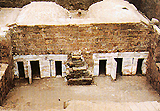
When archaeologists excavated the site from March through May 2003 they discovered a stone tomb comprising entrance tunnel, gates, corridor and main burial chamber with flanking side chambers.
They made their way into the tomb through a 48 meter long entrance tunnel. Some 10 meters high, it led to an underground courtyard of some 20 square meters. On one side of the courtyard they saw a slab of red and brown stone about 2.0 by 1.5 by 0.5 meters. Moving it aside they discovered wooden doors, still closed and sealed with an iron lock. Each door was decorated with three lines of golden nails, six nails to a line. Opening the doors, they found the main burial chamber extending to more than 10 square meters flanked by rectangular side chamber also secured by wooden doors.
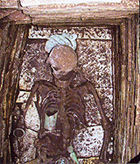
In the main chamber they found murals depicting the sun and the moon on each wall and the coffin, which was the most precious of all the relics. It rested undisturbed on a platform of eight colored supporting tiers where it had been placed all these long years ago. The red and black outer coffin, 2.3 meters long, 1.3 meters wide and 0.9 meters high, was decorated with images of cranes, phoenixes, peonies and clouds. The gilded cranes and peonies shone bright and wonderful for they had not lost their colors even though a millennium might have come and gone in the world outside. Wrapped in silk, the inner cypress wood coffin was some 1.6 meters long with colored golden dragons and flying phoenixes worked in bas-relief on the lid.
It held a young noblewoman who had been laid to rest wearing no fewer than 11 layers of clothing, one being a silk robe that was still intact after all these years. It carried a pair of phoenixes elaborately depicted in the style of the late Tang Dynasty.
The researchers discovered many copper, silver, gold, silk, lacquer and wood pieces. In the chamber, they found more than 200 mostly gilded, copper artifacts together with silver boxes and chopsticks, gold cups, glass cups, lacquer boxes and plates inlaid with silver, saddles overlaid with gold and silver and a quantity of silk fabrics.
Most of the gold and silver pieces were engraved with animal and human figures. Many jewels and other treasures had been interred, among them the most precious finds were two gold tablets inscribed with patterns of the sun and the moon. Indicative of a ritual significance, they had been placed one on each shoulder.
From a study of its shape and the relics it contained, the experts have established that this was a tomb of a Khitan noblewoman, in the style the style of the late Tang and early Liao Dynasties. Its colored coffin and coffin platform were each the first of their kind to be discovered in Inner Mongolia.
Archaeologists have found a rich variety of new research materials. They offer new insights into the history of the Khitans and the exchanges this ethnic group had with the late Tang and early Liao Dynasties. These finds are particularly valuable for they shed new light on the study of the society, customs, fashions and art of the Liao Dynasty.
9. Jining City Ruins, Inner Mongolia Autonomous Region.
Excavated by: Inner Mongolia Autonomous Region Institute of Culture Relics and Archeology.
Team Leader: Chen Yongzhi.
Era: Yuan Dynasty (1279 - 1368).
The engineers got quite a surprise when they stumbled upon the ruins of a Yuan dynasty city during a survey for highway construction in the Inner Mongolia Autonomous Region. The site just to the northeast of Jining lies on the route of the highway between there and Hohhot, the regional capital. They found the ruins in Tuchengzi Village of Bayan Tal County in the Qahar Right Wing Front Banner of the Ulanqab League. The site turned out to be especially significant for its ancient caches where archaeologists unearthed valuable pottery and porcelain items from the royal kilns of the Yuan dynasty.
This ancient walled city was built in 1192. It had a spring market serving an area that not only extended into today's Inner Mongolia Autonomous Region but also into Hebei and Shanxi Provinces. It was laid out to a rectangular plan 940 meters on the north-south axis and 640 meters wide. Two of its five to six meters thick walls were relatively well preserved and still 0.5 to 2.5 meters high, but two were gone.
The surviving east and west walls each had a single gate. In the northern end of the east wall, traders once entered the town through the square fortified entrance of the east-gate. The west-gate with its outer U-shaped defensive works stood central in the west wall. Inside the protection of the city walls, six roads ran north-south and seven ran east-west. These thirteen roads divided the town into 31 city blocks. In the north, the archaeologists found the foundations of what had once been large-scale buildings. To the south, they found the site of the ancient market.
Today there are farms where the ancient city once stood. From April of 2002 to November of 2003, experts from the Inner Mongolia Autonomous Region Institute of Culture Relics and Archeology worked to rescue the relics.
They excavated an area of 22,045 square meters that included many individual sites of interest including 91 house sites, 822 ash pits, 22 wells, 9 roads, 11 tombs, 4 coffins, 23 kilns and 34 caches of relics. Th
eir finds included more than 200 intact porcelain items, a further 7,416 porcelain items capable of being restored, 877 pottery items, ten items of gold and silver ware, 351 bronze-ware items, 268 iron goods, 456 bone items, 36,849 copper coins plus more than 2,000 stone and wooden items.
The various porcelain items were products of all nine of the countries most famous kilns of these days. Of special interest was a red-glazed spring vase, the first to be discovered in China.
Never before has porcelain from so many kilns been found in a site in the northern grasslands. The discovery of these relics has provided many fresh source materials for the study of the social, economic and cultural lives of the people of the Yuan Dynasty.
10. Imperial Kilns in Zhushan of Jingdezhen, Jiangxi Province.
Excavated by: School of Archeology and Museology of Peking University,
Jiangxi Provincial Institute of Culture Relics and Archaeology and the Jingdezhen Institute of Ceramic Archaeology.
Team Leader: Liu Xinyuan.
Eras: Ming (1368 - 1644) and Qing (1644 - 1911) Dynasties.
Jingdezhen, a city in east China's Jiangxi Province is often called the 'porcelain capital of China'. It has been renowned for its porcelain since the Song Dynasty (960-1279). It was here that archaeologists discovered two important sites during a 788 square meter excavation of an imperial kiln location that had been in use through the Ming (1368-1644) and Qing (1644-1911) dynasties. Some of the porcelain and pottery treasures they unearthed are so rare that it would not be easy to find their likes today even in museums or in private collections.
The relics unearthed included walls and kilns together with many houses and other buildings. There were six kilns grouped together, four of which had already been excavated. All the kilns had been built according to the same 'gourd-shaped' pattern. They stood facing west in a straight line. The distinctive features of these brick-built kilns are their gates, fire chambers, front compartments, back compartments and supporting walls.
'Gourd-shaped kiln' technology had been developed from 'dragon kiln' technology and had already been adopted in the folk kilns of the Yuan Dynasty in Jingdezhen. However this was the first site in which it had been found among the imperial kilns.
One of the sites contained relatively recent relics from the Jiangxi Porcelain Company of the late Qing Dynasty. Founded in 1902, the company was the first modern enterprise to be run cooperatively by officials and businessmen at Jingdezhen.
The older of the two sites comprised a group of kilns dating back to the early Ming Dynasty. This was the largest group of kilns at an imperial site ever discovered in China and is providing valuable evidence for research on imperial porcelain making techniques in those days.
One remarkable red glazed cup has attracted the attention of many archaeologists. It stands 10 centimeters tall and is 16 centimeters wide at the mouth. In the center it bears a seal in the zhuanshu style of calligraphy proclaiming it was 'Made in Reign of Yongle', a Ming emperor. It is by far the best example of its kind every found and the experts say that the quality of its vibrant red glaze could not be replicated using any known modern technique.
Covering an area of 50,000 square meters, Jingdezhen boasts the largest of the imperial porcelain workshops, with the longest history and which produced the most exquisite workmanship of all the feudal empires. So far over 3,000 treasured porcelain pieces have been restored from the fragments unearthed at Jingdezhen. Many other relics of great importance were also discovered. Altogether they are providing researchers with important new sources for their study of the porcelain making skills practiced in the imperial kilns of the early and middle Ming Dynasty.
(China.org.cn)