Population: 160,823
Major areas of distribution: Xinjiang and Heilongjiang
Language: Kirgiz
Religion: Islam
The Kirgiz ethnic minority, with a population of 160,823, finds 80 percent of its inhabitants in the Kizilsu Kirgiz Autonomous Prefecture in the southwestern part of the Xinjiang Uygur Autonomous Region. The rest live in the neighboring Wushi (Uqturpan), Aksu, Shache (Yarkant), Yingisar, Taxkorgan and Pishan (Guma), and in Tekes, Zhaosu (Monggolkure), Emin (Dorbiljin), Bole (Bortala), Jinghe (Jing) and Gonliu in northern Xinjiang. Several hundred Kirgiz whose forefathers emigrated to northeast China more than 200 years ago now live in Wujiazi Village in Fuyu County, Heilongjiang Province.
Origins and history
The Kirgiz language belongs to the Turkic subdivision of the Altaic family of languages. It borrowed many words from the Chinese language after the 1950s, and a new alphabet was then devised, discarding the old Arabic script and adopting a Roman alphabet-based script. The Uygur and Kazak languages are also used by the Kirgiz in some localities.
The forefathers of the Kirgiz lived on the upper reaches of the Yenisey River. In the mid-sixth century AD, the Kirgiz tribe was under the rule of the Turkic Khanate. After the Tang Dynasty (618-907) defeated the Eastern Turkic Khanate, the Kirgiz came into contact with the dynasty and in the 7th century the Kirgiz land was officially included in China's territory.
From the 7th to the 10th century, the Kirgiz had very frequent communications with the Han Chinese. Their musical instruments – the drum, sheng (a reed pipe), bili (a bamboo instrument with a reed mouthpiece) and panling (a group of bells attached to a tambourine) – showed that the Kirgiz had attained quite a high level of culture. According to ancient Yenisey inscriptions on stone tablets, after the Kirgiz developed a class society, there was a sharp polarization and class antagonism. Garments, food and housing showed marked differences in wealth and there were already words for "property," "occupant," "owner" and "slave."
During the Liao and Song dynasties (916-1279), the Kirgiz were recorded as "Xiajias" or "Xiajiaz". The Liao government established an office in the Xiajias area. In the late 12th century when Genghis Khan rose, Xiajias was recorded in Han books of history as "Qirjis" or "Jilijis," still living in the Yenisey River valley. From the Yuan Dynasty (1206-1368) to the Ming Dynasty (1368-1644), the Jilijis, though still mainly living by nomadic animal husbandry, had emigrated from the upper Yenisey to the Tianshan Mountains and become one of the most populous Turkic-speaking tribal groups. After the 15th century, though there were still tribal distinctions, the Jilijis tribes in the Tianshan Mountains had become a unified entity.
In the early Qing Dynasty (1644-1911), the Kirgiz, who had remained in the upper Yenisey River reaches, emigrated to the Tianshan Mountains to live together with their kinfolk. Many then moved to the Hindukush and Karakorum Mountains. At this time, some Kirgiz left their homeland and emigrated to Northeast China. In 1758 and 1759, the Sayak and Sarbagex tribes of Eastern Blut and the Edegena tribe of Western Blut, and 13 other tribes – a total of 200,000 – entered the Issyk Kul pastoral area and asked to be subjected to the Qing.
The Kirgiz played a major role with their courage, bravery and patriotism in the defense of modern China against foreign aggression.
The Kirgiz and Kazaks assisted the Qing government in its efforts to crush the rebellion by the nobility of Dzungaria and the Senior and Junior Khawaja.
They resisted assaults by the rebellious Yukub Beg in 1864, and when the Qing troops came to southern Xinjiang to fight Yukub Beg's army, they gave them assistance.
However, under the pretext of "border security," the Kuomintang regime in 1944 ordered the closing of many pasturelands, depriving the Kirgiz herdsmen of their livelihood. As a result, the Puli Revolution broke out in what is now Taxkorgan Tajik Autonomous County and part of the Akto area, and formed a revolutionary government. This revolution, together with uprisings in Ili, Tacheng and Altay, shook the Kuomintang rule in Xinjiang. More than 7,000 people took part in the Puli Revolution, the majority being Kirgiz, Tajiks and Uygurs.
Past socio-economic conditions
Before the founding of the People’s Republic of China in 1949, the Kirgiz derived their main revenue from livestock breeding, which was entirely at the mercy of nature. About 15 percent of the population engaged in farming, which was done in a very primitive way: a slash-and-burn method, without deep ploughing and fertilizer application. The handicraft industry was undeveloped and remained but a household undertaking. There were workshops making horse gear, carpets, felt cloth, fur hats and knitting wool. Cooking utensils, knives, tea, tobacco and needles had to be bought with animals or animal by-products. Hunting was another important sideline occupation.
The long-standing feudal patriarchal system left a deep impact upon Kirgiz economic life. Before 1949, 10 percent of the population owned 70 percent of the livestock. The masses of herdsmen owned very few or none of the domestic animals and had to work for the herd owners and farm landlords.
Once a man was hired, his whole family had to graze domestic animals, milk cows, shear wool, weave and cook for the herd owner in return for only two or three sheep a year plus food and clothing.
In the farming area, the landlord class plundered the poor peasants through labor hiring, land and water rent, and usury. Exploitation by religious leaders was also severe. The land owned by the Islamic clergy had to be tilled by peasants without pay and the taxes exacted by them accounted for 20 percent of an average peasant's annual income.
The Kirgiz tribal organization at that time was as follows: a major tribe had a number of sub-tribes, not necessarily herding in the same locality; each sub-tribe was composed of a number of "Ayinle," or clans; an "Ayinle" of five to ten families was a production unit as well as a traditional social organization; within the "Ayinle" there were customary relations of exploitation under the cover of "mutual clan assistance."
The ties between tribes were very loose, and there were generally no relations of dependence. The tribal chiefs, mostly big herd owners, wielded a certain degree of political power. The rulers of the Chinese dynasties throughout history invariably tried to accelerate and worsen the contradictions among the tribes so that they could "divide and rule."
Life style
In the first half of the 18th century, most of the Kirgiz in Xinjiang believed in Islam. Those in Emin (Dorbiljin) County in Xinjiang and Fuyu County in Heilongjiang, influenced by the Mongols, upheld Lamaism while retaining some Shamanistic legacies: Shamanistic "gods" were invited on occasions of sacrificial ceremonies or illnesses and the Shamanistic Snake God was worshipped.
The Kirgiz material life is still closely related to animal husbandry; garments, food and dwellings all distinctively feature nomadism.
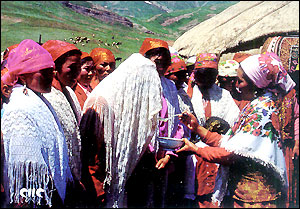
Men wear white round-collared shirts trimmed with lace and covered by a sheepskin jacket or a blue collarless, long cloth gown. Some wear camel wool fabrics with the sleeves in fringed black cloth. Normally, a rawhide belt is worn at the waist, attached to which is a knife and a flint for making fire. Some sport jackets with a standing collar and front buttons. They wear loose trousers and high boots. A characteristic Kirgiz shoe is made of rawhide. Throughout the year, all men, old or young, wear round corduroy caps in green, purple, blue or black and covered by a high, square-topped animal skin or felt hat with a rolled-up brim. The inside of the animal skin hat is bordered with black velvet.
Kirgiz women wear loose collarless jackets with silver buttons down the front. The long, pleated skirt is bordered with fur. Some wear dresses with the skirt pleated in the lower part, and covered with a black vest. Young women like red dresses and skirts, red velvet round caps or red otter skin hats decorated with pearls, tassels and feathers. While young women prefer red or green scarves, the elderly ones like white kerchiefs. Some of women's high boots are embroidered. Unmarried girls wear their hair in many small plaits, reduced to two after marriage. The pigtails are decorated with silver chains, coins or keys interlinked with a chain of pearls. Bracelets, earrings, necklaces and rings are made of silver. Girls in some areas wear on their chests round silver pieces carved with patterns.
The diet of the Kirgiz herdsmen mainly consists of animal byproducts, with some cabbages, onions and potatoes. They drink goat's milk, yogurt and tea with milk and salt. Rich herdsmen mainly drink cow's milk and eat beef, mutton, horse and camel meat, wheat flour and rice. They store butter in dried sheep or cattle stomachs. All tableware is made of wood.
The tents are made of felt, generally square in shape, fenced around with red willow stakes. The tent frame is first covered with a mat of grass and then a felt covering with a one-meter-square skylight, to which a movable felt cover is attached. The tent is tied down with thick ropes to keep it steady in strong winds and snowstorms.
The nomad Kirgiz live on the plains near rivers in summer and move to mountain slopes with a sunny exposure in winter. The settled Kirgiz mostly live in flat-roofed square mud houses with windows and skylights.
The Kirgiz family is generally composed of three generations, with married sons living with their parents. Marriage used to be arranged by the parents, sometimes even before birth -- this was called "marriage arrangement at pregnancy." Traditional courtship starts when the bridegroom calls on the bride's family with a roasted sheep. The relatives of the bride then tie the couple to posts in front of the tent. They will be released only after the father and brothers of the bridegroom ask for "mercy" and present gifts. The wedding is presided over by an imam who cuts a baked cake into two, dips the pieces in salt water and puts them into the mouths of the newly-weds as a wish for the couple to share weal and woe and be together for ever. The bridegroom then takes the bride and her betrothal gifts back to his home.
There is distinct division of labor at home: the men herd horses and cattle, cut grass and wood and do other heavy household chores, while the women graze, milk and shear the sheep, deliver lambs, process animal by-products and do household chores. Before liberation, the male was predominant and decided all matters of inheritance and property distribution. When the son got married, he was entitled to a portion of the family property which was usually inherited by the youngest son. Women did not have the right to inherit. The property of a childless male was inherited by his close relatives. When there is a funeral, all relatives and friends attend, wearing black clothing and black kerchiefs.
The Kirgiz are very hospitable and ceremonial. Any visitor, whether a friend or stranger, is invariably entertained with the best – mutton, sweet rice with cream and noodles with sliced mutton. Offering mutton from the sheep's head shows the highest respect for the guest. At the table, the guest is first offered the sheep tail fat, shoulder blade mutton and then the mutton from the head. The guest should in the meantime give some of what is offered back to the women and children at the dinner table as a sign of respect on the part of the visitor. Anyone who moves his tent is entertained by his old and new neighbors as tokens of farewell and welcome.
In the Kirgiz calendar, similar to that of the Han people, the years are designated as years of the rat, ox, tiger, rabbit, fish, snake, horse, sheep, fox, chicken, dog and pig. The appearance of the new moon marks the beginning of a month, 12 months form a year and 12 years is a cycle. At the beginning of the first month of the year, the Kirgiz celebrate a festival similar to the Spring Festival. There are also Islamic festivals. On major festivals and summer nights, old and young, men and women, gather on the pasturelands for celebrations: singing, dancing, ballad-singing, story-telling and games which include competing to snatch up a headless sheep from horseback, wrestling, horse racing, wrestling on horseback, catching objects from racing horses, horseback shooting, tug-of-war and swinging.
The Kirgiz are renowned singers and dancers. The songs with rich content include lyrics, epics and folk songs. There are many kinds of musical instrument. A three-stringed instrument is uniquely Kirgiz.
Many poems, legends, proverbs and fables have been handed down among the Kirgiz for centuries. The epic, "Manas," is virtually an encyclopedia for the study of the ancient Kirgiz. It has 200,000 verses describing, through the deeds of several generations of the Manas family, the bravery and courage of the Kirgiz in resisting plunder by the nobles of Dzungaria and their aspirations for freedom. It is also a mirror of the habits, customs and ideas of the Kirgiz of the time.
Kirgiz paintings and carvings feature animal horn patterns for decoration on yurts, horse gear, gravestones and buildings. The Kirgizs like bright red, white and blue colors. So their decorative art is always brightly colored and eye-pleasing, and full of freshness and vitality.
(China.org.cn June 21, 2005)