Population: 8,940,116
Major area of distribution: Guizhou, Hunan, Yunnan, Guangxi, Sichuan, Hainan and Hubei
Language: Miao
Religion: Polytheism
With a population of 8.9 million, the Miao people form one of the largest ethnic minorities in southwest China. They are mainly distributed across Guizhou, Yunnan, Hunan and Sichuan provinces and Guangxi Zhuang Autonomous Region, and a small number live on Hainan Island in Guangdong Province and in southwest Hubei Province. Most of them live in tightly-knit communities, with a few living in areas inhabited by several other ethnic groups.
On the Yunnan-Guizhou Plateau and in some remote mountainous areas, Miao villages are comprised of a few families, and are scattered on mountain slopes and plains with easy access to transport links.
Much of the Miao area is hilly or mountainous, and is drained by several big rivers. The weather is mild with a generous rainfall, and the area is rich in natural resources. Major crops include paddy rice, maize, potatoes, Chinese sorghum, beans, rape, peanuts, tobacco, ramie, sugar cane, cotton, oil-tea camellia and tung tree. Hainan Island is abundant in tropical fruits.
History
As early as the Qin and Han dynasties 2,000 years ago, the ancestors of the Miao people lived in the western part of present-day Hunan and the eastern part of present-day Guizhou. They were referred to as the Miaos in Chinese documents of the Tang and Song period (AD618-1279).
In the third century AD, the ancestors of the Miaos went west to present-day northwest Guizhou and south Sichuan along the Wujiang River. In the fifth century, some Miao groups moved to east Sichuan and west Guizhou. In the ninth century, some were taken to Yunnan as captives. In the 16th century, some Miaos settled on Hainan Island. As a result of these large-scale migrations over many centuries the Miaos became widely dispersed.
Such a wide distribution and the influence of different environments has resulted in marked differences in dialect, names and clothes. Some Miao people from different areas have great difficulty in communicating with each other. Their art and festivals also differ between areas.
Language
The Miao language belongs to the Miao-Yao branch of the Chinese-Tibetan language family. It has three main dialects in China – one based in west Hunan, one in east Guizhou and the other in Sichuan, Yunnan and part of Guizhou. In some places, people who call themselves Miao use the languages of other ethnic groups. In Chengbu and Suining in Hunan, Longsheng and Ziyuan in Guangxi and Jinping in Guizhou, about 100,000 Miao people speak a Chinese dialect. In Sangjiang in Guangxi, over 30,000 Miaos speak the Dong language, and on Hainan Island, more than 100,000 people speak the language of the Yaos. Due to their centuries of contacts with the Hans, many Miaos can also speak Chinese.
Custom
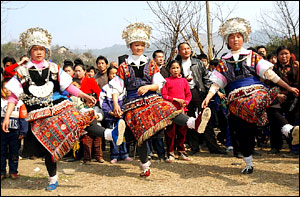
Their clothing has distinctive features which vary from place to place. In northwest Guizhou and northeast Yunnan, Miao men usually wear linen jackets with colorful designs, and drape woolen blankets with geometric patterns over their shoulders. In other areas, men wear short jackets buttoned down the front or to the left, long trousers with wide belts and long black scarves. In winter, men usually wear extra cloth leggings known as puttees. Women's clothing varies even from village to village. In west Hunan and northeast Guizhou, women wear jackets buttoned on the right and trousers, with decorations embroidered on collars, sleeves and trouser legs. In other areas, women wear high-collared short jackets and full- or half-length pleated skirts. They also wear various kinds of silver jewelry on festive occasions.
In southeast Guizhou, west Hunan, Rongshui in Guangxi and on Hainan Island, the Miaos eat rice, maize, sweet potatoes and millet as staple foods. In northwest Guizhou, Sichuan and northeast Yunnan, they mainly eat maize, potatoes, buckwheat and oats. In southeast Guizhou, Miao cooks make a sour mixture of glutinous rice and vegetables by packing them tightly into jars for up to two months. Before 1949, for lack of salt, many Miao people had to flavor their food with pepper or a sour taste. Many even had to live on wild vegetables.
Because timber resources are plentiful in most Miao areas, houses are usually built of wood, and roofed with fir bark or tiles or are thatched. In central and western Guizhou, houses are roofed with stone slabs.
Houses vary greatly in style. In mountainous areas, they are usually built on slopes and raised on stilts. Animals are kept under the stilted floors. In the Zhaotong area in Yunnan and on Hainan Island, most Miaos live in thatched huts or "branch houses," made of woven branches and twigs or bamboo strips plastered with mud.
The typical Miao family is small and monogamous. Aged parents are usually supported by their youngest son.
In some areas, a son's name is followed by his father's, but generally a Miao person uses only his or her own name. Influenced by the Han feudal patriarchal clan system, the Miaos made efforts to maintain their family pedigrees, built ancestral halls and adopted words in their names to indicate their position in the family hierarchy.
Marriages are usually arranged by parents, but unmarried young men and women have the freedom to court. Mass courting occasions sometimes take place during holidays, when young women from a host village gather to sing antiphonal love songs with young men from neighboring villages. If a couple are attracted to each other, they exchange love tokens. But they must still win the approval of their parents before they can marry.
In Chuxiong, Yunnan Province, the practice of setting up public courting houses for unmarried men and women prevailed until a few decades ago. After a day's work, they would visit these houses to sing, dance and court with their partners. The Miaos there also practiced the custom of "kidnapping brides." If the kidnapped girl consented to an offer of marriage, a grand wedding feast was held. If she did not, she was free to go.
Different Miao communities celebrate different festivals. Even the same festivals may fall on different dates. In southeast Guizhou and Rongshui County in Guangxi, the Miao New Year festival is celebrated on "Rabbit Day" or "Ox Day" on the lunar calendar. The festivities include beating drums, dancing to the music of a lusheng (a wind instrument), horse racing and bull-fighting. In counties near Guiyang, people dressed in their holiday best gather at the city's largest fountain on April 8 of the lunar year to play lusheng and flute and sing of the legendary hero, Yanu.
In many areas, the Miaos have Dragon Boat festivals and Flower Mountain festivals (May 5), Tasting New Rice festivals (between June and July), Pure Brightness festivals and the Beginning of Autumn festivals. In Yunnan, "Stepping over Flower Mountains" is a popular festivity for the Miaos. Childless couples use the occasion to repeat vows to the god of fertility. They provide wine for young people, who sing and dance under a pine tree, on which hangs a bottle of wine. Young men and women may fall in love on this occasion, and this, it is hoped, will help bring children to the childless couples.
The Miaos used to believe in many gods, and some of their superstitious rituals were very expensive. In west Hunan and northeast Guizhou, for instance, prayers for children or for the cure of an illness were accompanied by the slaughter of two grown oxen as sacrifices. Feasts would then be held for all the relatives for three to five days.
Culture
The Miao have a highly diversified culture developed from a common root. They are fond of singing and dancing, and have a highly-developed folk literature. Their songs, which do not rhyme and vary greatly in length from a few lines to more than 15,000, are easy to understand and are very popular among the Miaos.
The lusheng is their favorite musical instrument. In addition, flutes, copper drum, mouth organs, the xiao (a vertical bamboo flute) and the suona horn are also very popular. Popular dances include the lusheng dance, drum dance and bench dance.
The Miaos create a variety of colorful arts and crafts, including cross-stitch work, embroidery, weaving, batik, and paper-cuts. Their batik technique dates back 1,000 years. A pattern is first drawn on white cloth with a knife dipped in hot wax. Then the cloth is boiled in dye. The wax melts to leave a white pattern on a blue background. In recent years, improved technology has made it possible to print more colorful designs, and many Miao handicrafts are now exported.
Socio-economic structure
Miao areas differ in their scale of economic and educational development. Early Miao society went through a long primitive stage in which there were neither classes nor exploitation. Totem worship survived among Miao ancestors until the Jin Dynasty 1,600 years ago. By the Eastern Han Dynasty (AD 25-220), the ethnic minorities in the Wuxi area had begun farming, and had learned to weave with bark and dye with grass seeds, and trade on a barter basis had emerged. But productivity was still very low and tribal leaders and the common people remained equal in status.
Primitive Miao society changed rapidly between the third and tenth centuries AD Communal clans linked by family relationships evolved into communal villages formed of different regions. Vestiges of the communal village remained in the Miao's political and economic organizations until liberation in 1949. Organizations known as Men Kuan in the Southern Song Dynasty (1127-1279), and as Zai Kuan during the Qing Dynasty (1644-1911), were formed between several neighboring villages. Kuan leaders were elected by its members, who met regularly. Rules and regulations were formulated by all members to protect private property and maintain order. Anyone who violated the rules would be fined, expelled from the community or even executed. All villages in the same Kuan were dutybound to support one another, or else were punished according to the relevant rule.
By the end of the Tang Dynasty (618-907), the Miaos had divided into different social classes. Communal leaders had authority over land, and frequent contacts with the Hans and the impact of their feudal economy gave impetus to the development of the Miao feudal-lord economy. The feudal lords began to call themselves "officials," and called serfs under their rule "field people."
During the Song Dynasty (960-1279), some upper class Miaos were appointed prefectural governors by the imperial court, thus providing a political guarantee for the growth of the feudal economy. Under the rule of feudal lords, the ordinary people paid their rent in the form of unpaid service. The lords had supreme authority over them, and could punish them and bring them to trial at will. If feuds broke out between lords, the "field people" had to fight the battles.
By this time, agriculture and handicrafts had been further developed. Grain was traded for salt between prefectures, and Xi cloth was sent as a tribute to the imperial court. High-quality iron swords, armor and crossbows came into use. By the end of the Song Dynasty, the Miaos in west Hunan had mastered the technique of iron mining and smelting. Textiles, notably batik, also flourished. Regular trade sprung up between the Miaos and Hans.
The Miao feudal-lord economy reached its peak and began to decline during the Ming Dynasty (1368-1644). A landlord economy had taken shape and was in its early stage of development. In 1502, the Ming Court began to abolish the rule of Miao feudal lords, and appointed officials who were subject to recall. During the early years of the Qing Dynasty, these measures were applied to many Miao areas, contributing a great deal to the disintegration of the feudal-lord system and the growth of a landlord economy. In west Guizhou and northwest Yunnan, however, some lords still retained their power, and the feudal-lord economy continued to exist there until the end of the Qing Dynasty.
After 1951, a number of Miao autonomous divisions were established in Guizhou, Yunnan, Guangxi, Guangdong, and Hunan. Most of these autonomous divisions have taken the form of multiethnic autonomy, as the Miaos have for a long time lived harmoniously with the Tujia, Bouyei, Dong, Zhuang, Li and Han peoples.
In some Miao areas, before autonomous authorities were established, priority was given to such things as the election of delegates to the People's congress and the training and appointment of minority administrative staff. Now a large number of Miao people have been promoted to leading posts. In Northwest Guizhou Autonomous Prefecture alone, Miaos account for 68 percent of the district and township officials.
Before 1949, textiles, iron forging, carpentry, masonry, pottery, alkali making and oil pressing were the only industries in the area. After the birth of the People’s Republic of China, many factories and hydroelectric stations were built. Now electricity is widely used for lighting, irrigation and food processing.
In mountainous areas, the Miaos have built reservoirs, dug canals and created new farmland. They have also developed a diversified economy according to local conditions. As a result, grain production as well as oil, fiber and starch crops and medicinal herbs have all flourished. This has helped to open up new sources of raw materials and supplies for industry and commerce, and improved the Miao people's living standards.
Sheep raising has a long history in Weining Autonomous County, Guizhou, where 265,000 hectares of grassland and trees provide an ideal grazing area. Herds have grown rapidly as a result of the introduction of improved breeds and better veterinary services.
The construction of railways between Guiyang and Kunming, and between Hunan and Guizhou has boosted the development of the Miao areas along the routes. Before 1949, more than half the counties in Qiandongnan Autonomous Prefecture had no bus services.
Cultural, educational and public health provisions have also expanded rapidly. In 1984, there already were 23,000 teachers in Qiandongnan alone, of whom over half were of the Miao or Dong minorities. They set up schools in mountainous areas and brought education to the formerly illiterate mountain villages. Before 1949, the incidence of malaria was as high as 95 percent in Xinchi village in Ziyun County, Guizhou Province. But since liberation, the disease has been eradicated through massive health campaigns. This is giving rise to the rapid emergence of clean, hygienic and literate Miao villages.
(China.org.cn June 21, 2005)