Population: 8,923
Major area of distribution: Tibet
Language: Moinba
Religion: Lamaism
The Moinbas are scattered in the southern part of Tibet Autonomous Region. Most of them live in Medog, Nyingch and Cona counties.
They have forged close links with the Tibetan people through political, economic and cultural exchanges and intermarriage over the years. They share with the Tibetans the common belief in Lamaism and have similar customs and lifestyles.
Their language, which has many dialects, belongs to the Tibetan-Myanmese language family, and many of them can speak Tibetan.
Customs and habits
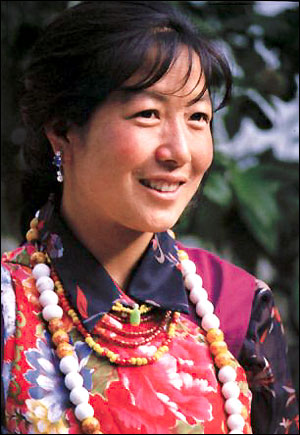
In Menyu area, men and women prefer to wear robes with aprons and black yak hair hats or caps. They wear soft-soled leather boots, which are decorated with red or black striped designs. Women usually wear white aprons, earrings, rings and bracelets. People in the subtropical Medog County dress differently. Women as well as men wear short or long jackets, and the women wear long striped skirts and various kinds of jewelry.
The Moinba's staple food includes rice, maize, millet and buckwheat. Maize and millet are ground and prepared to make porridge. Like the Tibetans, the Moinbas also eat zhamba (roasted qingke barley), butter tea and pepper.
Their homes are two- or three-story, herringbone-shaped houses of wood with bamboo or straw roofs. The second and third floors are used for living quarters and the first for livestock. They observe monogamy in marriage. Some are believers of primitive shamanism, while others are followers of Lamaism. Water burial, ground burial, sky burial and cremation are all used for their dead. They follow the Tibetan calendar and observe the same festivals as the Tibetans.
The Moinbas have composed many beautiful tunes and ballads over the centuries. Among their most popular folk songs are the "sama" and "dongsanba," which are similar to many Tibetan songs. Their dances are simple and dynamic.
Menyu area, at the foot of the Himalayas, enjoys abundant rainfall, swift rivers, beautiful landscape and fertile land, which bears rice, maize, buckwheat, qingke barley, winter wheat, soybeans and sesame. Virgin pine forests are inhabited by wild boars, bears, foxes and golden monkeys.
History
Various actions had been taken by Tibetan authorities over the centuries to consolidate their rule over Menyu area. The area became the hereditary manor of Tibetans' Zhuba Geju (faction) during the mid 14th and early 15th centuries. In the mid-17th century, the Fifth Dalai Lama united the whole of Tibet and established the yellow sect of Buddhism as the dominant religion. He sent two of his disciples to Menyu to set up an office there. They enlarged the Dawang Monastery and began the integrated rule of religion and politics over the area.
In the mid-19th century, the Resident Minister of the Qing court in Tibet and the Tibet local government also posted two officials in Menyu to administer their rule and to give the monastery special administrative powers. Each year, the Tibet local government would send officials to the area to levy taxes, purchase rice and administer trading of salt and rice. Local officials appointed by the government were responsible for passing on orders, settling local disputes, and running village and township affairs.
The Moinbas became poverty-stricken under a system of feudal serfdom following the establishment of the rule of the Zhuba Geju (faction) over them in the 14th century. Traces of this primitive system remained until the liberation of Tibet.
They used the simple slash-and-burn method of agriculture. Fields were left to nature's mercy, and productivity was very low.
Hunting was an important part of survival. Game was distributed among villagers, with the hunters getting double portions. Some game was bartered for grain and other necessities.
The three types of manorial lords – the Tibet local government, the nobility and the monastery – each possessed large areas of land, forests, pastures and other means of production, while the Moinbas were made serfs and slaves.
There were two categories of serfs – the tralpa and the dudchhung. The tralpa rented small plots of land from the manorial lords, and paid rent in cash and kind, such as butter tea, timber, dyes and charcoal, in addition to doing unpaid labor. The dudchhung were mostly immigrants from central Tibet and border areas, and were at the bottom of the social ladder. They were the poorest and most cruelly oppressed of all. They had to pay heavy taxes and do heavy unpaid labor. Some had to rent land from the tralpa.
Today, vestiges of this old society can still be found in certain clans and villages, where part of the land, pastures, hills and forests are communally owned. Villagers can reclaim wasteland and chop wood and bamboo free of charge at the consent of their headman. Outsiders who want to do the same must also have the headman's permission.
The Moinbas lived like beasts of burden under the cruel oppression and exploitation of the three manorial lords. They were forced to do unpaid labor for as many as 110 days a year. Many died as a result, and some hid deep in forests to escape.
On many occasions they revolted against this criminal rule. They sabotaged communication links and refused to do unpaid labor or pay taxes.
New life
Tibet was peacefully liberated in 1951, and democratic reforms were introduced in 1959 after a counter-revolutionary armed rebellion was put down. During the action, the Moinbas joined the Tibetan people in support of the People's Liberation Army. Since then, they have shaken off their yoke and begun a new life. The days of having to survive on wild fruits and nuts, wearing animal skins and banana leaves and living in caves and forests have gone forever. Agricultural output has risen considerably through the development of hillsides, introduction of irrigation systems and superior crop strains, and ending of the traditional slash-and-burn farming method.
Now the Moinbas have moved into bright, new electric-lit houses. Narrow footpaths and single log bridges have been replaced by roads and suspension bridges.
The Moinba people now have many schools for both children and adults, and have trained their first generation of teachers, accountants and other professionals. Some young people are studying at the Tibet Ethnic Minorities' Institute in Lhasa and the Central Ethnic Minorities' Institute in Beijing. Men and women of Moinba origin are working as administrators at various levels of government.
(China.org.cn June 21, 2005)