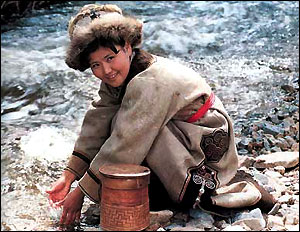
Population: 8,196
Major areas of distribution: Inner Mongolia and Heilongjiang
Language: Oroqen and Han
Religion: Shamanism
People of the Oroqen ethnic group dwell in the forests of the Greater and Lesser Hinggan Mountains in northeast China which abound in deer and other wild beasts the Oroqens hunt with shot-guns and dogs. The Oroqens, who lived in a primitive communal society four and a half decades ago, have leap-frogged several historical stages to a socialist society in the years following the founding of the People's Republic in 1949.
With no written script of their own, the Oroqens have a spoken language belonging to the Tungus branch of the Manchu-Tungusic group of the Altaic language family. Most of them have learned to read and write the language of the Hans, the biggest ethnic group in China.
The Oroqen population, which stood at 4,000 in 1917, dropped to 3,700 in 1943. A census taken in 1953 showed that their number had plummeted to 2,250. The population has started to grow slowly but steadily since, and the census in 1982 showed that their number has reached 4,100. The 1990 national census showed 7,000.
Most of the Oroqens live in the 55,000-square-kilometer Oroqen Autonomous Banner in the Greater Hinggan Mountains. Others have their home in several localities in Inner Mongolia and Heilongjiang Province. Situated in Inner Mongolia's Hulunbuir League, the Oroqen Autonomous Banner is 97 percent forested land. The seat of the autonomous government is Alihe, a rising town with highways, railways, cinemas, hotels, department stores, restaurants, electric lighting and other modern amenities.
History
For generations the Oroqens had lived a life of hunting and fishing in the forests. They went on hunting expeditions in groups, and the game bagged was distributed equally not only to those taking part in the hunt, but also to the aged and infirm. The heads, entrails and bones of the animals killed were not distributed but were cooked and eaten by all. Later, deer antlers, which fetched a good price, were not distributed but went to the hunters who killed the animals.
On the eve of the founding of the PRC in 1949, polarization was quite marked in some localities where horses, on which Oroqens rode on hunting trips, belonged to individuals. The rich owned a large number of horses and the poor owned a few. Horses were hired out to those hunters who needed them, and payment took the form of game sent to horse owners. Such a practice gradually developed into rent and exploitation of man by man.
The Oroqens are an honest and friendly people who always treat their guests well. People who lodge in an Oroqen home would often hear the housewife say to the husband early in the morning: "I'm going to hunt some breakfast for our guests and you go to fetch water." When the guests have washed, the woman with gun slung over her shoulders would return with a roe back. The Oroqens are expert hunters. Both the males and females are sharp shooters on horseback. Boys usually start to go out on hunting trips with their parents or brothers at the age of seven or eight. And they would be stalking wild beasts in the deep forest all on their own at 17. A good hunter is respected by all and young maidens like to marry him.
Horses are indispensable to the Oroqens on their hunting expeditions. Hunters ride on horses, which also carry their family belongings and provisions as well as the game they killed over mountains and across marshes and rivers. The Oroqen horse is a very sturdy breed with extra-large hooves that prevent the animal from sinking into marshland.
Oroqen women, who also hunt, show marvelous skill in embroidering patterns of deer, bears and horses on pelts and cloth that go into the making of head gears, gloves, boots and garments. Oroqen women also make basins, bowls, boxes and other objects from birch barks. Engraved with various designs and dyed in color, these objects are artistic works that convey the idea of simplicity and beauty. Taught by their mothers while still very young to rub fur, dry meat and gather fruit in the forest, Oroqen girls start to do household work at 13 or 14. Pelts prepared by Oroqen women are soft, fluffy and light, and they are used in making garments, hats, gloves, socks and blankets as well as tents.
The Oroqens, who led a primitive life, used to have many taboos. One prohibited a woman from giving birth in the home. She had to do that in a little hut built outside the house in which she would be confined for a month before she could return home with her newborn.
Customs
The Oroqens are a race of dancers and singers. Men, women and children often gather to sing and dance when the hunters return with their game or at festival times.
With a rich and varied repertory of folk songs, the Oroqens sing praises of nature and love, hunting and struggles in life in a lively rhythm. Among the most popular Oroqen dances are the "Black Bears Fight" and "Wood Cock Dance," at which the dancers execute movements like those of animals and birds. Also popular is a ritual in which members of a clan gather to perform dances depicting events in clan history.
"Pengnuhua" (a kind of harmonica) and "Wentuwen" (hand drum) are among the traditional instruments used. Played by Oroqen musicians, these instruments produce tunes that sound like the twittering of birds or the braying of deer. These instruments are sometimes used to lure wild beasts to within shooting range.
The Oroqens have many tales, fables, legends, proverbs and riddles that have been handed down from generation to generation.
Being Shamanists or animists, the Oroqens worship nature and their ancestors, and believe in the omnipresence of spirits. Their objects of worship are carefully kept in birch-bark boxes hung high on trees behind their tents.
The Oroqens have a long list of don'ts. For instance, they never call the tiger by its actual name but just "long tail," and the bear "granddad." Bears killed are generally honored with a series of ceremonies; their bones are wrapped in straw placed high on trees and offerings are made for the souls of dead bears. Oroqens do not work out their hunting plans in advance, because they believe that the shoulder blades of wild beasts have the power to see through a plan when one is made.
Wind burials are practiced by the Oroqens. When a person dies his corpse is put into a hollowed-out tree trunk and placed with head pointing south on two-meter high supports in the forest. Sometimes the horse of the deceased is killed to accompany the departing soul to netherworld. Only the bodies of young people who die of contagious diseases are cremated.
Monogamy is practiced by the Oroqens who are only permitted to marry with people outside their own clans. Proposals for marriage as a rule are made by go-betweens, sent to girls' families by boys' families.
The Oroqens originally peopled the region north of the Heilong River and south of the Outer Hinggan Mountains. But aggression and pillaging conducted by Tsarist Russia after the mid-17th century forced the Oroqens to migrate to the Greater and Lesser Hinggan Mountains. There were then seven tribes living in a clan commune society. Each clan commune called "Wulileng" consisted of five to a dozen families descended from a male ancestor. The commune head was elected. In the commune, which was then the basic economic unit of the Oroqens, all production tools were communally owned. The commune members hunted together, and the game bagged was equally distributed to all families.
The introduction of iron articles and guns and the use of horses during the Qing Dynasty (1644-1911) raised the productive forces of the Oroqens to a higher level. This gave rise to bartering on a bigger scale and the emergence of private ownership. That brought about profound social, economic changes. Individual families quit the clan commune and became basic economic units. The clan commune had disintegrated, though members of the same clan did live or hunt together in the same area. Organized under the Qing Dynasty's "eight banner system," the Oroqens were compelled to enlist in the armed forces and send fur to the Qing court as tributes. Most soldiers sent to fight in Xinjiang, Yunnan, Taiwan and other places lost their lives.
After the fall of the Qing Dynasty in 1911 came the rule of warlords who effected some changes in the administrative setup of the "eight banner system." Oroqen youths were dragged into "forest guerrilla units," and Oroqen hunters were forced to settle down to farm. Most of them later fled back to hunt in the forests. A few whom the warlords had made officers became landlords who hired Oroqen, Han, Manchu and Daur laborers to open up large tracts of land for crops.
The Japanese troops, who occupied northeast China in 1931, pulled down the cottages and smashed the farm implements of the remaining Oroqen farmers and drove them into the forests again. Oroqen youths were press-ganged into "forest detachments" officered by Japanese. The Japanese occupationists introduced opium smoking to ruin the health of the Oroqen people, some of whom were used in bacteria experiments. All this, coupled with incidence of epidemic diseases, had so decimated the Oroqen population that only some 1,000 of them remained at the time of the Japanese surrender in 1945.
Over a long period of time, the Oroqens had fought alongside other ethnic groups in China against Tsarist Russian and Japanese aggression to safeguard national unity.
New life after the founding of PRC
The Oroqen ethnic group was saved from extinction and a new life began to dawn for this ethnic minority in the years following the conclusion of the Anti-Japanese War in 1945. Shot-guns, cartridges and supplies of food-grain, clothes, cooking oil and salt were sent to the Oroqens by the government in the early days after the establishment of the People’s Republic of China. People sent by the government helped them to raise production as well as to set up local government.
Following the inception of the Oroqen Autonomous Banner on October 1, 1951, several autonomous townships were set up in places where the Oroqens live in compact communities. By 1981, government allocation for construction in these places had already amounted to 46 million yuan. Working at leading bodies at various levels are Oroqen functionaries.
While helping the Oroqens to promote hunting, the government made efforts to help them switch over to a diversified economy and to lead a settled life.
The building of permanent housing for the Oroqens got started in 1952 with government allocations. A dozen villages were built in the Heihe Area for 300 families that used to lead a wandering life in 51 widely-scattered localities. Another three villages were built for 150 families in 1958.
Taught by Han and Daur farmers, the Oroqens began to grow crops in 1956. And by 1975, the people in the autonomous banner became self-supporting in food-grain for the first time in Oroqen history.
With no industry whatsoever in the past, the autonomous banner has now established 37 factories and workshops turning out farm machinery, electric appliances, flour, powdered milk, furniture, leather, fur and candies. The banner also has built schools, department stores, hospitals, banks and cinemas.
All school-age children are enrolled in primary and middle schools. Every year a number of youngsters enter institutions of higher learning. The Oroqen people also have their own song and dance troupes, film projection teams, broadcast stations and clubs.
Diseases took a heavy toll in the old days and 80 percent of the women suffered from gynaecological troubles due to the lack of doctors and medicine and ignorance. They have been put under control with the help of mobile medical teams sent by the government, the launching of disease-prevention campaigns and the popularization of the knowledge of hygine. As a result the Oroqen population increased to 4,100 in 1982.
(China.org.cn June 21, 2005)