|
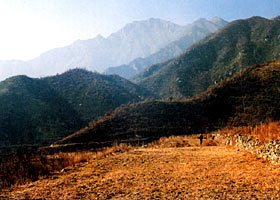
At the foot of Yunfeng Mountain, 10 kilometers northwest of Fangshan District seat to the southwest of Beijing, is the site of an ensemble of imperial mausoleums of the Kin Dynasty. With its capital in Beijing, the Kin regime ruled over a greater part of China through the reigns of nine emperors, covering 120 years.
Topography of Jinling, tombs of the Kin Dynasty
Originally as many imperial mausoleums were concentrated here as there were in the Ming Tombs and the East and West imperial tomb complexes of the Qing Dynasty. Its magnitude and historical and artistic values were not inferior to the Ming Tombs, but for many, many years its existence remained unknown to people. It was not known because the mausoleums were destroyed during the Ming Dynasty. Other than two mausoleums rebuilt early in the Qing Dynasty, whose remains can still be found, nothing remains of the others. All that is known is from a tablet inscription dated the 9th lunar month of the second year of the reign of Emperor Kang Xi (c.1664).
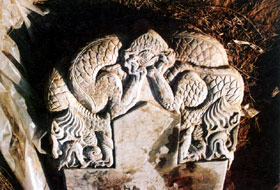
Carved stone tablet head at Jinling
The tablet was erected after renovation of the mausoleum halls of Kin emperors Tai Zu and Shi Zong by order of Emperor Kang Xi. Its inscription not only detailed why the Kin Dynasty mausoleums were destroyed and restored, but also refuted the Ming emperor's ignorant superstitious geomantic beliefs and denounced him for not reforming and administration which led to the loss of their country. Here is an excerpt:
Abiding by the rules of the former emperors ... I praise the illustrious kings of old and honor past emperors ... When our army had captured Liaoyang, the Ming Dynasty was deluded by geomancers (to believe) that our regime originated from the Bohai Sea and was vitally connected with the two mausoleums of the Kin Dynasty at Fangshan. In the first year (1621) of the reign of Tian Qi, the Ming Dynasty stopped its sacrifices at the Kin Dynasty mausoleums; in the second year, destroyed the mausoleums and cut the earth-pulse. In the third year, the Ming Dynasty built the Temple of the God of War at the place to suppress the spirits of the dead Kin emperors.
Since ancient times, the prosperity or decline of a nation has depended on whether it has benevolent rule. Heaven's omens are solely based on whether it is a good government or not. Good government thrives and bad government perishes, which has nothing to do with geomantic omens of mausoleums. At the last phase of the Ming Dynasty, political turmoil endangered the nation which was at the end of its destiny. Its emperors and ministers, fatuous and erroneous, did not seek to make changes, reform their rule and be diligent in attending to the welfare of the masses so as to bring back the favor of Heaven, but, credulously believing in untruths, shifted the calamity onto the mausoleums of another dynasty and destroyed them recklessly.
Afterwards ... popular sympathy was forfeited and their national destiny was doomed, (a destiny) not caused by geomantic omens; how could suppression of the spirits of the dead Kin Dynasty rulers and the destruction of their mausoleums save the Ming from turbulence and extinction? The holy kings in olden days buried skeletons and putrid carcasses of men, their kindness reaching to dry bones. The Ming emperors and ministers went so far as to destroy the imperial mausoleums of their preceding dynasty; their savagery and fallacy are indeed a derision for all time ....
From the passage above we know that this accumulation of Kin mausoleums was intentionally destroyed by the Ming ruling class during the last phase of their dynasty when it was on the verge of extinction, vainly hoping to save their dynasty by means of geomancy.
It can also be surmised that the early Qing Dynasty rebuilt only two main mausoleums because the others had been utterly destroyed and beyond recreation. But we can still learn from literature about the history and construction of the various mausoleums.
The Kin Dynasty was originally the Nüzhen tribe inhabiting the Changbai Mountains and the Heilongjiang River valley. In early I2th century, Aguda, leader of its tribal alliance (in fact, leader of the slave owners), defeated the Liao Dynasty and seized control over the Northeast and North China; he assumed the imperial title and was known to historians as Emperor Tai Zu.
After death, he was buried at first in Tailing Mausoleum west of Haigule City in the northeast and the mausoleum of his younger brother Emperor Tai Zong was originally also at Shangjing. In 1153, after Prince Hai Ling had moved his capital to Yanjing (or Zhongdu in the southwest corner of modern Beijing City), he removed their two mausoleums, and the ten mausoleums built beside them to Zhongdu. According to "Biography of Prince Hai Ling," History of the Kin Dynasty.
In the third lunar month of the third year (1155) of the reign of Zhen Yuan, he ordered that Yunfeng Temple in Dafangshan be changed into a mausoleum and an imperial palace for short stays be built at the foot of the mountain.
In the fifth lunar month of the same year he sent people to Shangjing to transport the coffins of emperors Tai Zu, Tai Zong and others. In the tenth lunar month, the imperial palace at Dafangshan was completed and the coffins from the two mausoleums arrived in Zhongdu. In the eleventh lunar month, they were buried in the mausoleum area in Fangshan. The choice of the Fangshan mausoleum area and the transportation and burial of the coffins are clearly explained in Illustrated Records of the Kin Dynasty:
Through deviation the forefathers of the Kin Dynasty were buried south of Huguolin. It was not until Liang (Prince Hai Ling, named Wanyan Liang) had moved to Yanjing that mausoleums were built there. He ordered Sitiantai (Office of Astronomy to choose the mausoleum area at Longxian Temple situated in Dahong Valley west of Dahong Mountain more than 50 li west of Liangxiang County seat. The place was densely wooded amid tall ridges and peaks. Liang soon razed the temple and, having removed the coffin of his grandfather, buried it on top of the temple foundation. At the place in the main hall where a Buddhist statue had originally been set he had niches dug to enshrine the emperors Tai Zu, Tai Zong and De Zong (father of Prince Hai Ling); the positions of the other mausoleums were arranged in order on the left and right.
After the coffins of emperors Tai Zu and Tai Zong were transported from beyond the Shanhaiguan Pass and buried in Fangshan Mausoleum Garden, succeeding emperors, empresses, imperial concubines and others had their mausoleums built here. The first mausoleums to be moved to Fangshan were the Ruiling (or Tailing) Mausoleum of Emperor Tai Zu, the Gongling (or Yuling) Mausoleum of Emperor Tai Zong, the Xingling Mausoleum of Emperor Shi Zong, the Daoling Mausoleum of Emperor Zhang Zong and the Siling Mausoleum of Emperor Xi Zong. Dozens of mausoleums and imperial tombs, including the Guangling, Xiling, Jianling, Huiling, Anling, Dingling, Yongling, Tailing, Xianling and Qiaoling mausoleums of the ten emperors and the imperial tombs of empresses and imperial concubines were also moved from Shangjing.
Because emperors of the Kin Dynasty often slaughtered their predecessors to seize the throne, their imperial titles were often terminated or depreciated after death and their mausoleums likewise led tentative lives. For example, Prince Hal Ling, who built the Fangshan mausoleum area, had become emperor by murdering Emperor Xi Zong. Perpetrating a ruthless rule domestically and pursuing a belligerent foreign policy, he repeatedly waged wars against the Southern Song Dynasty, during one of which he was killed by his generals at Guazhou Town (south of modern Yangzhou). He was first buried in Fangshan Mausoleum garden, but later declared a commoner, removed from the mausoleum area and buried in a desolate, remote location 20 kilometers southwest of the mausoleums.
In contrast, the mausoleum of the man he had killed, Emperor Xi Zong, was upgraded step by step. After his murder, Emperor Xi Zong was first buried in the tomb of Empress Pei Man and later removed to the mausoleum area of the various princes at Liaoxiangdian in Dafangshan. After Prince Hai Ling was killed, Emperor Xi Zong, given the posthumous title of Si Ling, was buried at Emei Mountain in the mausoleum area of emperors.
Since Emperor Xuan Zong (Wanyan Xun) had moved his capital to Daliang (modern Kaifeng, Henan Province), he was buried in Kaifeng in Deling Mausoleum. The last emperor, Ai Zong, hanged himself when his country was vanquished and even his bones were turned over to the Song Dynasty, so that the building of his mausoleum was entirely out of the question.
Depredation by man and nature long ago desolated the Kin Dynasty imperial mausoleums at Fangshan. Not only were the surface structures destroyed, but also the underground palaces were opened and looted. While there were some remains of the two mausoleums of emperors Tai Zu and Shi Zong to guide rebuilding during the early Qing Dynasty, no traces have been found of the other mausoleums of emperors, empresses and princes.
The two mausoleums of Emperor Tai Zu (Aguda changed his name to Wanyan Hao) and Emperor Shi Zong (Wanyan Yong) were only 30 to 40 meters apart. Today, except for their mounds, other surface structures have collapsed and disappeared. The mound of Emperor Tai Zu's Ruiling Mausoleum is larger, more than five meters high and over 30 meters in circumference. Its lower part is brick while the upper portion is packed with a native concrete of lime, earth and sand. Judging from its structure, the mound probably was, itself, rebuilt in the Qing Dynasty, because no mound was constructed with brick and native concrete before the Ming Dynasty.
South of the mound, a raised foundation of the hall where sacrifices were offered was found, built of smooth, rectangular stone slabs. The hall foundation is 16 meters in breadth, 12.2 meters in depth and more than 50 centimeters high. On the foundation are 16 stone plinths (for pillars about 30 centimeters in diameter) arranged in four rows. Surrounding the mound and the hall is the ruin of an enclosing wall about 26 meters from east to west and 60 meters from north to south. The wall is built of bricks and stone, and probably also was renovated in the early Qing Dynasty. But in the ruined wall are still discovered etched bricks of the Liao and Kin dynasties, surviving material utilized during the Qing reconstruction project. South of the mausoleum wall are remains of tablet pavilion, with a collapsed roof. The tablet inscription has weathered into illegibility, but it may be the one made on the order of Qing emperor Shun Zhi for the mausoleums of Kin emperors Tai Zu and Shi Zong.
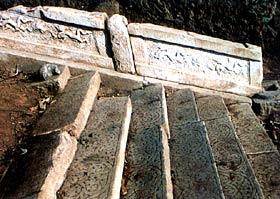
Stone steps leading to the Hall of Enjoyment at Jinling in Fangshan, Beijing
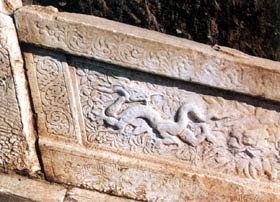
Part of carved stone railing
The organization of Xingling Mausoleum of Emperor Shi Zong is similar to Ruiling Mausoleum of Emperor Tai Zu. The mound is also a brick and native concrete structure, but slightly smaller in scale. Nothing visible remains of the hall where sacrifices were offered. In front of the mausoleum is another dilapidated tablet pavilion, site of the imperial tablet erected in the ninth lunar month of the second year of the reign of Kang Xi (1663). The tablet contains an account of the destruction of the Kin mausoleums at the end of the Ming Dynasty and the rebuilding of the two mausoleums in early Qing Dynasty in an inscription still clearly discernible.
|