|
Northwest of Xi'an City seat in Liquan County is a thrusting peak named Jiuzong Mountain, on which lies the largest of the Tang imperial tombs -- Zhaoling, the tomb of Li Shimin, Emperor Tai Zong. Li Shimin (599-649) was the second emperor of the Tang Dynasty, but its actual founder. His tomb is about 60 kilometers from Xi'an and 22.5 kilometers northeast of Liquan County seat. Now in front of the tomb of an attendant, Li Ji, and at the foot of the mountain stands the Zhaoling Mausoleum.
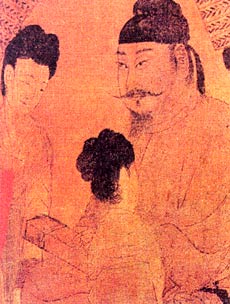
Portrait of Tang Emperor Tai Zong (Li Shimin)
Li Shimin was the second son of Li Yuan, Tang Emperor Gao Zu. In 626, Li Shimin staged a coup d'etat at Xuanwumen, killing his suspicious and deceitful elder brother, Li Jiancheng, who was over fond of wine and women and was preoccupied by animal-hunting; taking the life of his younger brother, who plotted to murder him, and forcing Li Yuan to abdicate.
Having ascended to the throne, Li Shimin carried out a policy of reducing class and nationality contradictions to secure domestic peace. As an administrator, he was noted for knowing his officials well enough to assign them to appropriate posts, even placing confidence in those whom he had defeated, including non-Han officials, and putting them in key posts, even with promotions. He encouraged his courtiers to speak out with their differing opinions. Among these, Wei Zheng was the most visible in exhorting the Emperor to "listen to both sides and you will be enlightened; heed only one side and you will be in the dark." Li Shimin is regarded as an outstanding statesman who strengthened the centralized state power system and consolidated national unity. During his reign, China experienced the powerful and prosperous "period of Great Order (627-649)."
Upon his death, this great emperor was buried in Zhaoling. Zhaoling was built high on Jiuzong Mountain, launching the practice of Tang emperors building their tombs near mountain peaks. This style of tomb looks much more impressive than do those of heaped earth. This new practice was said to have originated in burying Empress Zhangsun, who on her death-bed told Li Shimin to hold a thrifty and simple funeral, saying "please bury me on the mountain and do not heap the grave."
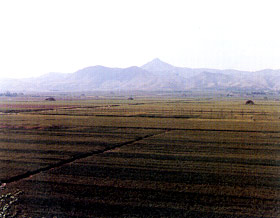
A distant view of Zhaoling, mausoleum of Tang Emperor Tai Zong
An inscription by Li Shimin reads: "A ruler takes the whole land under Heaven as his home. Why should he keep treasures within his tomb, possessing them as his private property? Now that the tomb has been built on Jiuzong Mountain with no gold, no jade, no slaves or horses within and the household utensils all made of earth and wood, thieves and robbers will cease their attempts, saving trouble for every one."
It is clear, however, that to build tombs in this way was not for frugality and simplicity but to demonstrate the ruler's power and stature through the magnificent mountain and also to prevent looting and grave-breaking. Therefore, when Empress Zhangsun was buried, Zhaoling's site and name had already been decided.
The steep Jiuzong Mountain, 1,188 metres above sea level, faces Taibai and Zhongnan peaks south across the Guanzhong Plain; while, to the east and west, rolling hills and crisscrossing ravines accentuate the towering peak chosen for Zhaoling. What makes it more magnificent are the Jingshui River winding across the front and the Weishui River flowing at the rear.
Construction of the tomb was a huge project, meticulous in design and flamboyant in structure. The design was said to be partly the work of famous Tang technicians and painters Yan Lide and Yan Liben. Historical data tell us Zhaoling's underground palace was tunneled into the mountain. The tomb passage, 75 zhang (about 230 metres) long, was guarded by five stone gates. The tomb chamber, as luxurious as any, is flanked by eastern and western wings in which are arrayed stone boxes containing sacrificial objects.
All these were confirmed when Wen Tao, a warlord of the Five Dynasties (907-960), opened and looted the tomb. He cut through to the strongly built tomb, went through the passage and was surprised that the palace in the middle of the mountain was "no less splendid than the outer world" and "the coffin was in the main chamber and in the two winds were stone platforms on which lay stone boxes containing iron caskets with paintings and books of former dynasties and handwriting of Zhong You and Wang Xizhi, all as fresh as ever." Conceivably, there were quantities of gold and silver treasures within, but Wen Tao, walking a line between explorer and looter, dared not make it public.
On the surface, houses and refreshment halls were built to "let the servants attend as before." Because the mountain range was too steep to walk," a plank road, hundreds of meters high was constructed along and up the cliff and 230 steps on it would bring you to the gate to the underground palace." Thus we can imagine the difficulty of its construction and how splendid the underground structure must be.
Ruins of Zhaoling's surface structures were scattered around the mausoleum. To the north was a sacrificial altar and gateway to the spirit path. Within this gateway stood in a line of carved stone images of fourteen minority chieftains of the "period of Great Order," of which the only survivors are three inscribed pedestals of Turk Khan Ashinasher, Yanqi King Longtu Qizhi, and Tibetan King Nongzan. The carved stone "Six Steeds of Zhaoling" in relief, known at home and abroad, were originally placed in the eastern and western verandas within the northern gateway to the spirit path.
The sacrificial altar was 53.5 meters wide and 86.5 meters long, almost trapezoidal in shape. A wall and steps are still recognizable. Due south are Rosefinch Gate and the sacrificial hall. To the southwest was "Lower Palace" (popularly called Imperial City), 237 meters wide and 334 meters long, surrounded by a wall 3.5 meters thick. Large numbers of houses had been built in that compound. According to the chronicles, 378 rooms were rebuilt in 798.
Though none of the surface structures of Zhaoling survive today, the stone tail of a sparrow hawk from the roof ridge, which was excavated from the ruins of the sacrificial hall, was 1.5 meters high, 7 meters long, 0.65 meters wide and weighed more than 150 kilograms. Expanding on that scale, it can be imagined how huge the hall must have been and how magnificent the entire structure must have looked, with its profusion of spacious halls and towers. Tang poet Du Fu captured some of the flavor of Zhaoling in his poem "Re-passing Zhaoling Mausoleum":
A line of tombs winds skyward up the slope
Where mountain beasts keep to their leafy lair;
I peer along a pine and cypress lane
Only clouds of sunset hanging in the air.
Construction of Zhaoling started in 636 with the burial of Empress Zhangsun and was finished in 649 when Li Shimin died. The thirteen years of construction were very costly, both in manpower and in material resources.
The full Zhaoling cemetery complex had a circumference of 60 kilometers, covering an area of 300,000 mu, and included 167 attendant tombs of nobles, distinguished court officials and generals. Highest of all on the mountain, Li Shimin's tomb occupied the commanding position while attendant tombs were placed on either side, lower on the mountain, indicating the Emperor's supremacy.
Each attendant tomb had its own archway and inscribed stone tablet as courtiers felt honored to be buried with the Emperor. The cemetery was covered w4th green pines and cypresses, huge Chinese scholar trees and poplars, resulting in the name "City of Pines." To describe the scenic cemetery, the late Tang poet Liu Cang wrote: "Entering the site of the underground palace along the mountain ridge, you will feel the chill of shady pines as if at midnight."
Reflecting the rigidity of the feudalistic patriarchal clan system and the hierarchical social estate system, attendant tombs differed in form and in position. For example, tombs of Princess Chang Le, Princess Xin Cheng and Princess Cheng Yang, daughters of Empress Zhangsun, as well as tombs of concubines, were located near the Emperor's tomb on the mountain. Their structures were unique; some had paired mounds at one end, others were topped by mound in an inverted dipper shape and four earthwork mounds at each end provided openings between them as gates or walkways. In contrast, tombs of princes and princesses by concubines lay at the foot of the mountain with simpler structure.
To praise officials for distinguished service in the unification wars to establish the Tang empire and in building up its political power, Li Shimin granted favors through burial protocol. For example, when Wei Zheng, favorite courtier of Li, died of illness in 646, Li ordered him to be buried on the Fenghuang (Phoenix) Hill, to the southwest of Jiuzong Mountain, and a pair of mounds were built in front of his tomb, to make it more impressive. Li also personally wrote an inscription for Wei.
Also appreciated by the Emperor for his stalwart military service, Li Jing's tomb was placed on the stairway grounds to the south of the mausoleum with mounds in an area shaped like Yinshan and Anyernaqen mountains whose adjoining parts tapered to sides of two rectangles. The impression left by the structure is one of rolling hills with the east part breaking off and the west joined. These tombs show dearly that Li Shimin was anxious to enlist talent into his service, without being bound by relationships or seniority.
Wei Zheng and Li Ji were good examples: both were ordinary landowners in the peasant army of the late Sui Dynasty; they were not only put to work, but were also given key positions. This Personnel policy helped to develop the bureaucratic apparatus at all levels, greatly strengthening the feudalistic power of the early Tang Dynasty.
Also buried in Zhaoling were chieftains of minority nationalities in northeast China, such as Ashinasher, Ashinazhong, Qibeheli, Zhishisili, Li Simo and others. All had rendered service to the Tang regime. This was one of the methods Li Shirnin used to consolidate the unity of this multi-national country and to maintain close ties with minority nationalities.
Constructed 1,300 years ago, Zhaoling no longer is ornate and impressive, but large numbers of precious cultural relics still remain on the surface and under ground.
In the Tang Dynasty it was common practice to erect inscribed stone pillars in front of tombs and to place engraved epitaphs within tomb chambers. Excavations had originally found over 20 such steles buried but upright at Zhaoling. Their existence had been noted in works and collections of epigraphic specialists of the Song and later dynasties. In recent years more steles have been discovered and excavated and these tombstones and epitaphs have disclosed a great deal of important historical data, with great continuing value for reference.
Tang calligraphy occupies an important place in the ancient Chinese treasure-house of culture and art. The stone engravings in Zhaoling mausoleum provide excellent examples of the magnificent panorama of early Tang calligraphy. Inscriptions in the handwriting of such great calligraphers as Ouyang Xun, Chu Suiliang and Wang Zhijing on tombstones of Wen Yanbo, Fang Xuanling and Li Jing, respectively, were of high artistic value and attracted much attention. Among newly unearthed pieces were handwriting examples of Wang Xingman on Zhou Hu's gravestone, Li Xuanzhi on Li Mengchang's and Jiang Xi on Jiang Xia's. Gravestones of Wu Guang and Dou Lukuan contained handwriting of unknown author-ship.
Each calligrapher had a unique style. Both Li Shimin and his son, Li Zhi, appreciated Wang Xizhi's handwriting rendered in running and cursive hand and they had left their handwriting on steles in Zhaoling. Li Zhi's handwriting on Li Ji's stele utilized Wang Xizhi's style -- elegant and free. Zhaoling could be said to have assembled a profusion of early Tang calligraphy.
Zhaoling's stone carving blazed many new trails and the exquisite relief sculptures "Six Steeds of Zhaoling' were works gaining highest praise of all.
One poem goes: "On armored horses the Emperor won the world under Heaven, and stone images of the Six Steeds are as distinguished as their battle achievements.''
Having carried Li Shimin through battle after battle and distinguished themselves in action, the six armored horses, upon Li Shimin's edict in 630 after Emperor Zhangsun was buried, were sculpted into six stone steeds to commemorate the Emperor's achievements on the battlefields and in memory of his beloved war horses.
"The best of their kind," the Six Steeds were carefully selected from a good breed of Persian horses in the Western Region. Before they were sculptured, renderings were first drawn by the great Tang painter Yan Liben, who based the Steeds' images, names and backgrounds on facts.
The "Six Steeds of Zhaoling" were carved on 2.5-metre-high by 3-metre-wide stone slabs and arrayed in rows on the eastern and western verandas of the northern gateway.
First in the eastern row was Te Le Biao (fatty prince), yellow with an off-white mouth, who had carried Li Shimin to suppress Song Jingang. The second, named Qing Zhui (black-and-gray horse), gray and white, was hit by five arrows in the chest while carrying Li in battle with Dou Jiande. The third, named Shi Fa Chi (various red), solid red, was hit by four arrows in the front and one on the back carrying Li to suppress Wang Shichong and defeat Dou Jiande.
First on the west was Sa Lu Zi, a valiant, purple looking horse. He was hit by one arrow in the front taking Li to calm the Eastern Capital (today's Luoyang, Henan) and wipe out Wang Chongchong. Sa Lu Zi was the only horse of the six who had a human figure carved into his stone.
The "Biography of Qiu Xinggong" in The New History of the Tang Dynasty reads: Qiu, bodyguard and general of Li Shimin, excelled in horsemanship and marksman-ship and was very brave. In the battle to seize Mangshan Mountain near Luoyang, Li, riding Sa Lu Zi, personally led scores of cavalrymen on a charge to learn the enemy's strength. In the end the only Li follower in sight was Qiu, who was closeby.
Suddenly Wang Chongchong broke free and fired an arrow that hit the steed Sa Lu Zi. Qiu turned, quickly shooting four arrows at the enemy, all hits, halting their advance. Qiu jumped from his horse, pulled the arrow from Sa Lu Zi, left his horse to Li and attacked the enemy on foot. With sword in hand, he killed several and rushed back to his emperor.
For this deed, Qiu's heroic image appears handsome and dignified in the Zhaoling horse carving. A helmeted, curly bearded and war robed, Qiu carrying a sword and, with an arrow bag at his waist, is depicted pulling the arrow from Sa Lu Zi.
The second horse, named Quan Mao Gua (curly haired yellow horse with black mouth), was hit by nine arrows carrying Li to suppress Li Heida. The third named Bai Ti Wu (white-hoofed black horse), pure black with four white hooves, was the Emperor's horse in the fight with Xue Rengao.
The "Six Steeds of Zhaoling" carvings are rare cultural relics and indicative of accomplishments of ancient China's sculptors. Containing a variety of postures and expressions, succinct and powerful lines and vivid shapes, these artistic works not only are excellent examples of shaping and carving, but tell rich historical tales. It is a pity that carvings of two of the Steeds, Sa Lu Zi and Quan Mao Gua, were stolen long ago and now are preserved in the museum of the University of Pennsylvania in the United States. The other four are in the Shaanxi Provincial Museum.
Large quantities of pottery figurines and various kinds of utensils have been found in the few attendant tombs so far excavated. Different types, such as painted pottery, glazed colored pottery and three-color glazed pottery, represent differing styles of different stages. Numerous c
aches of painted pottery unearthed from the Zheng Rentai and Zhangshigui tombs are a new discovery of great value. The brightly colored human figures display a variety of postures; elaborate gestures, movements and facial expressions, and clothing and decorations, give these pieces a subtle, but lively look. Deserving of special attention are figurines of ethnic minority people, reflecting the close relationships between ethnic cultures in bordering areas and the culture of hinterland China. Camels carrying silk cloth also are symbols of China's friendly economic and cultural exchange with foreign countries during the Tang Dynasty.
Three-color glazed camel dating from the Tang Dynasty excavated at Xi'an
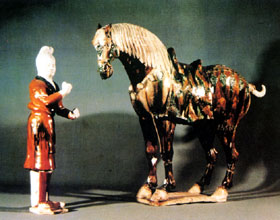
Three-color glazed horse and groom
Ancient Chinese painting developed into a rich and colorful art in the early Tang years. Large numbers of murals discovered in attendant tombs in Zhaoling are in bright colors with well-conceived layouts and depict diverse themes, most of which are figure painting of nobles and their life styles: business travel, singing and dancing, games, ladies-in-waiting and courtiers. In technique, both lines and coloring are emphasized and in some murals coloring was extended from face to clothing and utensils, giving the tableau an appearance of complexity in design.
Also unearthed from Zhaoling were uncounted quantities of articles, arts and crafts, including a specially made official hat, most rare, from Li Ji's tomb. It is said that Li Shimin had personally made three hats of this kind to award his most distinguished courtiers and Li Ji was honored with one.
Zhaoling Mausoleum is an underground store-house of cultural relics, with a mammoth treasure of objects of ancient arts and crafts and other culture relics waiting to be discovered.
|