China has unswervingly pursued a national defense policy that is defensive in nature. Under the premise of ensuring national security interests, China has always kept the quantity and size of its armed forces at the minimum level necessary for maintaining national security and has for many times taken the initiative to adopt unilateral disarmament.
Attaching high importance to the security, stability and development of the Asia-Pacific region, China has adhered to the principle of "building friendship and partnership with neighboring countries" and the policy of "fostering an amicable, peaceful and prosperous neighborhood," endeavored to seek effective approaches for confidence-building measures (CBMs), actively participated in the construction of regional security mechanism and devoted itself to establishing an Asia-Pacific security framework featuring dialogue rather than confrontation.
Large-scale Reduction of the Military Personnel
China made the decision to downsize its military personnel by one million in 1985. By 1987, the size of the People's Liberation Army (PLA) had been reduced from 4.238 million to 3.235 million and further reductions followed thereafter. By 1990, the number of armed forces had been cut down to 3.199 million, downsized by a total of 1.039 million.
Since 1990, China's armed forces have undergone a series of adjustments and their size has continued to shrink. China decided in 1997 to once again downsize its military by 500,000 within three years, reducing its military size to the level of 2.5 million. In 2003, China decided to further cut down the number by 200,000 within two years and to reduce its military size to the level of 2.3 million.
The wide scope and magnitude of China's unilateral disarmament in such a relatively short period of time are rarely seen in the history of international arms control and disarmament. This has fully demonstrated the firm belief of the Chinese government and people on the arms control and disarmament cause as well as their sincere aspiration for peace and development.
Maintaining a Low Level of Defense Spending
China has always put emphasis on the control of its defense expenditure scale. The defense spending is appropriately allocated under the guideline of coordinated development of national defense and economy. Since the adoption of the reform and opening-up policies, the Chinese government has kept its defense expenditure under strict control in order to concentrate its strength on economic development. From 1979 to 2004, the percentages of China's defense expenditure to its financial expenditure of the same period followed a downward curve on the whole. It was 17.37% in 1979, and 7.76% in 2004, down by about 10 percentage points.
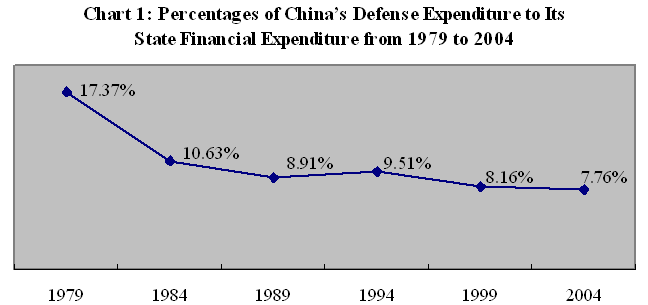
China's overall defense expenditure remains at a relatively low level in the world. This is not only reflected in the absolute amount of defense expenditure, but also in the percentages to the GDP and financial expenditure. In 2004, China's defense expenditure registered 219.986 billion yuan, accounting for 1.61% of that year's GDP and 7.76% of that year's financial expenditure and amounting to only 5.77% of that of the US, 41.03% that of the United Kingdom, 75.65% that of France and 63.97% that of Japan. China's defense budget for 2005 is 247.756 billion yuan.
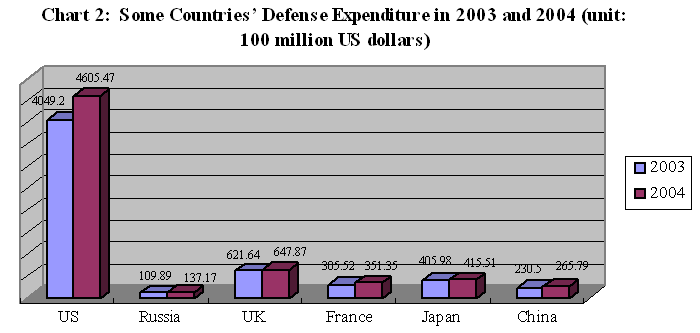
Note: Statistics in the chart are sourced from the national defense reports, financial reports or other government reports released by the said countries. In 2003 and 2004, the average dollar-yuan exchange rate was 8.2770 and 8.2768 respectively.
|
Chart 3: Percentage of Defense Expenditure to GDP and to State Financial Expenditure of Some Countries in 2004 (%) | ||||||
|
Country |
US |
Russia |
UK |
France |
Japan |
China |
|
To GDP |
4.02 |
2.69 |
3.50 |
2.01 |
0.98 |
1.61 |
|
To State Financial Expenditure |
20.09 |
15.49 |
8.33 |
11.14 |
5.97 |
7.76 |
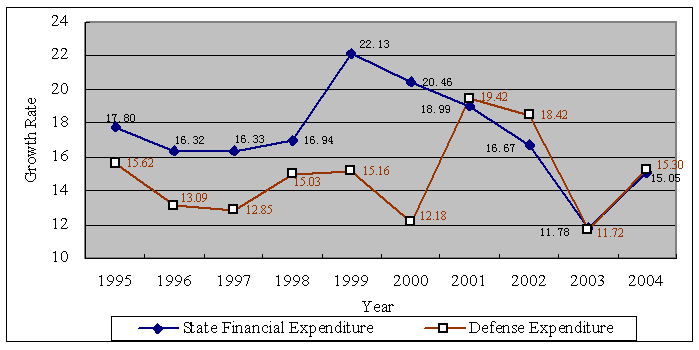
Based on the economic development and revenue growth, China has moderately increased its defense expenditure in recent years. However, the increase was relatively small. For most years since the 1990s, the growth rate of China's defense expenditure has been lower than that of the state financial expenditure. The increased part of the defense expenditure has primarily been used for the following purposes: 1. Increase of the salaries and allowances of the military personnel to ensure the improvement of their living standards in step with the socio-economic development; 2. Further improvement of the social insurance system for servicemen, including the establishment of systems like casualty insurance, medical insurance for ex-servicemen, housing subsidy, basic life guarantee for accompanying spouses of servicemen and social insurance subsidy; 3. Support for the structural and organizational reform of the military and proper resettlement for the 200,000 servicemen recently discharged from active service; 4. Increased investment in the development of high-caliber talents in the military, and refined incentive mechanism for talented people to ensure the achievement of the PLA's Strategic Project for Talented People; and 5. Moderate increase of equipment expenses to improve the PLA's defensive combating capability under the conditions of modern technology, particularly high technology.
Chart 4:Comparison Between the Growth Rates of China's Defense Expenditure and State Financial Expenditure from 1995 to 2004 (%)
The Chinese government has always adhered to the principle of strict control, strict management and strict supervision of defense expenditure and has established a full-fledged management and legal system. The Chinese government, pursuant to the National Defense Law of the People's Republic of China, ensures the necessary funds for national defense, incorporates the entire expenditure in the state budget and exercises management over it in accordance with the Budget Law of the People's Republic of China. Examined and approved by the National People's Congress, China's defense budget is open and transparent.
Regional Disarmament and Confidence-Building Measures
China attaches great importance to and actively promotes the cooperation on regional disarmament and CBMs. It has reached a series of agreements and consensus with relevant neighboring countries, thus making contributions to the improvement of regional security environment and enhancement of common development. These agreements reflect the new security concept initiated by China and embody the principles and spirit that are of universal significance to security dialogue and cooperation in Asia-Pacific, including mutual and equal security; seeking security through dialogue and cooperation; equal consultation and mutually beneficial cooperation; being not against a third state; no threat or harm to the security and stability of other countries; insisting on national defense policy of defensive nature; friendly exchanges in the military field, etc.
In July 1994, China and Russia signed the Agreement on the Prevention of Dangerous Military Activities. In April 1996, China, Kazakhstan, Kyrgyzstan, Russia and Tajikistan signed the Agreement on Confidence-Building in the Military Field Along the Border Areas. In April 1997, China signed the Agreement on the Mutual Reduction of Military Forces in the Border Areas with the aforementioned countries. These agreements opened the cooperation process of the "Shanghai Five" and laid down a solid foundation for the establishment and development of the Shanghai Cooperation Organization (SCO). For more than four years since its establishment, SCO has formed a full-fledged institutional system and legal basis, smoothly launched the cooperation in the security, economic and other fields and is growing into a significant mechanism promoting regional security, stability and development.
In September 1993, China and India signed the Agreement on the Maintenance of Peace and Tranquility Along the Line of Actual Control in the China-India Border Areas. In November 1996, the two countries signed the Agreement on Confidence-Building Measures in the Military Field Along the Line of Actual Control in the China-India Border Areas. In April 2005, the two countries signed the Protocol on Modalities for the Implementation of Confidence-Building Measures in the Military Field Along the Line of Actual Control in the China-India Border Areas, which is an agreement on the concrete implementing approaches of relevant clauses in the Agreement signed in 1996. The signing and implementation of these agreements have played important and positive roles in maintaining peace and tranquility in the China-India border areas, promoting the friendly relations between the two countries and facilitating the peaceful resolution of the border issue.
In November 2002, China and ASEAN signed the Declaration on the Conduct of the Parties in the South China Sea (DOC), which showed all parties' common desire to maintain stability and carry out cooperation in this region. The parties concerned undertook to resolve their territorial and jurisdictional disputes by peaceful means, refrain from taking any actions that would complicate or escalate disputes, promote mutual trust through dialogues between defense officials and voluntary notification of joint military exercise, and actively carry out cooperation in the fields of marine environmental protection, marine scientific research, safety of navigation and communication at sea, search and rescue operation and combating transnational crimes. In December 2004, China and ASEAN held the Senior Officials Meeting on the Implementation of the DOC, at which important consensus was reached on launching the South China Sea cooperation and the decision was made on the establishment of a Joint Working Group for the implementation of the DOC. In August 2005, the first meeting of the Joint Working Group was convened in the Philippines.
China attaches great importance to the role played by the ASEAN Regional Forum (ARF), supports its CBMs and voluntarily submits the Annual Report on Security Outlook every year. Since 1997, China has hosted two Inter-sessional Meetings on CBMs of the ARF and undertaken eight CBMs programs, including Training Courses on Chinese Security Policies, Seminar on Military Logistics Support and Seminar on Strengthening Cooperation in the Field of Non-traditional Security Issues. China supports gradual expansion of defense officials' participation in the ARF. At the ARF's Tenth Meeting of Foreign Ministers in 2003, China put forward the proposal of convening a meeting on security policies, and in November 2004, the first ARF Security Policy Conference was held in Beijing.