| Tools: Save | Print | E-mail | Most Read |
| Premier Wen Delivers Gov't Work Report |
| Adjust font size: |
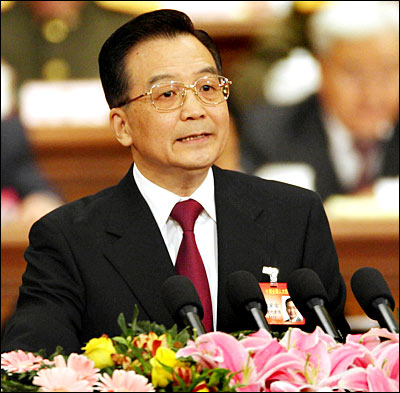
China targets an 8 percent economic growth this year and will take measures to keep the development "fast" and "steady," Wen said. The projected growth rate is 1.9 percentage points lower than the actual growth in 2005. The premier also proposed an annual growth rate of 7.5 percent for the national economy during the period of the 11th Five-Year (2006-10) Guidelines for National Economic and Social Development. This indicates a projected target of doubling the per capita gross domestic product (GDP) of 2000 by the year 2010. Between 2001 and 2005, China's GDP grew at an average annual rate of 9.5 percent, 0.9 percentage points higher than the annual figure in the Ninth Five-Year Plan period (1996-2000).
The following are some of the facts and figures about China's achievements in economic and social development in 2005, as seen in Wen's report: l China's GDP reached 18.23 trillion yuan (US$2.27 trillion) in 2005, an increase of 9.9 percent over the previous year; l Fiscal revenue exceeded 3 trillion yuan (US$373 billion), 523.2 billion yuan (US$65.1 billion) more than the previous year; l Consumer price index rose 1.8 percent; l Import and export volume totaled US$1.42 trillion, an increase of 23.2 percent; l Actually-used direct foreign investment reached US$60.3 billion; l Foreign exchange reserves totaled US$818.9 billion at the end of 2005; l A total of 9.7 million urban residents entered the workforce for the first time; l Urban per capita disposable income rose to 10,493 yuan (US$1,305.1), an increase of 9.6 percent after adjusting for inflation; l Rural per capita net income grew to 3,255 yuan (US$405), an increase of 6.2 percent after adjusting for inflation; l Agricultural tax was rescinded in 28 provinces, autonomous regions and municipalities directly under the central government, and the livestock tax was rescinded nationwide; l Last year, 297.5 billion yuan (US$37 billion) from the central government budget was spent on agriculture, rural areas and farmers, an increase of 34.9 billion yuan (US$4.3 billion) over 2004; l With considerable increase in 2004, grain output rose by 14.55 billion kg to reach 484 billion kg; l A total of 21.9 billion yuan (US$2.7 billion) was allocated by the central government to subsidize the policy-based closure and bankruptcy of 116 state-owned enterprises; l The central government spent 116.8 billion yuan (US$14.5 billion) in 2005 on science and technology, education, health and culture, an increase of 18.3 percent over the previous year. In addition, 9.54 billion yuan (US$1.2 billion) from the sale of treasury bonds was spent on these items; l Over 7 billion yuan (US$870.6 million) was allocated by the central and local governments to pay tuition and miscellaneous fees, provide free textbooks, and subsidize room and board for 17 million students from poor families in 592 designated poverty-stricken counties. Free textbooks were also provided to more than 17 million students from poor families in the central and western regions; l Over the past three years, the central and local governments spent 10.5 billion yuan (US$1.3 billion) to basically complete the establishment of a disease prevention and control system that operates at the provincial, city and county levels; l A total of 16.4 billion yuan (US$2.04 billion) was spent on setting up a medical treatment system for public health emergencies, and work is proceeding smoothly; l Total expenditures from the central government budget for fighting natural disasters and providing disaster relief came to 8.9 billion yuan (US$1.1 billion) last year, and more than 90 million people were helped; l The central and local governments allocated 16.2 billion yuan (US$2 billion) for poverty alleviation, and the number of rural residents living in poverty decreased by 2.45 million; l Elections for village committees were held in 21 provinces, autonomous regions and municipalities.
The following are the main targets for China's economic and social development in 2006, revealed in the report: l China's GDP should grow about 8 percent, and energy consumption per unit of GDP should fall by about 4 percent; l The rise in consumer prices should be kept under 3 percent; l Urban employment should increase by 9 million persons, and the urban registered unemployment rate should be kept under 4.6 percent; l The equilibrium in the balance of payments should stay basically balanced; l The government plans to issue 60 billion yuan (US$7.46 billion) worth of long-term treasury bonds, 20 billion yuan (US$2.49 billion) less than last year, while increasing regular construction investment from the central government budget by 10 billion yuan (US$1.24 billion); l The deficit in the central government budget is projected to be 295 billion yuan (US$36.69 billion), 5 billion yuan (US$621.89 million) less than last year.
Regarding the energy issue, Wen said China will strive to chop down its energy consumption rate by 4 percent this year, a new key index to guide economic and social development. "Energy consumption per unit of GDP should fall by about 4 percent in 2006," Wen said. It is the first time China combines energy-efficiency with the indexes of economic growth, price, employment and balance of payments for macro-control of its economy. China is determined to reduce energy consumption per unit of GDP by 20 percent and the total volume of major pollutant discharges by 10 percent in the coming five years, a new round of economic and social development beginning this year, Wen said. Necessitated by the country's current conditions and long-term interests, these targets are designed to tackle the mounting pressure on resources and environment and provide a clear guide for policy-making, Wen said. "Though achieving them will be quite difficult, we have the confidence and determination to succeed," he said, noting that China is resolved to build a resources-saving and environment-friendly society. Official statistics show that the total volume of energy consumption in China last year was equal to 2.22 billion tons of standard coal, up 9.5 percent over the previous year and lower than the 9.9 percent economic growth rate. Energy consumption per 10,000 yuan (US$1,250) of GDP was equivalent to 1.43 tons of standard coal, roughly the same level as that in 2004. China has seen its economic volume quadrupled in the last two decades of the 20th century largely due to huge investment and doubled energy consumption. However, the obvious conflict between environment protection and booming economic growth will challenge China's future development. The premier called for the establishment of various standards for conserving energy, water, land and materials in all industries, and the development of environment-friendly products, projects and buildings. He added that energy-efficiency index of all regions and major industries will be released to the public on an annual basis. In this sense, the public will be mobilized to join in the long-term campaign of energy and resources conservation in a bid to bolster a recyclable economy and an environment-friendly society. To build a "new socialist countryside," Wen said the government will spend 339.7 billion yuan (US$42 billion) in agriculture, rural areas and farmers this year, which is 42.2 billion yuan (US$5.25 billion), or 14.18 percent, more than last year. "We need to implement a policy of getting industry to support agriculture and cities to support the countryside, strengthen support for agriculture, rural areas and farmers, and continue making reforms in rural systems and innovations in rural institutions to bring about a rapid and significant change in the overall appearance of the countryside," he said. The Central Committee of the Communist Party of China (CPC) has set objectives including "enhanced productive forces, higher living standards, civilized living style, an orderly and clean environment, and democratic administration," he said. China is an agricultural country traditionally, and old-style farming lasted for thousands of years in most areas. Like any other countries, China had drawn a huge sum of funds for industry development from agriculture and rural areas in the initial stage of industrialization and urbanization since 1949, resulting in yawning gap between the city and the countryside. To narrow the gap, the government has kept increasing central fiscal expenditure on agriculture, rural areas and farmers over the last few years. In 2005, the fund from the central budget and T-bond proceeds to support agriculture, rural areas and farmers reached 297.5 billion yuan (US$36.7 billion), which was 34.9 billion yuan (US$4.34 billion) more than in 2004 and over 100 billion yuan (US$12.44 billion) more than in 2002. The capital inputs of many localities for this purpose also reached a record high. Wen said this year priority will be given to developing modern agriculture and promoting steady expansion of grain production and sustained increase in farmers' incomes. "We will further increase direct subsidies to grain producers, subsidies for growing superior grain cultivars, and subsidies for agricultural machinery and tools," he said. "We need to resolutely work to reorient investment by shifting the government's priority in infrastructure investment to the countryside. This constitutes a major change," he said. The fund will be mainly used for strengthening basic development of farmland, accelerating construction of infrastructure projects such as roads, drinking water supplies, methane facilities, power grids and communications. In what was called "a milestone event" in China's educational history, Wen pledged that the government would eliminate all charges on rural students receiving a nine-year compulsory education before the end of 2007. The new policy, apparently resulting from the central leadership's latest call for building a "new socialist countryside," will benefit some 160 million school-age children in the vast rural region, who account for nearly 80 percent of the country's primary and junior middle school students. "Over the next two years, we will completely eliminate tuition and miscellaneous fees for all rural students receiving compulsory education," the premier said. The policy's successful implementation, which Wen said requires an increase of 218.2 billion yuan (US$27.27 billion) in the central government budget expenditure over the next five years, will basically lift China out of the rank of less than 30 countries worldwide that fail to provide their kids with completely free compulsory education. China in 1986 promulgated the law on compulsory education, which stipulates that the state should provide a nine-year compulsory education "free of tuition fees" for all primary and junior middle school students. However, the law has failed to guarantee the funding of compulsory education, thus forcing many schools, particularly those in the impoverished rural regions, to either continue to collect the tuition fees or charge various "miscellaneous fees" on their students in the name of "voluntary donations," "fund-raising for school construction" or "after-school tutoring fees." Excessive charges by the schools have become a major reason behind the increasing rural dropouts in recent years. The dropout ratio for rural primary and junior middle schools in 2004 was 2.45 percent and 3.91 percent respectively, while the figure in the less developed central and western regions was much higher. Wen said the new policy would be first implemented in the western regions this year and then extended to the central and eastern regions next year. "We will also continue to provide free textbooks to students from poor families and living allowances to poor students residing on campus," he added. Funding the repair and renovation of rural school buildings and guaranteeing the payment of rural school teachers' salaries are also among the measures Wen promised to take in the coming years. Addressing the key issue of financing, he said expenditures on rural compulsory education will be "fully incorporated into the central and local government budgets," and promised to gradually establish a "mechanism to guarantee funding for rural compulsory education." The NPC has already started amending the two-decade-old compulsory education law, focusing on sufficient funding. Underlining the significance of the new policy, Wen said, "It is bound to have a far-reaching impact on raising the overall quality of the people of China."
The following are the main facts and figures about the drive to build a "new socialist countryside," revealed in the report: l Central government budget expenditures for agriculture, rural areas and farmers this year will total 339.7 billion yuan (US$42 billion), 42.2 billion yuan (US$5.25 billion) more than last year; l China will completely rescind the agricultural tax throughout the country in 2006, a tax that China has been collecting for 2,600 years. The reform of rural taxes and fees has greatly benefited farmers by eliminating 33.6 billion yuan (US$4.18 billion) of agricultural tax and over 70 billion yuan (US$8.71 billion) of various sorts of fees and charges; l Starting this year, the government will appropriate over 103 billion yuan (US$12.8 billion) annually to ensure the normal operation of town and township governments and meet the needs of rural compulsory education. This figure is comprised of more than 78 billion yuan (US$9.7 billion) in transfer payments from the central government budget and over 25 billion yuan (US$3.1 billion) from local government budgets; l Over the next two years, the government will completely eliminate tuition and miscellaneous fees for all rural students receiving compulsory education. The central government budget expenditures for compulsory education will increase by 218.2 billion yuan (US$27.27 billion) over the next five years; l The state will spend more than 20 billion yuan (US$2.5 billion) over the next five years on renovating hospital buildings in towns and townships and in some counties and upgrading their equipment; l China will speed up the establishment of a new type of rural cooperative medical care system by extending the scope of current trials to 40 percent of the counties in China this year and by increasing the allowances paid by the central and local governments to farmers participating in the system from 20 yuan (US$2.5) to 40 yuan (US$5). An additional 4.2 billion yuan (US$522.4 million) will be allocated from the central government budget for this program. The premier also said the central government will allocate 71.6 billion yuan (US$8.91 billion) this year for investment in science and technology, representing an increase of 19.2 percent year-on-year. "China has entered a stage in its history where it must increase its reliance on scientific and technological advances and innovation to drive social and economic development," he said. Wen said China will establish a mechanism to ensure stable growth of government investment in science and technology. "Local governments and enterprises also need to increase their investment." The State Council published an Outline of the National Program for Long- and Medium-term Scientific and Technological Development in February, saying that China's total sci-tech expenditures should account for 2.5 percent of its GDP by 2020, which will be similar to that of developed economies and science powers. In 2004, China's expenditures in this respect took up 1.23 percent of the GDP, which is the highest among all developing countries. According to the 11th Five-Year Guidelines also tabled with lawmakers for examination and approval, China will in the next five years launch a number of major scientific and technological projects in strategic industries such as information technology and biotechnology, and projects to address important, pressing problems in energy, resources, the environment and the health of the people, as well as technologies with both military and civilian applications. These projects are of "major and immediate significance and will have far-reaching importance" for speeding up the solution of crucial scientific and technological problems with a bearing on China's overall situation and long-term development, and raising the overall technological level in those areas, Wen said. Since the 1950s, China has made remarkable progress in sci-tech development, highlighted by atom bombs, man-made satellites, manned spaceships, hybrid rice and high performance servers. But the role of technology development has yet to be brought to full play for the promotion of national economy.
Turning to the Taiwan issue, Wen said anybody who acts against people's wishes for peaceful and stable relations across the Taiwan Straits is bound to meet failure. "Everyone wants cross-Straits relations to be peaceful and stable and to develop to the mutual benefit of both sides," he said. "Anyone who tries to reverse this major trend will most certainly fail," he said. Relations between the mainland and Taiwan showed signs of improvement last year thanks to efforts of people on both sides. Taiwan leader Chen Shui-bian, however, announced on February 27 a decision to stop the function of the "National Unification Council" and its guidelines, seen as a dangerous move toward "Taiwan independence" and a grave threat to peace across the Straits. The world public opinion quickly points out that Chen has done this to save his poor political record and unpopularity, attempting to gain support in a conflict with the mainland. Chen is now under denouncement in and outside Taiwan for his repeated moves to make trouble in the cross-Straits relations. The premier reiterated the mainland's adherence to the basic principles of "peaceful reunification," "one country, two systems" and an eight-point proposal for developing cross-Straits relations and promoting China's peaceful reunification under the present circumstances. The mainland will unswervingly uphold the one-China principle and never give up its efforts to achieve peaceful reunification and never change the principle of placing hopes on the people of Taiwan, said Wen. Meanwhile, the mainland will uncompromisingly oppose secessionist activities aimed at "Taiwan independence," he said. "We will continue working with Taiwan compatriots to facilitate visits by individuals, promote economic, scientific, technological, and cultural exchanges and cooperation, and establish peaceful and stable cross-Straits relations," he said. Wen said the mainland will strive to resume dialogue and negotiation between the two sides under the one-China principle and promote resumption of the "three links" of mail, trade and transport on a comprehensive, direct and two-way basis. "We will support economic development on the west shore of the Taiwan Straits in Fujian and in other areas where Taiwan investment is concentrated, protect the legitimate rights and interests of our Taiwan compatriots in accordance with the law, and serve them wholeheartedly," he said. A total of 68,095 projects funded by business people from Taiwan had been approved on the mainland by the end of 2005, with a contractual investment of US$89.7 billion from Taiwan and US$41.76 billion actually used. Indirect cross-Straits trade volume had hit US$495.81 billion, including US$81.73 billion of mainland exports to Taiwan and US$414.08 billion of Taiwan exports to the mainland, resulting in an aggregate trade surplus of US$332.35 billion for Taiwan. The mainland is Taiwan's No.1 export market and largest trade surplus source, while Taiwan is mainland's second largest import market.
(Xinhua News Agency March 6, 2006)
|

| Tools: Save | Print | E-mail | Most Read |
 |
| Related Stories |
|
Product Directory China Search |
Country Search Hot Buys |
