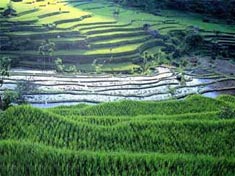
Every morning, 40-year-old Xia Guoyuan, a farmer in Xiaguanyuan, a town in Hubei Province, tours his paddy fields.
Xia was selected last year to join the scientists' trial program to plant genetically modified (GM) rice, known for its resistance to pests.
In the past two rice planting seasons, Xia has used a very limited amount of pesticides, about 20 percent of the amount he applied before on the same area of land.
Xia knows that the GM rice he has planted cannot be sold in the open market because it has not yet been approved for commercialization.
This approval could increase Xia's income significantly, but depends on the State Agricultural GM Crop Biosafety Committee. Technically the decision-making body for commercialization of GM plants in China, the committee is in charge of GM crop safety and is entrusted to evaluate GM rice for research or marketing.
Forging ahead?
The committee, founded in 2001, stipulates that its members can only serve five-year terms. The 50 members in the first committee mainly consisted of GM crop researchers and quarantine experts.
In late June, the second group of the biosafety committee members were appointed. There are 74 members, some of them bio-safety and environmental scientists, according to the Ministry of Agriculture.
The Chinese government approved the commercialization of genetically modified cotton, tomato, pimiento and a species of morning glory in the late 1990s.
So far, no country in the world has approved the commercialization of the transgenic main grains, including wheat and rice, the staple food of nearly half the world's population.
Peng Yufa, a member of the GM crop biosafety committee and chief scientist at the biosafety research center under the Beijing-based Chinese Academy of Agricultural Sciences, said that new committee is not dominated by agricultural biotech scientists, and promotes a more cautious decision-making process towards commercializing GM grain, such as rice.
However, in an interview with China Daily on the sidelines of a bio-economic forum held in Beijing earlier this month, Zhang Wei, vice president of Weiming Kaituo Agricultural Biotech Co Ltd, said that he hoped the new committee would provide a more scientific evaluation and recommendation to help decision-makers to set the course for the future of GM rice.
GM crops transplant genes from outside sources -- often from other kinds of crops or bacteria -- into the crop. This helps increase insect-resistance, salt and drought tolerance, and anti-herbicide and anti-crop disease traits.
The most frequently used outside gene is derived from bacteria and commonly called Bt, which makes crops produce a chemical that kills bollworms.
Insiders say the new committee is scheduled to meet in November. On the agenda will be four varieties of GM rice that Chinese scientists have developed -- three insect-resistant varieties and another able to withstand bacterial blight.
The four breeds have been going through pre-production safety evaluation since December 2004. The committee's evaluation is the last step before it is approved for commercialization.
"China's GM rice technologies are leading the world and they are very mature for commercialization," said Zhen Zhu, a leading rice scientist and the deputy director of the Bureau of Life Science and Biotechnology of the Chinese Academy of Sciences (CAS).
Zhu's team has successfully transplanted two anti-insect genes into rice. Significant progress has also been made with developing drought- and salt-tolerant varieties of GM rice, which are already in field trials.
"So far, many experiments have proved the transplanted genes are safe to mammals," said Wu Changyin, a biotechnology researcher at Huazhong Agricultural University, during an earlier interview with China Daily.
Take Bt gene as an example. Its toxicity only works in the alkaline environment of insect's digestion system. It causes no harm in the acid alimentary canals of mammals. In addition, its toxicity disappears at 50 degrees centigrade, which makes it safe to eat cooked rice.
The Bt gene has been tested for more than 20 years in other commercialized GM crops such as soybean and does not show any specific impact, Wu added.
In a recent research published in Science magazine, economist Huang Jikun, director of CAS' Agricultural Policy Research Center, and his colleagues, revealed that insect-resistant GM rice reduces pesticide use by 17 kilograms per hectare, or nearly 80 per cent of the original volume.
Meanwhile, the insect-resistant GM rice increases yield by six-nine percent.
Growing concerns
"It is not because insect-resistant GM rice naturally has a higher output, but because for non-GM rice, farmers cannot spray pesticide frequently enough, and thus insects eat up some of the yield despite the pesticide use," said Huang.
Insect-resistant GM rice reduces the rate of pesticide-related illnesses among farmers who grow rice, he added.
Last year, senior Chinese scientists recommended that policymakers give the green light to commercialize GM rice, but the attempt was followed by a series of publicly expressed concerns regarding its safety.
Sze Pang Cheung, a campaigner for Greenpeace China, said that researchers in Europe have found that GM food might be a source of human allergies.
Chinese scientists at the Chinese Center for Disease Control have tested the safety of GM rice on mice and found no abnormal phenomenon in three generations of mice in the past three years.
But Sze said that the duration experiment time was too short to reveal any potential harm to human beings.
The bigger concerns come from environmental scientists.
Xue Dayuan, a scientist at the Nanjing Institute of Environmental Sciences, told China Daily that if massively planted, GM rice might release their transgenic genes into the environment, polluting other species, especially the wild varieties of rice.
Wild rice is often crossbred with planted rice to improve traits. In China, three of the 20 known varieties of wild rice have been found.
Zhang Yongjun, a senior research fellow at the Institute of Plant Protection, said the target insects of GM crop may develop resistance to the insect-resistant gene and become super pests.
While disputes over the biosafety measures of GM rice continue, some groups of Chinese scientists have been trying other ways to improve rice traits.
In July, Wu Ping, deputy dean of the College of Life Sciences of Hangzhou-based Zhejiang University, led a team of researchers. They published their findings in the US journal of Plant Physiology: a gene in the crop itself which is able to reduce rice's reliance on phosphate fertilizer.
The gene can be used either through genetic engineering or traditional crossbreeding aided with molecular marker seeding technology for developing new varieties.
"Because this gene comes from rice itself, its will not pose any threat to environmental safety," Wu said.
In a more recent attempt, researchers at Shanghai Institute for Biological Sciences of CAS and the University of California, Berkeley, identified a rice gene linked to salt tolerance from a kind of Japanese rice called Nona Bokra.
"Although some GM rice varieties able to tolerate high salt level have undergone field trials in China, questions for their biosafety exist due to their outsourced genes," said Lin Hongxuan, the lead researcher of the Shanghai Institute for Biological Sciences. "Ours can be applied in the downstream seeding process to develop salt-tolerant varieties of rice."
In Yunnan Province, rice researchers are trying to use the genetic biodiversity of rice to prevent rice blast, a major rice disease. They plant different varieties of rice in accordance with certain proportions. This has significantly reduced the rate of rice blast.
"This research offers a way of thinking that we might not always rely on outsourced genes and genetic modification to solve all crop problems," said researcher Li Chengyun of Yunnan Agricultural University.
Li Chuanyou, a scientist at the Institute of Genetics and Developmental Biology of CAS, is trying to isolate the natural resistance of plants against pests.
"In the long history of plant evolution, some natural pest resistance traits have been developed, and if we can find them, the need for genetic modification will reduce," Li said.
"Currently, my research is far from successful as compared with mature genetic modification technologies, and more time and greater investment might harvest some fruits in this area," Li said.
(China Daily September 29, 2005)