| |
Before 1951, Tibet was under a feudal system based on temporal
and religious administration, characterized by joint dictatorship
of clerical and secular officials and nobles, land possession by
manorial lords and personal attachment of serfs and slaves to manorial
lords. Serfs and slaves, who made up over 95 percent of the population,
did not hold any means of production, and were totally dependent
on the "three manorial lords"(government officials, nobles and monasteries),
who constituted less than 5 percent of the total population but
owned all the land and forests and most of the livestock. In addition
to heavy land rents, the serfs had to pay dozens of taxes and perform
many different types of corvee labors. With serfs belonging to their
owners from birth, many were sold or transferred many times during
their lifetime. The marriage of a serf couple was subject to the
agreement of their respective owners. After death, the names of
serfs were written off from the book held by their owners, who could
claim all or most of any personal property. This inhuman situation
remained virtually unchanged from 1951 when Tibet won peaceful liberation
to 1959 when the Democratic Reform was carried out in the region.
 However,
due to the weak foundation, Tibet witnessed unbalanced development.
At the end of the 1970s, as people in some parts of the region began
to enjoy ample food and clothing, a total of 870,000 residents still
led a poor life. China launched a poverty-relief program in 1994,
aiming to lift the entire country's 8 million poor citizens out
of poverty in the remaining years of the 20th century. In that year,
the central and local governments appropriated 750 million Yuan
in poverty-relief development funds. In 1996, the Tibet regional
government made another decision to guarantee poor local people
their basic needs in clothing, food, housing and transportation,
improve their basic production and business conditions and enable
them to have a secured income. In terms of price indicators, the
per-capital net income (taking a county as a statistical unit and
calculated in 1990 constant prices) was to reach 600 Yuan in agricultural
areas, 700 Yuan in pastoral areas, and 750 Yuan in semi-agricultural
and semi-pastoral areas by the end of the century. Drinking water
for people and domestic animals would be guaranteed; medical service
conditions would be improved, and illiteracy would be eliminated
among young and middle-aged people. However,
due to the weak foundation, Tibet witnessed unbalanced development.
At the end of the 1970s, as people in some parts of the region began
to enjoy ample food and clothing, a total of 870,000 residents still
led a poor life. China launched a poverty-relief program in 1994,
aiming to lift the entire country's 8 million poor citizens out
of poverty in the remaining years of the 20th century. In that year,
the central and local governments appropriated 750 million Yuan
in poverty-relief development funds. In 1996, the Tibet regional
government made another decision to guarantee poor local people
their basic needs in clothing, food, housing and transportation,
improve their basic production and business conditions and enable
them to have a secured income. In terms of price indicators, the
per-capital net income (taking a county as a statistical unit and
calculated in 1990 constant prices) was to reach 600 Yuan in agricultural
areas, 700 Yuan in pastoral areas, and 750 Yuan in semi-agricultural
and semi-pastoral areas by the end of the century. Drinking water
for people and domestic animals would be guaranteed; medical service
conditions would be improved, and illiteracy would be eliminated
among young and middle-aged people.
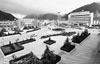 In
2001, Tibet achieved self-sufficiency in grain and edible oil. Poverty-stricken
population decreased from 480,000 to 70,000, with the proportion
of poor people in regional population dropping 15.6 percentage points
from 18.3 percent to 2.7 percent. Farmers and herders in 18 counties
whose people lived under poverty line won an annual net income of
1,316 Yuan per capita, a figure close to the regional level; the
annual average increase stayed higher than the regional average
by 4.4 percentage points. The net per-capital income of farmers
and herders rose from 200 Yuan in 1978 to 1,410 Yuan in 2001, an
increase of 5.9 percent over 2000. The per-capita income of urban
residents for living expenses increased by a big margin over the
1978 level, to 5,998 Yuan, higher than the national average level. In
2001, Tibet achieved self-sufficiency in grain and edible oil. Poverty-stricken
population decreased from 480,000 to 70,000, with the proportion
of poor people in regional population dropping 15.6 percentage points
from 18.3 percent to 2.7 percent. Farmers and herders in 18 counties
whose people lived under poverty line won an annual net income of
1,316 Yuan per capita, a figure close to the regional level; the
annual average increase stayed higher than the regional average
by 4.4 percentage points. The net per-capital income of farmers
and herders rose from 200 Yuan in 1978 to 1,410 Yuan in 2001, an
increase of 5.9 percent over 2000. The per-capita income of urban
residents for living expenses increased by a big margin over the
1978 level, to 5,998 Yuan, higher than the national average level.
Individual Consumption
A sample survey of 3,181 farmers indicates that residents in agricultural
areas use 24 percent of their spending for housing construction
and 68.4 percent on household furniture and daily necessities. The
diet is becoming increasingly diversified. Consumption of vegetables,
eggs, alcoholic beverages, candies and pastries has increased. A
sample survey of urban dwellers shows that more than 50 percent
of spending goes to food, of which meat, poultry, milk, eggs, dried
and fresh fruits and vegetables constitute 58 percent. Citizens
are spending more money on ready-made clothing of better quality
and in new styles.
Social Security
The government of the Tibet Autonomous Region has paid great attention
to social welfare undertakings related to employment, medical care,
housing, old-age care, insurance, and poverty and disaster relief.
It takes full care of the livelihood of senior citizens without
any family, and orphans. It has established 10 welfare institutions
and 50-odd seniors"homes in rural and pastoral areas. More than
7,000 elderly people with no family, and handicapped, infirm and
seriously sick citizens who have lost the ability to work, are cared
for by the government in five ways (food, clothing, medical care,
housing and burial expenses).
In line with the requirements for the establishment of a socialist
market economy, the regional government has accelerated reforms
aimed at establishing a social security system centered on old-age
care and unemployment insurance. Close attention is being paid to
the expansion of the coverage of old-age insurance and an increase
of the proportion of funds subject to unified management. The regional
authorities take the responsibility for unified planning of old-age
insurance. A part of the basic pension will be pegged to the average
wage level and the other part to the actual sum and the duration
for which the individuals have paid. The government's unemployment
insurance fund and supervisory mechanism have been improved, while
services for the re-employment of the jobless have been enhanced.
The number of the handicapped in Tibet totals some 150,000. During
the Ninth Five-Year Plan, more than 5,200 of them recovered health.
In addition, some 1 million people were given iodine capsule to
take. Nowadays, upwards of 70 percent of the counties in Tibet have
set up federations for the handicapped. In many villages, there
are people charged with offering special services for such people.
In 2000, Tibet set up the Lhasa Special Education School, which
is the first school specially for the blind, the deaf and the mute.
Thirty-five children from Lhasa, Shannan and Nyingchi now attend
the school.
|
|


