The Guge Kingdom in Ngari, Tibet, is discussed within archeological circles in similarly reverential tones as the Mayan Civilization and Pompeii. The three have in common that they were abruptly destroyed at their peak and obscured from the world for centuries. Also that when excavated, all were found to be in an uncannily well-preserved state.
There are a dozen or so households scattered around the ruins of the ancient kingdom, none that have any connection with its original inhabitants. Exactly how this kingdom of 100,000 inhabitants disappeared from view 350 years ago is still a matter of debate.
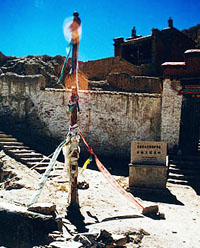
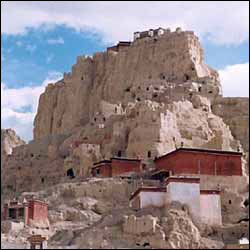
The ruins of the Guge Kingdom are in western Tibet on an isolated plateau at a latitude 4,000 meters above sea level. The remains of a formerly imposing city, comprising 879 cave dwellings, 445 houses, 58 forts and 28 pagodas, stand on a 300-meter-high hill beside the Xianquan River in Zanda County.
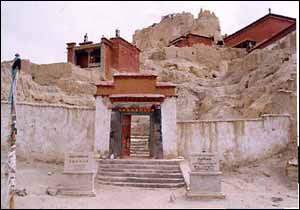
A narrow path from the city entrance leads upward to the Tara Hall, the White and Red Temples and Daweide (Grand Dignity and Virtue) Hall. Murals in the White Temple depict the family trees of the Tubo, Guke and Indian kings, and Red Temple frescos reflect religious events and rites, most notably the joyful meeting, celebrated with dancing to the accompaniment of drums and horns, of Ngari King Yeshe Od and Indian Buddhist master Adisha in 1038. There are well-preserved murals of the Buddha's guardian warriors, knights and gods of war in the Daweide Hall. Despite the passing of several centuries, their colors are still bright and lustrous, and the murals' detailed flowery decorations and occult connotations of Esoteric Buddhism are reminiscent of Indian, Nepalese and even Islamic art.
The path up the hill is intersected with many steep slopes that serve as fortification. Armor, shields, broadswords, daggers and arrows have been discovered in the hillside caves, all in good condition thanks to the dry weather in the region.
The imperial compound comprising more than 40 mud and wood structures is at the hill summit. Buildings are flat-roofed, and one, two and three storied with an average area of 12 to 18 sq m. The palace is to the southeast of the site. The remains of its largest building, a 200 sq m hall, are thought to be where the king discussed state affairs with his officials. It has a mud and cobblestone floor built on pounded sand a traditional Tibetan architectural technique for floors and roofs that is still used in many Tibetan areas. Farther north up the hilltop is a tunnel with a narrow entrance that gradually widens as it winds downward for 20 meters. It leads to the uncompleted underground palace of the Guge king.
The imperial castle is surrounded on all sides by precipitous cliffs that make it inaccessible other than by a 50-meter twisting trail that starts halfway up the hill. Reaching it is no easy task as low, overhanging rocks along the way obscure the light and force the traveler to walk stooping, and the steep, slippery stairs must be climbed with extreme care. It takes on average three hours to cover the 300-meter distance to the hilltop.
Murder Mystery or Funerary Ritual?
The Guge Kingdom is much larger than the ruined city. It was founded 1,300 years ago by a member of the Tubo royal family, and was once the seat of rule over the whole Tibetan plateau. At the height of its power, the kingdom's territory covered all of Ngari Prefecture. It existed for over 700 years and reigned over by more than kings before vanishing in the 17th century.
The kingdom's abrupt downfall is widely attributed to a religious war. Guge subjects were Tibetan Buddhists at the time Portuguese Jesuits entered the region via India. These Portuguese missionaries converted first the queen and then the king. Lamas were appalled, and felt compelled to look to Kashmir for help. This collaboration culminated in the Kashimiri army's invasion and eventually annexation of Guge.
A paper mask in the ruins of the Guge city upon which are written Portuguese quotations from the Bible was a discovery that sent tremors through architectural and historical circles, as it provided indisputable corroboration of the religious war theory.
Human remains in an eerie cave in a cliff 600 meters behind Guge city also provide clues as to the kingdom's demise.
The cave is three meters above ground, 1.2 meters in height and 0.8 meters wide at the entrance. Inside are three chambers, the largest of which has an area of 10 sq m and a tiny niche in the wall. The rear and southern chambers leading off it incorporate two narrow exits, and are even smaller. The chambers contain the remains of 30 human beings and their clothes, some rags and twigs.
All the skeletons are headless, and dried skin and flesh are still visible on many of the bones. The only skull remnants so far found are two mandibles, and a few braided scalps. This would suggest that the corpses were whole when brought in. But no reasonable explanation has been found as to why the heads are missing.
The remains of 10 bodies wear collarless Tibetan robes or are wrapped in baize blankets. Their limbs have been kept in place with tightly bound woolen cords.
One suggested explanation for the cave and its contents is that at the end of the war with Kashmir, the Guge King, seeing no hope of victory, agreed to surrender on the condition that his subjects were not harmed. When the Guge soldiers gave up their weapons, the perfidious Kashmiri invaders slaughtered them all, and dumped their bodies in the cave.
But a young woman's remains and evidence of burial rituals on the site cast doubt on this theory. So who these dead Gugers were-nobility, soldiers or ordinary people-and whether or not their burial followed a massacre remains a mystery.
Heavenly Handicrafts
Lugba Township north of the Guge city ruins was the main source of the silver and gold wares used in the Guge Kingdom. Lugba is Tibetan for "smelter." It was in this township that the metal statues, figurines and ritual utensils used in the 24 chapels of the Thoding Monastery were made. Buddhist figurines were cast in a gold, silver and copper alloy, and so perfectly cast as to leave no seam. This made them more valuable than artifacts made from pure gold.
Lugba was also the only forge producing the much sought after copper "Guge Silver Eye," Buddha statuary. It was not until the summer of 1997 during excavation of another Guge site that this style of figurine came to light. It wears a crown, holds ritual objects in all four hands, and sits cross-legged on a lotus throne. It has three glittering silver gilded eyes on a golden bronze face.
Newly excavated sculptures, carvings and murals in the ancient Guge Kingdom in recent years, together with studies of the distinct symmetry the Guge city remains, are helping archeologists to piece together the story of this lost civilization.
Tips for Tourists
Location: The ruins of the Guge Kingdom are in Zanda County in southern Ngari Prefecture, which borders India to its south. Zanda is 1,500 kilometers from Lhasa, the Tibetan capital, 200 kilometers from Shiquanhe Town in the prefecture capital Gar County, and 1,200 kilometers from Yecheng in Xinjiang Uygur Autonomous Region.
Transportation: There are two routes to Guge city. One is from Yecheng in Xinjiang to Zanda via Shiquanhe Town. The other is from Lhasa to Xigaze, then to Zanda. Taxis from Lhasa to Ngari charge RMB 4/5 per kilometer, and hiring a vehicle and driver costs RMB 12,000 to 14,000 plus the driver's accommodation. A chartered vehicle is needed for the trip from the Zanda County seat to the Guge ruins 18 kilometers west.
Frontier Visitor's Permit: A visitor's permit is required for travel to Zanda. Prospective visitors fill in the appropriate forms at the local police station, and receive the permit, free of charge, the same day.
(china.org.cn via China Today August 6, 2007)