|
Population: 132,394
Major areas of distribution: Inner Mongolia, Heilongjiang and Xinjiang
Language: Daur and Han
Religion: Shamanism
The Daurs live mainly in the Inner Mongolia Autonomous Region and Heilongjiang Province. About several thousand of them are found in the Tacheng area in the Xinjiang Uygur Autonomous Region in northwest China. They are descendents of Daurs who moved to China's western region in the early Qing Dynasty (1644-1911). The Daurs speak a language related to Mongolian and used Manchu during the Qing Dynasty as their written language. Since the 1911 Revolution, mandarin Chinese has replaced Manchu.
The biggest Daur community is in the Morin Dawa Daur Autonomous Banner, which was set up on August 15, 1958 on the left bank of the Nenjiang River in Heilongjiang Province. This 11,943 sq. km.-area has lush pasture and farmland. The main crops are maize, sorghum, wheat, soybeans and rice. In the mountains which border the Daur community on the north are stands of valuable timber – such as oak, birch and elm – and medicinal herbs. Wildlife, including bears, deer, lynx and otters are found in the forests. Mineral deposits in the area include gold, mica, iron and coal.
History
The Daur people are thought to be descended, along with the Ewenkis and Oroqens, from the Khitan nomads, who founded the Liao Dynasty (916-1125). They originally inhabited the lower reaches of the Heilong River.
In the early Qing Dynasty, the Daurs had a diversified economy which comprised fishing, hunting, farming and stock raising. They traded hides for metal implements, cloth and other articles from the more economically advanced Hans.
During the reign of Emperor Shun Zhi (1644-1662), the Daurs moved south and settled on the banks of the Nenjiang River, from where they were constantly conscripted to serve in the armies of the Qing emperors and in garrisons all over the Chinese empire. The Daurs helped to repel Cossack invaders from Tsarist Russia in 1643 and 1651. When the Japanese invaded China’s Northeast in 1931, the Daurs opposed them and helped the resistance forces until liberation in 1945.
Traditional economy and customs
Before the founding of the People’s Republic of China in 1949, the Daurs had a well developed agriculture, with per-hectare yield of grain reaching 350 kg. They raised horses and oxen. Those living in the mountainous north of the area were also engaged in hunting, charcoal burning, edible plants gathering, tanning, and the manufacture of carts and wooden pipes. Distribution of land and animals was very uneven, with the big landlords exploiting the majority of the people.
Monogamy was the general rule, and marriages were arranged by the parents. A man from a different clan would go to live with his wife's family, but had no claim of their property. Closest ties are those between brothers-in-law. All important celebrations require the presence of the brothers-in-law and their families, who send gifts to new-born children.
The religion of the Daurs was shamanism, while a few were followers of Lamaism. The biggest festival of the year was held in May, when pigs and oxen would be sacrificed to the gods to ensure prosperity for the coming year. At the Spring Festival, sacrifices were made to the ancestors and firecrackers set off in the evening. Everyone joined in a round of visits to their neighbors to partake of steamed New Year cakes and give presents of various delicacies.
Pipes are passed to visitors, men and women alike, as a sign of respect. Girls make elaborate tobacco pouches and slip them into the pockets of young men who take their fancy.
Wrestling, horse racing and archery are popular sports among the Daurs. They also play a kind of football with a ball made of ox hair.
Daur villages are neat, usually built on mountain slopes and facing streams, and the houses have courtyards surrounded by wickerwork fences.
The women have always been renowned for their needlework, decorating their clothing with fine patterns. Men wear straw hats in summer or simply tie a piece of white cloth around their foreheads. In winter they wear leather caps with ear flaps. Women wear white cloth socks and patterned shoes in summer, donning leather boots and long gowns in winter.
Typical of the daily diet of the Daurs is millet or buckwheat noodles mixed with milk, buckwheat cakes and oat porridge cooked with soybeans. Game figures high on the list of Daur delicacies, especially deer meat, pheasant and duck. They cultivate a variety of vegetables.
Inseparable from the Daur scene is the "leleche" -- a small cart with large wheels drawn by an ox.
Cultural life
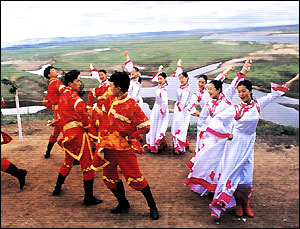
The Daurs have a rich repertory of folk dances which they love to perform during festivals. Women participate in group singing and most women own a musical instrument called a "mukulian." Men play a similar instrument, but the women are the most accomplished players.
Daur folk literature is mostly based on observations of nature, but it also contains a wealth of legends and fables. One of their most popular stories is called "The Young Stalwart and Dai Fu." It tells of the struggles of the Daurs against national oppression and their feudal rulers in the latter part of the 19th century. Also famous among the Daurs are stories by Ahlabudan, a Qing Dynasty author, such as "Fringed Iris Pouch," "Song of the Four Seasons" and "Song of Refraining from Drinking." Also well known are tales adapted from classical Chinese novels. The best-read contemporary works are those by a Daur writer named Qin Tongpu, such as "A Farmer's Song," "Song of the Fishermen" and "Song of the Lumbermen." The Daurs have a love for poetry, which they compose in several unique verse forms. Their long winter evenings are also enlivened by oral literature, riddles and proverbs, as well as handicrafts such as toy making, embroidery and paper cuts.
The dead are buried in graveyards arranged according to family lineage. Buried along with the deceased are ornaments, tobacco pipes, cooking utensils, and sometimes slaughtered horses.
(China.org.cn June 21, 2005)
|