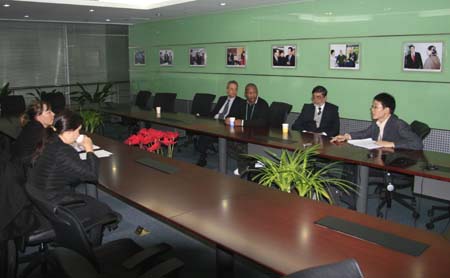
On November 22, China.org.cn interviewed four sustainable energy
experts who were attending the two-day International Conference of
Rural Energy Development in China, jointly organized by the UNDP
and the Office of the State Council Energy Leading Group in
Beijing. The four experts; Ms. Kelly Hayden from Australia, Mr.
Monga Mehlwana from South Africa, Mr. Ronaldo Seroa da Motta from
Brazil and Mr. Anil K. Rajvanshi from India, talked about their
theories and concerns regarding renewable energy, the role of
government and the process of change toward sustainable energy
resources.
China.org.cn: Please tell us how you think
renewable energy sources can be developed in China.
Anil K. Rajvanshi: I think China can follow the
path that we are trying to take in India instead of simply copying
the western countries, especially the United States. Energy is the
basis of life, and in India the greatest percentage of people are
employed as farmers, just as in China. So I believe that the
availability of affordable energy in rural areas is the only way to
improve the quality of life among rural residents. We need to offer
energy production via agriculture in conjunction with high
technology devices in order to provide for basic needs: cooking,
lighting and clean water in rural areas. Biofuels, liquid – such as
ethanol, gas, such as methane and electricity must be supplied. In
India we use sweet sorghum to produce ethanol; this could also be
done in China.
China.org.cn: China is experiencing rapid
economic growth; how can we use this growth to promote sustainable
energy resources?
Ronaldo Seroa da Motta: That's a good question.
As an economist I can tell you rich people, not poor people,
consume that 80 percent of the total energy worldwide; so the real
question becomes: why don't they switch to renewable resources?
Anil K. Rajvanshi: Because they are greedy.
Rich people forget about the quality of life and everything for
them becomes a numbers game; how many houses, how many cars, how
much money invested here and there.
Monga Mehlwana: As far as I can tell,
particularly in South Africa, renewable energy is usually
associated with the poor, not the rich; this is the public
perception. It's not popular yet; there is not enough information
out about renewable energy, especially among the poor.
Anil K. Rajvanshi: I firmly believe that to
change the way a system works one must start with himself. It may
sound small and insignificant to begin with one person but that is
the way ultimate change happens, in India, in China, anywhere in
the world. Another key is to harness the enthusiasm and energy of
youth; the younger generation could change the current energy
mindset. The transition from steam to oil took a long time but when
it happened it was a paradigm shift. Right now oil technology is
centralized, everything is in place and profits flow from it. When
you talk about technology paradigm shifts you must allot time for
change.
Monga Mehlwana: The government must also show
the people other alternatives; government leaders are responsible
for guiding change.
China.org.cn: What about protecting the poor?
How can we provide enough energy for the rural poor in China?
Monga Mehlwana: You know, energy is like blood:
you don't think about it directly for your life but we all need it
to live.
Ronaldo Seroa da Motta: As an economist I think
that if you want to provide for the poor, give them a certain
allotment of energy for free. It doesn't make sense to levy a
higher tax on the rich for using the same amount of energy; I know
they fine drivers according to income brackets in Finland but
that's a very small homogeneous country with a wealthy population
and steady economic history; it wouldn't work in a huge country
like China. And besides, the rich will use more energy than the
poor, so they'll pay more in the end result. I feel that, instead
of a cross subsidy the government could give the poor direct
subsidies. It's a mistake to have different prices for people in
different income categories.
Monga Mehlwana: South Africa does indeed have a
policy of providing direct subsidies to the rural poor, but there
are problems within this system. First of all: who is entitled to
the subsidy: how poor is poor? And then there are people who cannot
use up the energy, maybe they don't have electrical appliances, so
they end up selling their allotment. There are unintended
consequences to these kinds of subsidy deals.
Ronaldo Seroa da Motta: In any case, I think
technology-based solutions to provide adequate energy won't
succeed; we must depend upon pure economics. Just developing a new
technology is not enough. The market economy is the best thing a
country can provide its rural poor and the rest of its citizens as
well. China is a shining example of this. The previous planned
economy in Russia wreaked havoc on the environment and in China, I
assume, as well. The tragedy of the commons has been repeated
throughout history; privatization and market economies are much
more responsible than closed systems. And as far as developing new
renewable resource technology – it will never change the path the
world is going toward unless economics is directly involved.
Anil K. Rajvanshi: Technology does help but the
levels must be suitable for the population it serves, and the type
of power generation facilities must be operated at the grassroots
level so that the people are directly involved and they can manage
the power they use: this is a way of personalizing power rather
than depersonalizing it and putting it in the hands of unknown
bureaucrats, who may be wasteful, ignorant or uncaring about the
people who need this power. Also, I think we all must try as best
as we can as individuals to promote renewable resources and live at
sustainable levels. We should all make individual efforts to
support sustainable, renewable energy and purchase vehicles and
machines that promote this kind of technology. It is already
available, and I have spent most of my life trying to invent
devices that follow these precepts.
Ronaldo Seroa da Motta: Why would I buy a clean
car if air pollution remains the same? The answer goes above
individual actions. Mechanisms to cope with these problems are
found in market economies. If something goes wrong you can assign a
price to it, price mechanisms rationalize nefarious things like
pollution and profit is a leading motivation for development.
Anil K. Rajvanshi: Granted, the government must
take an active role creating policies to allow free enterprises to
work effectively. Without their policies the country is like an
ostrich with her head in the sand, ignoring environmental
destruction. In other countries, especially western countries that
developed industrially like China is doing today, private industry
and business would have polluted everything if not for governmental
lobbies.
Monga Mehlwana: Indeed. We need to allow
government a role in all kinds of issues regarding energy and the
environment but regarding subsidies we must be careful. They often
create wasteful tendencies in business and industry, they can
actually promote energy inefficiency and they can benefit the rich
rather than serve the rural poor.
China.org.cn: How much should energy cost?
Should the government subsidize the cost?
Kelly Hayden: A good way to apply an energy
subsidy is to look at the Thai government. First, they levied the
price of oil. From this tax a fund for conservation and education
was created. Then a second fund for public transport as well was
enacted. Second, their pricing structure looked initially like
people were paying more at the outset, but actually they were
saving more because of the benefits they received overall. The
transportation and distribution channels determine how a country
can save energy in the long run. Thinking of alternatives and
developing scenarios that not only cut emissions but also
incorporate other societal benefits is the key.
Monga Mehlwana: South Africa can learn from
China because it is already a great success story. The central
planning is thoughtful and China is traditionally a very
resourceful country. China has done things much faster than any
other country; part of this is due to the fact that the government
has a strong sense of social responsibility.
China.org.cn: Can you comment on pollution
caused by fossil fuels and how to create a sustainable energy
policy?
Anil K. Rajvanshi: I may be repeating myself
but I still think awareness is the first step in creating a
sustainable energy policy. We need to tell people how necessary it
is to reduce their energy consumption. I am an inventor and a
thinker: I believe education is the key to change. Also I believe
that what really affects us comes at the personal level.
Ronaldo Seroa da Motta: Inventors and engineers
are optimists: as an economist I think that only economics creates
change because it directly affects technological innovations.
The USA, a wealthy country, fails to participate in the Kyoto
protocols. How can China take responsibility for pollution and
advocate renewable energy if the USA doesn't cooperate?
The Kyoto protocols are just the beginning. It is still very
difficult to believe that without any price recommendations
promising technology to replace fossil fuels will go into
widespread usage. As fossil fuels become scarcer and scarcer and
pollution worse everyone is going to have to sit up and take notice
because competition for resources will create bigger problems than
we have right now.
Anil K. Rajvanshi: That's true. All the major
world wars, as far as I'm concerned were and are resource wars. If
China develops amazing renewable resources it will not only help
her people but also promote world peace.
Kelly Hayden:?That's right, and also I
feel that the environment and the economy don't have to be at odds
with each other; it shouldn't be a trade off, one for the other;
rather it should be a complementary process.
Ronaldo Seroa da Motta: The world has followed
the path of rich countries like the USA. Perhaps this is faulty
because their current market mechanism does not take into account
the environmental and social costs.
Kelly Hayden: We need more integrated
mechanisms. Right now many developed and developing countries are
locked into inefficient paradigms. The real costs, even with urban
planning, have hidden social costs and negative environmental
impact.
Anil K. Rajvanshi: Yes, we need to leapfrog
over the systems of developed countries. China is in an ideal
position to do just that, but to do this we must keep in mind that
the entire world also requires new technologies. Many amazing
things are in the process of being developed, especially under the
auspices of national defense and the space programs, especially in
the USA, so even if the Americans aren't cooperating with the Kyoto
accords they are still developing inadvertent gifts to humanity.
For example, thermo-electrics has made quantum leaps. Awareness,
plus education, plus technology equals positive change.
Monga Mehlwana: Technology, along with
responsible government, will help China and the world to succeed
energy-wise.
Ronaldo Seroa da Motta: And don't forget to
keep the free market in place.
(China.org.cn by Valerie Sartor November 23, 2007)