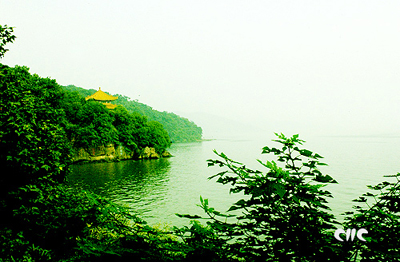
For 73-year-old fisherman Ni Tingrong, who lives in a village on
the northwestern shore of Taihu Lake, China's third largest
freshwater lake, the idyllic scenes portrayed in the folk song
"Beauty of Tai Hu" are confined to memory.
The lyrics go something like this: "Green reeds at the water's
edge, rich in fish and shellfish at low tide, the lake water weaves
through irrigation nets and the fragrance of fruit and rice wafts
up from the lake."
But the modern-day reality is far from poetic.
"Just 20 years ago, I fished in the lake and the rivers nearby
almost everyday," said Ni, who began working as a fisherman at the
age of 14. "But pollution has only left us blue-green algae and the
odor of dirty water, the fish stocks are drying up."
Taihu's nightmare
Covering an area of 2,400 square kilometers in east China, Taihu
Lake is a major source of drinking water for people living in
Shanghai and Jiangsu and Zhejiang provinces. Historically a rich and
fertile area, the lake region has become one of the most populous
and prosperous regions in the country with 33.5 million people
living in the surrounding area.
However, the lake has come under increasing environmental strain
for years as untreated sewage from towns and villages, as well as
the region's booming chemical and light manufacturing industries,
have choked its water with pollutants.
The fine line between rapid economic growth and continuous
ecological degeneration was crossed in May when a large bloom of
blue-green algae was found to have swamped the lake. The
combination of the low water level and the accumulation of waste
and untreated sewage had triggered the algae bloom, turning the
water putrid and cutting the water supply to more than two million
residents.
Workers collected thousands of tons of algae from the lake and
residents raced for bottled water.
It was not the first time Ni had seen the lake water clogged up
with waste in his hometown of Zhoutie, outside Yixing City, in
Jiangsu Province, home to more than 100 chemical plants.
"Actually, all the families in our village have been using water
from the nearby well, instead of that from Taihu Lake, as drinking
water since 1998, because the lake water had a weird smell of
chemicals," said Ni.
The old man said Zhoutie Town saw its first chemical plant 15
years ago and so many others followed in the space of one decade
that the town soon won a reputation as the "hometown of chemical
plants".
The booming chemical industry has inspired the economic growth
of Zhoutie Town, but the industrial waste has also brought
environmental disaster to its residents with urban sewage and
chemical fertilizers from agriculture.
"Black water flows directly into the lake. Soon fish in the
rivers nearby died and we had to fish in the large lake, " said
Ni.
"There is still fish in the lake, but the quantity is reducing
because the lake is being polluted too."
Zhoutie Town is no exception to the Taihu Lake region. Around
20,000 chemical plants that cluster in the Taihu valley have had a
drastic effect on the water quality of the lake.
Experts say that the lake's environmental problems include
accelerated eutrophication, or aging, caused by nitrogen and
phosphorus enrichment. These materials cause an overgrowth of algae
and further deterioration, including oxygen depletion.
Investigations from the State Environmental Protection
Administration (SEPA) show that the content of nitrogen in the lake
in 2006 was three times the amount in 1996, while the content of
phosphate pollutants had increased 1.5 times in the 1996-2006
period.
To mitigate the lake's environment pressure, all towns around
Taihu Lake have been ordered to establish sewage treatment plants
and are forbidden from discharging untreated sewage into the lake
and rivers in the Taihu valley.
Existing plants must also install nitrogen and phosphorus
removal facilities and those that fail to meet the raised water
emission standards risk suspension. They will be shut down
permanently if they still fail to meet the standards by the end of
next June.
In addition, more than 1,000 small-sized chemical plants that
are scattered around rivers and lakes have been closed since June
in the cities of Wuxi, Suzhou and Changzhou in Jiangsu.
In Zhoutie alone, 93 chemical plants were closed in the past
three months and more than 40 others are left, said Wu Xijun, Party
chief of the town's government.
"After the algae incident, voices to reform the chemical plants
are coming from everywhere and we have felt more pressure than
ever, so we know we have no other choice but to close the plants,"
said Wu.
"I hope the policies will be faithfully implemented," said Ni, "
or what an irony it will be, if we have no water to drink though
the lake is right before our eyes."
Plateau lake's uncertain future
While people living around Taihu Lake were haunted by algae,
thousands of kilometers away in the northwestern province of Qinghai, farmers and herdsmen living around
Qinghai Lake, the country's largest saltwater lake, were busy
preparing to receive tourists from all over the world.
Perched more than 3,200 meters above the sea level, the
4,300-square-km Qinghai Lake, located in the northeast of
Qinghai-Tibet Plateau, is not only a "Holy Lake" to Tibetans, but
also home to 189 species of birds and a crucial barrier against the
desert spreading from west to east. With a slim population of more
than 70,000, the Qinghai Lake valley is historically a land for
farming.
"Generally speaking, the lake is healthy thanks to few
industrial projects even till now", said Zhao Haoming, head of the
provincial environment protection department.
Beautiful scenery has drawn more and more tourists to the lake
in recent years. According to Dong Lizhi, deputy manager-general of
the Qinghai Lake Tourism Development Co. Ltd, more than 890,000
people visited the lake in 2006 and by July this year, the lake had
received more than 500,000 tourists and the figure was expected to
hit one million by the end of this year.
Degyi, 19-year-old Tibetan girl who grew up in a nomadic family
living by the lake, has been getting used to her new role as a tent
restaurant waitress.
Like many of their neighbors, Degyi's father began to set up two
white tents four years ago on the grassland on the southern shore
of the Qinghai Lake, to receive tourists. Visitors are provided
with traditional Tibetan food like boiled mutton, milk tea and
yogurt made of yak milk. They can also rent a horse to pose for
pictures or for riding.
Though the business only lasts from May to October, Degyi's
family is able to earn more than 15,000 yuan every year, accounting
for two thirds of the family's annual income.
However, with booming tourism comes pollution. The waste
produced by hotels and restaurants have been discharged into the
lake without being properly treated and garbage, such as crisp
packets and plastic drink bottles left behind by tourists, are
frequently found around the lake.
In addition, the lake is threatened by global warming and
encroaching desert. Statistics with the provincial environment
protection administration show the lake shrunk more than 380 sq km
between 1959 and 2006 and the average water level dropped three
meters to the present level of 18 meters.
More than 111,800 hectares of land around the lake has been
suffering from desertification brought about by overgrazing around
the lake and global warming, according to the provincial forestry
department.
To curb ecological degeneration on the lake, China has invested
470 million yuan on recovering the plants around the lake and
dealing with desertification. Local government has also banned
fishing in the lake since 1982.
A latest move taken by Qinghai is to ban the construction of
permanent buildings around the lake.
"Not only the projects under construction have been stopped, the
hotels, restaurants, and shops near the lake shore will be torn
down," said Jetik Majil, vice governor of the province.
According to Jetik, under a new tourism development plan around
the lake which is expect to be enacted next year, permanent
buildings such as hotels, restaurants and tourist service centers
will be relocated to an "accommodation zone" at least three
kilometers away from the southern shore of the lake.
"Grassland will be restored after the buildings are demolished.
In the future, tourists can only tour around the lake by riding
horses and bikes, taking shuttle buses powered by electricity or
walking on a boardwalk," said the vice governor.
"For a province like Qinghai which falls far behind many of our
counterparts in terms of economic development, to improve GDP
growth is very important to us", said Jetik. "However, we can't
afford to taking the old road of developing first, cleaning up
later."
New perception of development
Protecting the environment and sustainable development are now
part of China's national strategy, which calls for a "scientific
concept of development".
The new policy put forward by the Central Committee of the
Chinese Communist Party of China in 2003 has been calling for
coordinated development between urban and rural areas, among
different regions, between economic and social development, between
the development of man and nature, and between domestic development
and opening up to the outside world.
"The new perception of development has been set out to halt the
trend of local governments, in both economically developed coastal
areas and underdeveloped inland areas, pursuing economic growth at
cost of ecological deterioration and many other negative social
consequences," said Ma Jun, director of the Beijing Public and
Environment Affairs Institute.
The Taihu Lake algae incident again clearly demonstrates a
conflict between China's development and environmental protection
and "the root cause of the problem is the evaluation system of
Party and government officials based on GDP figures," he said.
A national investigation of the Ministry of Water Resources
shows that more than 70 percent of China's waterways and 90 percent
of its underground water is contaminated by pollution.
Ma's comments were echoed by Wu Xijun, Party chief of the
Zhoutie Town government.
"The booming chemical industry in our town is somehow related to
the GDP evaluation system," said Wu, who came to his current post
in 2005. "The chemical industry is helping to resolve the local
employment issue and encourage economic growth and increase GDP,
which will reflect leaders' achievements."
The central leadership has also detected the dark side of the
GDP evaluation system, and has been working on new systems of Green
GDP or Happiness Index, which put public opinions into
consideration.
"In the past two years, the evaluation system for officials has
taken on great changes. Economic growth is not the only major
factor and residents' satisfaction with their living environment
has become another major index," said Wu.
Zhoutie Town has banned construction of chemical plants since
2005 and the existing factories have been ordered to meet water and
gas emission standards.
After the large scale reform of the chemical industry, the
town's GDP ranking has fallen from the third in Yixing City to the
sixth, according to Wu.
"But I think it's worthwhile as our living environment has an
opportunity to recover. A place with a better environment has more
space for future development," said Wu. The town plans to import
high-tech projects and develop tourism in the future.
"The scientific concept of development will not be a mere
political slogan or a catchphrase," Ma said. "After being in
practice for four years, the Party, government and the people have
realized it will be the only right way of China's future
development."
Government actions are already in the pipeline. The State
Council, China's cabinet, has called for research on green taxes,
looking at using a tax to bolster environmental protection. New
research and trials on environmental tax and compensation policies
are also underway. The authorities will audit the environmental
records of listed companies, hold trials of compulsory
environmental liability insurance, and strengthen oversight of
export firms' environmental standards.
And the new perception of development is also winning more and
more support from the public.
The Tibetan girl Degyi does not know exactly what the new
concept means, even though she claimed to have heard about it on
television. However, she and her family show understanding and
support to government policy to end their tent restaurant business
near the Qinghai Lake.
"When I was young, there are many farms around the lake and
people launched a campaign of what they called 'opening up the
wasteland', which resulted the dropping of the water level and the
expansion," said Huage, 43, Degyi's father. "I don't want to see
that keep happening."
Huage has applied to open new tent restaurants in the
"accommodation zone".
"It is the most beautiful scenery to see tourists riding horses
on the green grasslands by the lake and I hope this is able to last
forever," said Degyi.
(Xinhua News Agency October 10, 2007)