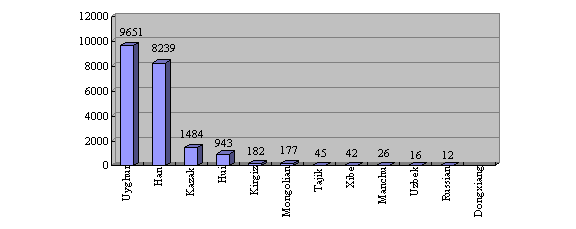
The Xinjiang Uyghur Autonomous Region is inhabited by people of many ethnic groups. According to the fifth national census in 2000, Xinjiang is home to people of 55 ethnic groups, including the Uyghur, Han and Kazak. In 2008, Xinjiang's population totaled 21.308 million, of which people of ethnicities other than the Han was 12.945 million, or 60.8% of the total. In 2007, there are three ethnic groups each with a population over one million, namely, Uyghur (9.651 million), Han (8.239 million), Kazak (1.484 million); three ethnic groups each with a population between 100,000 and one million: Hui (943,000), Kirgiz (182,000), and Mongolian (177,000); and six ethnic groups each with a population between 10,000 and 100,000: Tajik (45,000), Xibe (42,000), Manchu (26,000), Uzbek (16,000), Russian (12,000), and the Dongxiang. The population of all the other ethnic groups is less than 10,000.
Fig. 9 Ethnic Groups in Xinjiang with Population over 10,000
(Unit: 1,000 persons)
?Xinjiang has been inhabited by diverse peoples since ancient times. The inhabitants of Xinjiang all migrated from other areas historically. According to historical records, in 101 BC the Han Dynasty (206-220 BC) began stationing garrison troops to open up land for crop cultivation in Luntai (Bügür), Quli and other areas. Later, it sent more troops to all other parts of Xinjiang for the same purpose. After the the Protectorate of the Western Regions was established in 60 BC by the Han central government, the inflow of Han people to Xinjiang, including officials, soldiers and merchants, never stopped. By the end of the dynasty, Han residents could be found in scattered settlements in Xinjiang, with garrison reclamation points forming compact communities. The Han thus became one of the earlier peoples who inhabited Xinjiang. After 1759, the government of the Qing Dynasty sent Manchu, Mongolian, Xibe, Daur (Suolun), Han and Hui troops to Xinjiang in order to strengthen the frontier defenses of the region, and encouraged Uyghurs to move from southern Xinjiang to Ili in the north, as well as Han and Hui people from inland areas to migrate to Xinjiang to promote production. From the late 19th century to the early 20th century, a great number of Russian, Uzbek and Tatar people settled down in the region. When the People's Republic of China was founded in 1949, Xinjiang was comprised of 13 ethnic groups, with Uyghurs as the majority. Each ethnic group was characterized by living together or mixing with other groups, or in compact communities. The majority in southern Xinjiang were Uyghurs, while northern Xinjiang was mainly inhabited by Han and Kazak peoples. The Kirgiz, Xibe, Tajik and Daur peoples mostly lived in compact communities, while most of the remaining ethnic groups reside scattered among other groups.
Since the founding of the PRC in 1949, an increasing number of people have moved to and from Xinjiang, making more prominent the phenomenon of a multiethnic population living together. Especially since reform and opening-up in 1978, many citizens, guided by market forces, have frequently moved simultaneously and on their own will between Xinjiang's rural and urban areas, between its northern and southern areas, and between Xinjiang and other inland areas, for the purposes of education, employment, business or job-seeking. In 2008, about 240,000 surplus laborers went from Xinjiang to work in the economically developed coastal areas. In addition, there are large seasonal flows of people moving within Xinjiang or between Xinjiang and other inland areas. Each year from late August to November, hundreds of thousands of people from other provinces and municipalities go to Xinjiang to pick cotton.
The socio-economic development of Xinjiang has given rise to a recurrent flow of labor, leading to a series of changes in the population and ethnic distribution in the region. First, the number of ethnic groups has increased. In 2000, except for the Jino people, Xinjiang was inhabited by people of 55 of China's 56 ethnic groups. Second, the population of almost every ethnic group in Xinjiang is increasing. From 1978 to 2007, the populations of the region's four largest groups — Uyghur, Han, Kazak and Hui — have increased, respectively, 74%, 61%, 81% and 78%. Third, the percentage of the population of each minority in their traditional settlements has decreased. For example, the ratio of Uyghurs in southern Xinjiang's three prefectures, namely, Kashi, Hotan and Aksu, to the total Uyghur population in Xinjiang fell from 84.6% in 1944 to 71.5% in 2007. The percentage of Kazaks in the Kazak Autonomous Prefecture of Ili to the entire Kazak population in Xinjiang decreased from 83.4% in 1944 to 76.8% in 2007. Fourth, the multiethnic mixture in the cities and towns of Xinjiang has become more prominent, and the population of ethnic minorities has increased in the cities. Urumqi, the capital of the autonomous region, is inhabited by people from 52 ethnic groups, and the percentage of minority residents in the city's total population increased from 18% in 1978 to 27% in 2007.
The diverse peoples of Xinjiang have formed deep friendships while living together for generations. Over the last 60 years, they have established, developed and consolidated strong ties of mutual respect, trust, support and harmony. These make up the important contents and fundamental guarantees for the advancement of Xinjiang.
Recognizing the existence of each ethnic group and guaranteeing its equal rights in every aspect is the fundamental principle and policy of the Chinese government to handle ethnic problems. It is also the foundation of all other policies concerning the ethnic issue. The Constitution of the PRC stipulates: "All ethnic groups in the People's Republic of China are equal. The state protects the lawful rights and interests of ethnic minorities, and upholds and develops the relationship of equality, unity and mutual assistance among all of China's peoples. Discrimination against and oppression of any ethnic group is prohibited; any acts that undermine national unity or instigate secession are prohibited." In Xinjiang, citizens of every ethnic group enjoy the rights prescribed by the Constitution and laws, including freedom of religious belief, and rights to vote and stand for election, to equally administer state affairs, to receive education, to use and develop their own spoken and written languages, and to preserve and advance the traditional culture of their own peoples.
Over the past 60 years, China's central government and local governments in Xinjiang have made tremendous efforts to protect equal political rights and social status for each and all of Xinjiang's peoples, and achieve their common development and prosperity. Before the founding of the PRC in 1949, there were still remnants of feudal serfdom in some areas of southern Xinjiang, and in certain individual areas serfdom was even found intact. In the 1950s, democratic reform was carried out in Xinjiang. The abolishment of the old system enabled minority peoples to enjoy basic human rights, with their rights to participate in the administration of state affairs under special protection. In the previous terms of National People's Congress (NPC), deputies were selected from minority communities in Xinjiang for proportional representation. All 60 deputies in the Xinjiang delegation to the 11th National People's Congress came from 11 ethnic groups, and 60% of them were ethnic minorities. At present, some members of the NPC Standing Committee and the leadership of the Chinese People's Political Consultative Conference are from Xinjiang's minority ethnic groups. In the local people's congresses of Xinjiang, there are deputies from each ethnic group who live in compact communities. In the Ninth People's Congress of the autonomous region, the 542 deputies were comprised of 13 ethnicities, and the proportion of minority deputies accounted for 65.5%, four percentage points higher than the ratio of the minority population to the total population of the region.
In Xinjiang, political equality for the various ethnic groups is realized mainly through the system of ethnic regional autonomy. Under the unified leadership of the state, implementing ethnic regional autonomy in place where ethnic minorities live in compact communities to allow them to manage their own internal affairs is a basic policy for China to resolve ethnic problems; it is also an important political system of China. Founded in 1955, the Xinjiang Uyghur Autonomous Region is an ethnic autonomous area with the Uyghurs as the principal body of the local population. Within the territory of the autonomous region, there also exist areas where other minorities live in compact communities. Thus, five autonomous prefectures for four ethnic groups — the Kazak, Hui, Kirgiz and Mongolian — have been established, in addition to six autonomous counties for five ethnic groups — the Kazak, Hui, Mongolian, Tajik and Xibe, and 43 ethnic townships. Xinjiang is the country's only autonomous region with autonomous areas at all three administrative levels (region, prefecture and county). When it comes to the composition of deputies to the people's congresses and the appointment of cadres, the region's autonomous organs at each level have adhered to the principles of equal participation and common management, so as to ensure that all peoples become masters of the country. In light of actual conditions, these organs shall formulate and implement autonomous laws, local laws, and decisions of legal force, to safeguard their rights of autonomy in accordance with the law. By the end of 2008, the people's congress of the autonomous region and its standing committee had altogether enacted 127 local laws and regulations, and approved 28 statutory resolutions and decisions, and approved 100 local laws and regulations formulated by Urumqi City and the governments of the various autonomous prefectures and counties.
The state and the autonomous region have always considered the selection, training and employment of cadres from among ethnic minorities to be a key to carrying out the policy of ethnic regional autonomy. A large number of outstanding cadres of minority origin have been trained and fostered by being sent out for study, receiving training, working at the grassroots level, or at different places through job exchanges or on rotation basis. In this way, the numbers of cadres have increased, their overall quality improved, ensuring corresponding percentages of such cadres at various levels and categories. The number of Xinjiang's cadres from minority ethnic groups was 46,000 in 1955, 67,000 in 1965, 93,000 in 1975, 202,000 in 1985, 272,000 in 1995, 340,000 in 2005 and 363,000 in 2008. The last figure accounts for 51.25% of the total number of cadres in Xinjiang. In today's Xinjiang, the heads of the autonomous region, autonomous prefectures and autonomous counties, as well as the heads of the standing committees of local people's congresses, the presidents of the people's courts and the procurator-generals of the people's procuratorates at corresponding levels are citizens from the ethnic group(s) exercising regional autonomy in the areas concerned. An overwhelming number of the heads at the prefecture and city levels are citizens of ethnic minority origin.
Fig. 10 Numbers of Ethnic Minority Cadres in Xinjiang (Unit: 1,000 persons)

?The government of the autonomous region has adopted a variety of special policies and measures to implement and protect all its peoples' equal rights in political and social life. Promulgated in 1993 and revised in 2002, "Regulations for Work Concerning Spoken and Written Languages in the Xinjiang Uyghur Autonomous Region" enshrines in legal form the equal rights of all peoples in terms of their own spoken and written languages, encouraging people to study the spoken and written languages of other ethnic groups. Enacted in 1996, "Measure Concerning Implementation of the PRC Law on Protection of Consumer Rights and Interests in the Xinjiang Uyghur Autonomous Region" stipulates that all commodities produced and sold in the autonomous region should have both the relevant minority and Han Chinese languages written on their packaging and users' manuals; that business operators who have the Muslim phrase "halal" (qingzhen) or its symbol visible on their business premises or on food packaging or labeling, should be approved by ethnic affairs administrative departments of the people's government above the county level.
The state adheres to the principle that the spoken and written languages of all peoples are equal, and opposes linguistic privilege in any form. In light of actual conditions in Xinjiang, the government of the autonomous region promulgated, respectively in 1988 and 1993, "Provisional Regulations of Administration for the Use of Minority Languages in the Xinjiang Uyghur Autonomous Region" and "Regulations for Work Concerning Spoken and Written Languages in the Xinjiang Uyghur Autonomous Region," which legally enshrine the freedom and rights of ethnic minorities to use their own spoken and written languages. Now, Xinjiang has 13 ethnic groups inhabiting there for generations and using 10 spoken and written languages. The government organs of the autonomous region, prefectures and counties, in handling public affairs, use the language of the ethnic group exercising autonomy in that particular area as well as the Chinese language. Spoken and written languages of the minority peoples are widely used in news, publishing, radio, movies, and television programs. The Xinjiang Daily newspaper is printed in Uyghur, Han, Kazak and Mongolian languages, while the Xinjiang Television Station broadcasts its programs in the same four languages. The Xinjiang People's Publishing House uses the above four languages plus the Kirgiz and Xibe languages for its publications. Over 70% of books and audiovisual products published in Xinjiang use minority languages.
Respecting ethnic minorities' folkways and customs is an important aspect of ensuring equal rights for all peoples. State and local governments in Xinjiang have formulated a number of policies and regulations to show respect for and protect the customs of minority peoples in terms of food, attire, festivals, marriage and funerals, while acknowledging that all peoples have the freedom to maintain or reform their own folkways and customs. Every year the government of the autonomous region makes specific arrangements to guarantee the production and supply of meats and other foodstuffs consumed daily by ethnic minorities, so as to ensure the production and supply of special foods for all communities, especially the 10 groups believing in Islam. In Xinjiang, on the Ramadan and Kurban festivals, all Muslim communities may enjoy statutory holidays, while those of Russian background may observe their own statutory holidays such as Christmas and Easter.
Ethnic unity is central to guaranteeing equality among all China's ethnic groups. The state protects the legitimate rights and interests of ethnic minorities, while opposing estrangements, discrimination, hatred and conflicts between ethnic groups, as well as big ethnic chauvinism, especially Han chauvinism, and local nationalism. In Xinjiang, striving for unity among all its ethnic groups is of specific significance, because it is an important guarantee for accomplishing all work in the region. Over the years, the government of the autonomous region has strongly promoted the idea that "Everyone treasures the idea of ethnic unity, understands the policies on ethnic issues, and strives for and contributes to ethnic unity." Through their experience, the people of all ethnic groups in Xinjiang have come to the conclusion that "the Han Chinese cannot live without the minority groups, that the minority groups cannot live without the Han Chinese, and no one minority group can live without the other minority groups (known as the ‘three inseparable ties')." In 1982, Xinjiang took the lead in China to launch a campaign of commendation activities for endeavors towards ethnic unity. So far, the region has held five conferences commending a total of 862 model units and 1,520 exemplary individuals. Since 1983, the government of the region has launched an "educational month of ethnic unity" in May throughout the whole region, carrying out intensive and extensive public education work concerning ethnic unity. Now this work has been ongoing for 27 years. Xinjiang's primary schools right up through its universities, all include in their syllabuses courses concerning ethnic unity and knowledge of other ethnic groups. Through constant education, people of all communities in Xinjiang have been suffused with the concepts of equality and unity, and the idea of "three inseparable ties," and treasuring mutual support, respect and love has become a common practice.
In Xinjiang, ethnic relations featuring equality, unity, mutual assistance and harmony are reflected in every aspect of social life. Influenced by their traditional ways of production and life, the Uyghur and Hui peoples tend to focus on business and food services, while Han people would grow vegetables, and Kazaks are more inclined toward pasturing. With their respective strengths, they have cooperated with one another, aiming at common development in a unified market and with the same production objectives. The unified social system, common political and economic organizations as well as shared community living have all helped form stable cooperative relationships between different communities and have made them become closer comrades, colleagues, neighbors and friends, thus greatly enhancing their understanding and friendship. According to a questionnaire survey conducted in more than 10 counties (or cities) in 2004 and 2005, among the Uyghur and Han urban residents, those who have more than two friends from other ethnic groups accounted for 65% and 61%. Those who have no friends outside their own ethnic group made up 30% and 29%. In recent years, intermarriages have increased between people of different ethnicities. In Urumqi, the percentage of intermarriages in the city's registration was 2.1% (218 couples) in 1980, while the figure rose to 5.9% (811 couples) in 2003. In Tacheng, the percentage of intermarriages in the city's registration was 5.5% in 1995, rising to 39.5% in 2003. According to a 1987 survey conducted in a neighborhood inhabited by people from four ethnic groups, among 141 who have linguistic abilities, 48 people can use two languages, 16 use three languages, six use four languages, and one person could use five languages. Each time Muslim communities, such as Uyghur, Kazak and Hui, celebrate the Ramadan and Kurban, or when Han and Mongolian peoples celebrate their Spring Festival, friends and colleagues from other ethnic groups would send their best wishes and share in the festive celebrations.