Development road to gold is paved green
 0
0 


She has more than a taste of two different lives. First, she has had the privilege of going to two of the best institutions in the US and the UK (Harvard University and Imperial College, London) and returning to China to the comfort of Beijing's Finance Street to establish its financial regulations and set up some of its first national funds. Second, she is living a life most social activists would be proud of: advising the government of the country that is one of the largest greenhouse gas emitters on climate change and new energy.
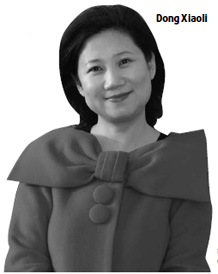
Dong Xiaoli was trained to be an insurance expert and was one of the main brains behind China's first national health insurance system 10 years ago. But now she wants to take on a much bigger insurance project: insuring China's sustainable development.
Talking to China Daily in her office at the National Council for Social Security Fund (NCSSF), where she is director of the equity management department, Dong says hers is a "green-gold economy" campaign.
|
|
"Green-gold economy is different from green economy," she says. Green economy, as most people understand it, means a fast-growing new economic development model as opposed to the existing "black" model, based on fossil fuels, such as coal, petroleum and natural gas.
"But green-gold economy is a development strategy involving macro-economic development, economic structure, technological innovations and environmental protection." That means, at the macro-economic level, the government has to invest more in infrastructure, technological innovation, research and development, and education to support the green sector. And at the micro-economic level, Chinese enterprises have to make technological innovation and management change their top priorities.
"Green-gold" may be Dong's personal campaign, but she is not alone in this struggle, for she has a whole party behind her. Dong is a senior member of Zhi Gong Party. It was founded in San Francisco, US, in October 1925, and its members participated in the War of Resistance Against Japanese Aggression (1937-45). Now Chinese who have returned from overseas and those with relatives abroad have joined Zhi Gong Party, which is one of the eight parties that make up the Chinese mainland's government and the Chinese People's Political Consultative Conference.
Dong's campaign reflects the common passion of her party members. In fact, Zhi Gong Party chairman Wan Gang is a devoted researcher in electrical automobiles and a member of the country's Cabinet. He holds the science and technology portfolio.
Dong says she has seen a lot of progress on the environment front since she returned to China 10 years ago. For example, 38 percent of China's $586-billion stimulus package to mitigate the impact of the global financial crisis is being spent directly or indirectly on eco-friendly projects. And apart from the other top leaders of the country, Vice-Premier Li Keqiang has also repeatedly pledged greater central government support for the development of clean-energy technologies.
But this is only the beginning. What the future will see, she says, is something of a paradigm shift, in which the financial system as well as the entire economy's value chain will shift its focus from GDP growth to sustainable development.
It is true that China has achieved an economic miracle in the past three decades. But it is also true that it has achieved an enormous environmental cost. The existing development model is highly dependent on energy, consumes huge amounts of resources and causes immense pollution, because it follows the developed world's blueprint for economic growth. As a result, one-third of China's territorial land gets acid rain, more than 300 million rural residents are without drinking water, and one-third of the urban population breathes heavily polluted air.
"It is time this old development model is phased out in China (and we have) the money and necessity to do so," she says. "But what I am suggesting is not just a green economy as most people understand it."
"My notion of green-gold economy is even bigger," she says, "in which the entire economy, from its macro-economic level leadership to its main thrust on technological innovation, indeed the economy's entire value chain is redefined by low-carbon emission and high energy efficiency." It's here that the government can play a leading role by issuing policies and providing enough funds for the development and commercial application of core technologies in new energy, and related management systems.
This should be made the strategic focus of the country's 12th Five-Year Plan (2011-2015), Dong says. The five-year period should be a big moment for China because some of the new energy technologies are expected to generate huge green profits. "It is expected to be our turning point toward sustainability."
All economies experience ups and downs. Yet none can remain innovative and resilient without mastering key technologies and managerial practices that help sharpen its competitive edge from time to time, without which no major economy can meet challenges. The global financial crisis may actually create new opportunities for China and prompt it to change its development model and tilt toward a low-carbon economy more quickly.
Her work as an institutional investment manager, she says, tells her that change is imminent. The NCSSF, which is different from ordinary pension funds, was set up in 2000 as part of China's strategic reserves to meet the demand for benefit payment, which will increase when the curve of the nation's aging population rises sharply in the middle of this century. The fund's most important task is to generate long-term returns. The NCSSF has been investing in expressways and high-speed railways, but Dong says it may look toward to green projects, too, once they seem profitable and capable of minimizing risks.
"I'm not an utopian. But I can see remarkable potential out there," she says. For example, thanks to exponential growth of its clean energy sector for four consecutive years, last year China became the fourth largest generator of wind power, even though it was not a pioneer in the field. A year earlier, it had become the world's largest manufacturer of solar panels. Over the next few years, China will tilt more toward nuclear energy because generating thermal power may no longer be cost-effective. This will help providers of nuclear-related solutions and managers to grow into larger businesses.
The yields of some Chinese clean energy companies are already high, she says. Such companies may not be drawing institutional investment, but they will soon become the targets of private equity and venture capital investors.
But despite Dong's claims, many experts say China is still far from a green-to-gold shift. For example, the State Electricity Regulatory Commission recently reported that most of the wind farms in the country are poorly managed and are running at a loss, and nearly one-third of them are not being used at all. The quality of solar panels manufactured by many Chinese enterprises has now fallen, and hence they cannot compete with the top products made in other countries. China is no better in nuclear energy either, because it still imports most of its crucial technologies.
"That's why I emphasize the ownership of technologies," Dong says. "Without core technologies, all you get are companies waving green banners and shouting green slogans, not much of anything else " Companies without core technologies can easily end up as low-end suppliers, she says. To become truly green, China should at all costs avoid low-level construction and low-quality work while building its next-generation industry.
Admittedly, she says "the country can only encourage the use of clean energy gradually". "Or else how can the large number of thermal power plants be shut down at once? How can the workers in those plants survive?" She suggests the government draft detailed plans to help the traditional power industries turn toward clean technologies, and gradually provide more support for a green-gold economy by, for example, improving and upgrading the power network.
There should be a unified national strategy and a universal set of standards, and both should be written into the 12th Five-Year Plan, she says. Plus, a nationwide network should be built to support them, and promote innovative technologies and management.
Some companies have gone bust despite getting ample financial support from governments, Dong says. Their failure makes it all the more necessary even for the capital market to invest in green technologies.
She says she was happy to see last week's opening of ChiNext, the country's Nasdaq-style stock board for start-ups. China stands a good chance to succeed in green business because it can, if it makes a serious effort, compete with other countries on an equal footing. "China lost to the West during the Industrial Revolution. My lifetime's wish is to see that it does not lose in the new game, too."


