American economy was very sick before the financial crisis
- By Joseph E. Stiglitz
 0 Comment(s)
 Print
Print E-mail
Shanghai Daily, October 13, 2011
E-mail
Shanghai Daily, October 13, 2011


|
|
|
[By?Zhou Tao/Shanghai Daily] |
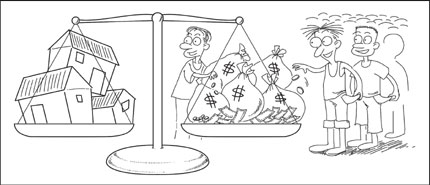
As the economic slump that began in 2007 persists, the question on everyone's minds is obvious: Why?
Unless we have a better understanding of the causes of the crisis, we can't implement an effective recovery strategy. And, so far, we have neither.
We were told that this was a financial crisis, so governments on both sides of the Atlantic focused on the banks. Stimulus programs were sold as being a temporary palliative, needed to bridge the gap until the financial sector recovered and private lending resumed. But, while bank profitability and bonuses have returned, lending has not recovered, despite record-low long- and short-term interest rates.
The banks claim that lending remains constrained by a shortage of creditworthy borrowers, owing to the sick economy. And key data indicate that they are at least partly right.
After all, large enterprises are sitting on a few trillion dollars in cash, so money is not what is holding them back from investing and hiring. Some, perhaps many, small businesses are, however, in a very different position; strapped for funds, they can't grow.
Still, overall, business investment - excluding construction - has returned to 10 percent of GDP (from 10.6 percent before the crisis).
With so much excess capacity in real estate, confidence will not recover to its pre-crisis level anytime soon, regardless of what is done to the banking sector.
The financial sector's inexcusable recklessness, given free rein by mindless deregulation, was the obvious precipitating factor of the crisis. The legacy of excess real-estate capacity and over-leveraged households makes recovery all the more difficult.
But the economy was very sick before the crisis; the housing bubble merely papered over its weaknesses.
Without bubble-supported consumption, there would have been a massive shortfall in aggregate demand. Instead, the personal saving rate plunged to 1 percent, and the bottom 80 percent of Americans were spending, every year, roughly 110 percent of their income.
Even if the financial sector were fully repaired, and even if these profligate Americans hadn't learned a lesson about the importance of saving, their consumption would be limited to 100 percent of their income. So anyone who talks about the consumer "coming back" - even after deleveraging - is living in a fantasy world.
Fixing the financial sector was necessary for economic recovery, but far from sufficient. To understand what needs to be done, we have to understand the economy's problems before the crisis hit.
First, America and the world were victims of their own success. Rapid productivity increases in manufacturing had outpaced growth in demand, which meant that manufacturing employment decreased. Labor had to shift to services.
Globalization has been one, but only one, of the factors contributing to the second key problem - growing inequality. Shifting income from those who would spend it to those who won't lowers aggregate demand. By the same token, soaring energy prices shifted purchasing power from the United States and Europe to oil exporters, who, recognizing the volatility of energy prices, rightly saved much of this income.
The final problem contributing to weakness in global aggregate demand was emerging markets' massive buildup of foreign-exchange reserves.
Countries recognized that without reserves, they risked losing their economic sovereignty.
But, while the buildup of reserves - currently around US$7.6 trillion in emerging and developing economies - protected them, money going into reserves was money not spent.
Where are we today in addressing these underlying problems? To take the last one first, those countries that built up large reserves were able to weather the economic crisis better, so the incentive to accumulate reserves is even stronger.
Similarly, while bankers have regained their bonuses, workers are seeing their wages eroded and their hours diminished, further widening the income gap.
Moreover, the US has not shaken off its dependence on oil. With oil prices back above US$100 a barrel this summer- and still high - money is once again being transferred to the oil-exporting countries. And the structural transformation of the advanced economies, implied by the need to move labor out of traditional manufacturing branches, is occurring very slowly.
Government plays a central role in financing the services that people want, like education and health care.
And government-financed education and training, in particular, will be critical in restoring competitiveness in Europe and the US.
But both have chosen fiscal austerity, all but ensuring that their economies' transitions will be slow.
Joseph E. Stiglitz is University Professor at Columbia University and a Nobel laureate in economics. Copyright: Project Syndicate, 2011. www.project-syndicate.org. Shanghai Daily condensed the article.


