XI. Major Problems of China's Large Companies in 2009
 0
0 


On the whole, China's large companies made great contributions to the country, helping it to overcome the global financial crisis. Central and local state-owned companies, comprising 2/3 of the Top 500 companies, played an important role in implementing economic stimulus measures and the industrial revitalization plan, which provided sustainable economic growth and helped maintain stability. Private companies, accounting for 1/3 of the Top 500, also actively adjusted their industrial structures and took on new forms of social responsibility to overcome the crisis.
However, two major problems, unbalanced and unsound development, have been recognized across the top 500 firms.
1. Unbalanced development in large firms
Unbalanced development is largely reflected in the following three aspects: imbalance between state-owned and private companies, imbalance among companies in China’s different districts, and imbalance between the secondary and tertiary industries.
1.1 The phenomenon "the state advanced while the private sector retreated" (or "guo jin, min tui" in Chinese) indeed existed during the global financial crisis.
The "guo jin, min tui" phenomenon was one of the most closely watched during the global financial crisis. Prior to the financial crisis, the Chinese government denied the existence of the phenomenon, citing the proportion of non-state-owned companies to state-owned according to number, revenue, assets and profits during the period. Officials insisted that the phenomenon only refers to state-owned companies' aggressive expansion during the financial crisis, largely due to the government's economic stimulus measures. Coincidentally, during this period, private companies' growth slowed or even shrank. In the long run, China's private companies account for a large part of the nation's GDP, while a smaller proportion of state-owned firms maintain a dominant role in shaping economic development. In general, academics and the public are more concerned with the social environment and policy guidance. During the financial crisis, the country provided preferential policies for state-owned companies and strengthened their intervention in the micro-economy. However, this phenomenon chiefly existed during the financial crisis and cannot be applied to the situation that existed before 2009.
The data from the Top 500 Companies of China in 2010 indicates that unbalanced development still exists between state-owned and private companies. State-owned and state holding companies account for 2/3 of the Top 500 while the private companies occupy only 1/3. This proportion hasn't changed for the past ten years; however, the state-owned companies (including central and local) have obviously expanded much faster than the private ones, and the phenomenon indeed exists in some places that "the state advances while the private sector retreats".
During the global financial crisis, state-owned companies expanded much faster than the private ones. In 2009, 154 companies of the Top 500 went through the process of merger and reorganization, incorporating 909 companies in total. Specifically, state-owned companies purchased 830 companies, 91.31 of the total mergers, while the private companies acquired 79, only 8.69 percent. On average, the 154 companies undergoing mergers and reorganization incorporated 5.9 companies; however, the average number for the state-owned companies was 6.9 (7.3 for local and 6.7 for central), while private companies on average only acquired 2.4 firms. (See Table 1-26)
Table 1-26. Comparison of the number of merged companies by the Top 500 in 2010
(Unit: percent)
|
|
Number of Companies |
Number of Merged Companies |
Average Number of Merged Companies |
Proportion |
|
Top 500 Companies of China in 2009 |
154 |
909 |
5.9 |
100 |
|
State-owned |
121 |
830 |
6.9 |
91.31 |
|
Local State-owned |
78 |
567 |
7.3 |
62.38 |
|
Central State-owned |
43 |
260 |
6.1 |
28.60 |
|
Private |
33 |
79 |
2.4 |
8.69 |
The phenomenon indeed exists in some places that "the state advances while the private sector retreats". In 2009, the ten companies which acquired the largest number of firms were all state-owned, including 3 central and 7 local ones. Coal company acquisitions in Shanxi Province are the most eye-catching. In 2009, six state-owned coal companies from Shanxi purchased 362 firms in all, 40 percent of the total number of merged companies in the Top 500 in 2010.
Table 1-27. The ten companies of China which acquired the largest number of firms
|
Ranking |
Ranking on Top 500 List |
Company Name |
Number of Merged Companies |
Ownership |
|
1 |
127 |
Lu'an Mining Industry Group Co., Ltd. 山西潞安礦業(集團)有限責任公司 |
101 |
Local State-owned |
|
2 |
144 |
Datong Coal Mine Group Co., Ltd. 大同煤礦集團有限責任公司 |
83 |
Local State-owned |
|
3 |
76 |
Shanxi Coking Coal Group Co., Ltd. 山西焦煤集團有限責任公司 |
73 |
Local State-owned |
|
4 |
259 |
Shanxi Coal Import and Export Group Co., Ltd. 山西煤炭進出口集團有限公司 |
53 |
Local State-owned |
|
5 |
2 |
State Grid Corporation of China 國家電網公司 |
50 |
Central State-owned |
|
6 |
71 |
China National Building Materials Group Corporation 中國建筑材料集團有限公司 |
47 |
Central State-owned |
|
7 |
128 |
Yangquan Coal Industry Group Co., Ltd. 陽泉煤業(集團)有限責任公司 |
38 |
Local State-owned |
|
8 |
48 |
China Guodian Corporation 中國國電集團公司 |
19 |
Central State-owned |
|
9 |
106 |
Shanxi Jincheng Anthracite Mining Group Co., Ltd. 山西晉城無煙煤礦業集團有限責任公司 |
14 |
Local State-owned |
|
10 |
60 |
Henan Coal Chemical Industry Group Co., Ltd. 河南煤業化工集團有限責任公司 |
11 |
Local State-owned |
1.2 Large companies in central, western and northeast China have weaker development.
Unbalanced development has existed among large companies in China's different districts for a long time. Particularly, there are a small number of larger companies in central, western and northeast China, and it has been historically more difficult to develop private companies there compared to China's eastern and coastal regions.
In terms of the geographical location of China's large companies, those in the coastal areas of eastern China including Beijing, Tianjin, Hebei and the Bohai Bay rim region, Yangtze River Delta, and Pearl River Delta have always taken the lead. Since the China Enterprise Confederation released the Top 500 Companies of China for the first time in 2002, more than 70 percent of the list has been from eastern China, and this hasn't changed in the past ten years. Meanwhile, large companies from central and western China saw gains in numbers in recent years, and in 2010 accounted for more than 23 percent of the Top 500. Northeast China saw slight reductions in the number of large companies making the top 500.
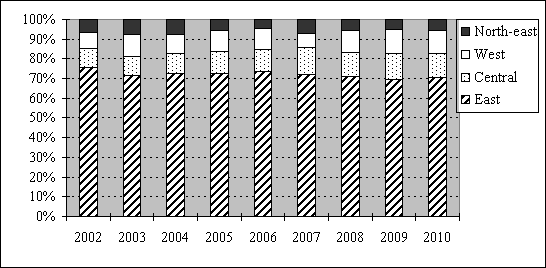
Figure 1-11. Geographical distribution of the Top 500 Companies of China (2002-2010)
Secondly, a large gap exists among private companies from different districts. Of the private companies among the Top 500 in 2010, those from Jiangsu and Zhejiang Province had the largest proportion. There were 49 companies from Jiangsu shortlisted in the Top 500, of which 41 were private; among the 46 companies from Zhejiang shortlisted in the Top 500, 36 were private. Private companies from the two provinces hit 45 percent of the total number of private firms in the Top 500. In contrast, private companies from northeast, central, southwest and northwest China experienced limited development. Guangxi Zhuang Autonomous Region and the other eight provinces including Heilongjiang, Shanxi, Anhui, Fujian, Guizhou, Yunnan, Gansu and Qinghai had no private companies shortlisted in the Top 500; for Jilin, Hubei, Jiangxi, Hainan and Shaanxi, each province only had one private company shortlisted. The data indicated that those districts with a weaker state-owned economy and a greater number of private companies proved to have more economic strength. Private companies have had a major role in promoting economic growth in Guangdong, Zhejiang, Jiangsu and Shandong.
Table 1-28. The number of private companies among the Top 500 in 2010 classified by provinces and districts
|
Province |
Number of |
Number of Private Companies |
Province |
Number of Companies |
Number of Private Companies |
|
Three Northeast |
29 |
7 |
Pearl River Delta |
39 |
9 |
|
Heilongjiang |
6 |
0 |
Guangdong |
34 |
8 |
|
Jilin |
5 |
1 |
Guangxi |
4 |
0 |
|
Liaoning |
18 |
6 |
Hainan |
1 |
1 |
|
Six Provinces in |
59 |
9 |
Fujian |
31 |
0 |
|
Henan |
16 |
5 |
Southwest China |
10 |
5 |
|
Shanxi |
11 |
0 |
Chongqing |
10 |
2 |
|
Anhui |
12 |
0 |
Sichuan |
2 |
3 |
|
Hunan |
6 |
2 |
Guizhou |
9 |
0 |
|
Hubei |
9 |
1 |
Yunnan |
30 |
0 |
|
Jiangxi |
5 |
1 |
Northwest China |
9 |
5 |
|
Bohai Bay Rim |
191 |
55 |
Shaanxi |
8 |
1 |
|
Beijing |
98 |
9 |
Gansu |
3 |
0 |
|
Tianjian |
22 |
3 |
Qinghai |
1 |
0 |
|
Hebei |
15 |
10 |
Xinjiang |
3 |
2 |
|
Shandong |
56 |
33 |
Inner Mongolia |
6 |
2 |
|
Yangtze River |
121 |
81 |
National Total |
500 |
171 |
|
Shanghai |
26 |
4 |
|
|
|
|
Jiangsu |
49 |
41 |
|
|
|
|
Zhejiang |
46 |
36 |
|
|
|
1.3 Large companies in tertiary industries had weaker development.
Since 2002, as China's economy entered a developing stage of heavy and chemical industrialization, large companies in secondary industries, particularly the heavy chemical industry, developed quite rapidly; however, tertiary industries have been relatively weak. Among the Top 500 Companies of China in 2010, only one belonged to primary industries, accounting for 0.2 percent; 356 were in secondary industries, 71.2 percent of the Top 500; and 143 in tertiary industries, occupying 28.6 percent. Such unbalanced development between the secondary and tertiary industries is partly attributed to China’s economic development stage, and partly due to national policy.
In secondary industries, private companies had weak development. Among the 365 companies in secondary industries, 140 are private, accounting for 39.3 percent. Specifically, of the 26 coal mining companies, only one is private, occupying 3.8 percent; of the three petroleum exploitation companies, none are private; of the 37 construction companies, 9 are private, accounting for 24.3 percent; of the 279 manufacturing companies, 30 are private, occupying 46.6 percent; of the 11 power generation companies, none is private. (See Figure 1-12).
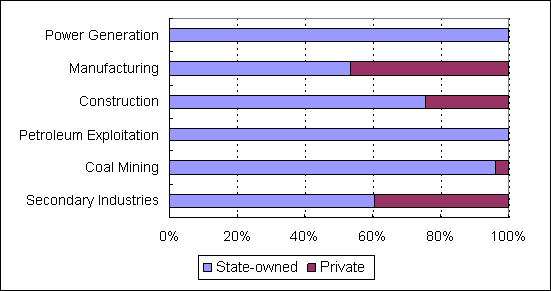
Figure 1-12. State-owned and private companies of the Top 500 in 2010 in secondary industries
In tertiary industries, development of private companies was even weaker. Among the 143 service companies, 31 are private, accounting for 21.7 percent. Specifically, there are no private companies in fields of energy supply, railway transportation, mobile communication, storing and logistics; there is only one private company in air transportation (Haihang Group Corporation Ltd.), one in commercial retail (Liqun Group Co., Ltd.) and two in commercial banks. The private companies are largely in the fields of real estate development (10 of the 12 property companies are private.), retail (including commercial retail, retail of electrical appliances, wholesale & retail of medicine and auto retail) and import-export. (See Figure 1-13)
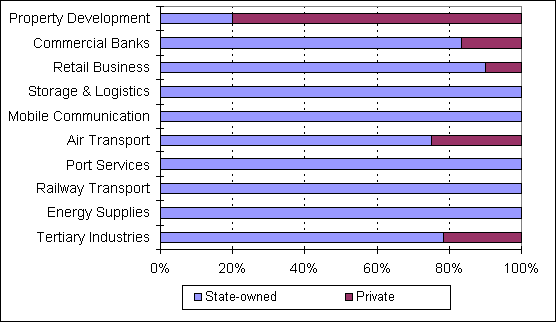
Figure 1-13. State-owned and private companies of the Top 500 in 2010 in tertiary industries


