Living with terra-cotta army
 0
0 


|
|
|
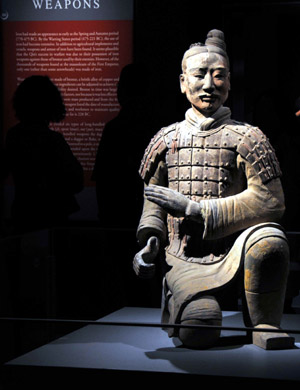
A terra cotta warrior is on display at the Houston Museum of Natural Science in Houston, the United States, on Oct. 18, 2009. The exhibition "Terra Cotta Warriors: Guardians of China's First Emperor" is concluded at the museum on Sunday, receiving over 200,000 visitors during its 5-month-long exhibition period. [Xinhua/Chen Ruwei] |
Wearing a traditional Chinese-style beige shirt and glasses, gray-haired Yang Zhifa busily signs books in a gift shop in the Museum of Terra-cotta Warriors and Horses, sometimes pausing to puff his long-stemmed pipe and blow a cloud of smoke.
A huge photo showing U.S. President Bill Clinton meeting him on June 26, 1998, hangs on the wall behind him.
Yang was one of the farmers who first dug up fragments of the terra-cotta army when they were drilling a well in Xiyang Village of Lintong County, 35 kilometers east of Xi'an, capital of northwest China's Shaanxi Province, 35 years ago.
The 72-year-old bid farewell to farming 14 years ago to work a nine-to-five routine. He now gets a salary of 1,000 yuan (147 U.S.dollars) a month from the gift shop for signing books of which he is not the author.
Tour guides bring a constant stream of people into the bookstall. "This is Mr Yang Zhifa, the first discoverer of terra-cotta warriors and horses. We are so lucky to meet him here today. You can buy a book to get his signature," the guides tell tourists. But Yang sits there everyday.
The 150-yuan (22 U.S. dollars) book, "Dreams of the Qin Dynasty Terra-cotta Army," in eight languages, including Chinese, English, Japanese, French and Spanish, sells quickly - almost 500 copies a day in the peak season. Some generous tourists drop tips in the drawer in front of Yang.
"I heard that he is one of the first discoverers, so I want to buy a book with his signature as a gift for my grandson," said Lloyd Carlton, from the United States.
Yang silently immerses himself in the autographing. His signature is hard to read. If a tourist raises camera, he uses his pipe to tap the plate in front of him, which reads "no photo, no video."
"I'm tired of signing and the noisy tourists, and I hate those tabloid reporters," says Yang.
A Chinese newspaper in 2002 described Yang as an illiterate who didn't know how to write his own name, saying he could only draw three circles as his signature when he met Clinton.
Still angry, Yang insists he had a primary school education. He sued the newspaper, and got 20,000 yuan (2,941 U.S. dollars) in damages for the defamation.
Yang has been invited to Beijing, Shanghai, Hong Kong and Japan to tell his story about how the terra-cotta army was found.
"The weather was very dry in 1974, and the grain in the field was dying. The leaders of our village decided to dig a well. We found a place lower than other places and began to dig. We found the red earth about a meter down was very hard. And then on the third day, I dug out something like a jar. Actually, it was the head of a terra-cotta warrior. But we didn't know that at the time. Another villager asked me to dig gently because he could take the 'jar' home as a container. Then we dug out the body, which was like a statue in a temple," says Yang.
Nobody knew the statues would be one of the greatest archaeological discoveries of the 20th Century. Fragments of statues were scattered in the fields, and farmers sold many unearthed bronze arrowheads to the recycling station.
It's until the archaeologists came several months later, that the farmers realized the significance of the find.
Yang Zhifa never went to see the terra-cotta army over the next20 years, until a manager of the gift shop of the Museum of Terra-cotta Warriors and Horses came to ask Yang to sign books in 1995.
"He said he would pay me 300 yuan (44 U.S. dollars) a month. I thought that's not bad. So I came. My salary has risen to 1,000 yuan in the last three years," Yang says.
"Although I often feel tired of signing, I'm satisfied with my life." He still keeps the hoe he used to dig out the terra-cotta warriors 35 years ago to plant flowers in his home.
ARCHAEOLOGICAL HEAVEN
When archaeologist Yuan Zhongyi was sent to Lintong to excavate the site in July 1974, he had no idea that he would spend his next30 years there. One of his leaders said the excavation would probably last a week. However, it has lasted more than three decades and will continue for generations.
Yuan, 77, has retired from his post of curator of the Museum of Terra-cotta Warriors and Horses. Now living in Xi'an, he is often invited to the museum to help solve problems in the excavation of the No.1 pit, which started in June 2009.
"I spent most of my life digging. Archaeological excavation is boring work. But I often feel a happiness that cannot be understood by outsiders because it is heaven for archaeologists," Yuan says.
"First we excavated around the well drilled by the farmers. We found the relic site much, much larger than we had expected. It took us about half a year to find the edge of the site, which turned out to cover 14,000 square meters. So we estimated there were about 6,000 terra-cotta warriors and horses buried in that single pit," Yuan recalls.
"We were so excited because such a big funerary pit had never been found anywhere in the world. And the enormous life-sized underground terra-cotta army shocked not only China, but the world," Yuan says.
The second and third pits were found in 1976 during the construction of the Museum of Terra-cotta Warriors and Horses. The second pit is about half size of the first, but its warriors, painted diversely in red, green, purple and other colors, are regarded as the best preserved. The third and smallest pit is the "headquarters" of the buried army.
Altogether, the three pits hold almost 8,000 terra-cotta warriors and horses, of which 2,000 have been unearthed under Yuan's leadership.
The excavation has had its risks. Once the heavy iron bracket of a tackle used to lift the earth fell into the six-meter-deep pit, brushing past him. On a snowy day in the winter of 1976, Yuan lay in a pit from morning to afternoon, brushing off the earth from the burial horses. He forgot the time, and when his colleagues found him, he was stiff from being confined for so long in the cold.
"But the happiness after arduous work is tremendous," says Yuan.
When Yuan was digging the southeast corner of the No.1 pit, he saw a bronze sword under the body of a terra-cotta warrior. He covered the sword immediately and called it a day, fearing that thieves might be nearby. After the workers left, he and two assistants cleared the earth again and found an untarnished bronze sword, the first bronze sword unearthed at the site. He worked until midnight that day. In a dilapidated house in a nearby village, Yuan lovingly measured and recorded every detail of the sword as it glittered under a candle.
"That was one of the happiest moments in my life."
There were low points too. Early in the dig, archaeologists worked year round, only taking off the Spring Festival holiday. While they were excavating the bronze chariots, the wife of archaeologist Cheng Xuehua came to ask Yuan when her husband could come home. Yuan told her the work was almost finished. Shortly after, Cheng's wife committed suicide.
"When I heard that, I felt as if a knife was being stabbed into my heart," says Yuan.
TERRA-COTTA ARMY DIVISIONS
The army has been a cause of resentment among local people too.
Three farmers, who were among those digging the well 35 years ago, submitted a request to the Museum of Terra-cotta Warriors and Horses in 2003, asking the museum to issue them a certificate to confirm they were the discoverers of terra-cotta army.
One of the three, Yang Xinman, 71, says, "The museum only says in the introduction that the terra-cotta warriors and horses were discovered by local farmers when they were digging a well. They should add our names to the introduction."
But they ended up with nothing, because China has no law to determine the discoverer of cultural relics.
Nobody can say definitively how many people were working on the well 35 years ago, but Yang Zhifa's fame and earnings have made the other farmers envious.
Another key figure in the discovery was very angry at the farmers' request. Zhao Kangmin, whose name is rarely heard, was the first to realize the true value of the terra-cotta fragments, and the first to reconstruct the warriors and horses.
"What they want is money," said Zhao, who has retired from his post of curator of the Lintong Museum in Lintong town.
"Seeing doesn't mean discovering. The farmers saw the terra-cotta fragments, but they didn't know they were cultural relics, and they even broke them. It's me who stopped the damage and collected the fragments and reconstructed the first terra-cotta warrior," Zhao said.
Zhao, a frail 74-year-old, goes to the Lintong Museum everyday. He sits in a dark display room in the museum, autographing postcards, beside four terra-cotta warriors and a horse that he reconstructed 35 years ago.
But the tourists in this small museum are not as generous as those in the Museum of Terra-cotta Warriors and Horses. Few want to pay 15 yuan (2.2 U.S. dollars) for a set of postcards.
Unlike Yang Zhifa, who only signs his name on books, Zhao writes. "Zhao Kangmin, the first to discover, restore, appreciate, name and excavate terra-cotta warriors."
Zhao was an official of in charge of cultural relics in the government Lintong County when he got the news that a large amount of terra-cotta fragments had been found. He rushed to the site and was surprised to see fragments of heads, torsos, arms and legs. He asked the farmers to collect them and pile them on to three trucks, which took them to Lintong Museum.
He began to reconstruct the statues from the thousands of fragments, some as small as a fingernail. During this task, Xinhua News Agency journalist Lin Anwen heard the news and came to see the find. His report roused the interest of China's leaders, who sent an archaeological team to do the excavation.
During the dig, archaeologists found 30 tombs dating to different periods over the past 2,000 years, indicating that the terra-cotta warriors and horses could have been "seen" at least 30times in history.
But the army kept its secret secure for two millennia.
TEA AND CLONES
The first emperor of China's feudal dynasties, Qin Shihuang, hoped the underground army would protect his mausoleum forever. But the real beneficiaries were the local people 2,000 years later. Since its discovery, the terra-cotta army has attracted almost 60 million visitors.
A saying in the new village outside the Museum of Terra-cotta Warriors and Horses goes, "Don't forget the Communist Party liberated us. Don't forget Qin Shihuang made us prosperous."
The two-story houses with white walls and gray tiles were designed by the local government, but built by the villagers from 2003 to 2005. About 500 people from 200 families have moved to the new village from old homes nearby, to protect the environment of the mausoleum area of Qin Shihuang.
Each family has telephone access and more than 10 percent have broadband Internet access. Seven families in the village own factories and stores producing and selling terra-cotta warrior and horse replicas, and 38 families have opened farmhouse restaurants and hotels. About half the villagers make and sell souvenirs.
Villager He Li, 48, owner of a restaurant and a souvenir production factory, treats guests with tea ceremonies in his home. His living room is decorated with tea sets and art. Only his dark skin shows he once worked in the fields.
"When the terra-cotta warriors and horses were found, I was 14.Every family in our village was poor at that time. I went to the site and found nothing interesting. I worked in the cinema of the museum in the 1980s. I saw many tourists bought the replicas. I thought producing and selling the replicas could be good business," says He.
He set up a factory, becoming one of the first farmers to produce replica terra-cotta warriors and horses. His statues, ranging from miniatures to life size, can cost more than 10,000 yuan (1,470 U.S. dollars). He opened a shop outside the factory and wholesalers come to buy in bulk.
The replicas are sold to America, Germany, Spain, Japan and other countries. He, who just bought his third car, won't say how much money he makes every year.
"Recently, the statues of generals and kneeling archers have been most popular. We can also make statues emulating the faces of our customers, and statues in golfing poses," says He.
"The terra-cotta warriors and horses are great, and Qin Shihuang really was a great emperor."


