|
|
|
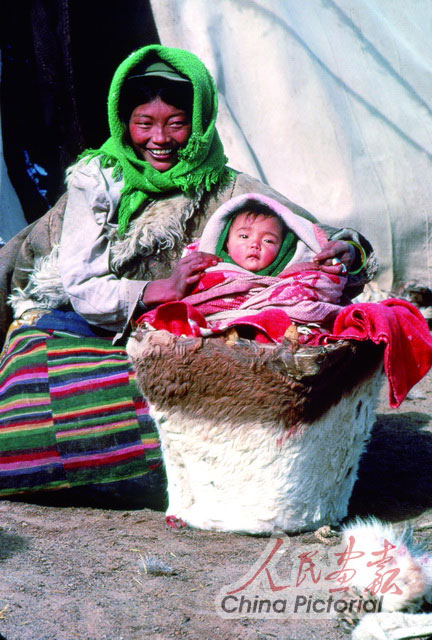
Chang Tang life a decade ago. by George Schaller
|
Chiru, kiang, and wild yak, among others, are Class I protected animals in China. Yet this has not prevented hunters from killing wild yak and kiang for meat well into the 1990s to feed laborers and sell in towns. Nor did it prevent the mass-slaughter of chiru for its fine wool that is smuggled to India where it is woven into expensive shawls for the international market.
The amount of wildlife that once lived in these stark and harsh uplands was truly amazing. One traveler in 1903 marveled at the great chiru herds, noting that "there could not have been less than 15,000 or 20,000 visible at one time." Another observed "hundreds upon hundreds of yak grazing" on one hill. Such herds are now a distant memory, the decline due to indiscriminate hunting.
Fortunately much wildlife does survive. The steep decline has generally been halted, and in some areas the animals are actually increasing. Greater anti-poaching efforts, confiscation of guns, appointment of local rangers, better law enforcement inside and outside of China, stiff punishment of poachers, education programs — all have benefited the wildlife.
Wildlife protection has created such new challenges. When not hunted or harassed, animals become less fearful of people. Chiru, kiang and Tibetan gazelle graze peacefully near the Golmud-Lhasa highway in spite of the heavy traffic. However, some species do come into conflict with humans. Massive wild yak bulls enter herds of domestic yaks during the summer rut and abscond with females. Other considerations aside, the genetic purity of wild yaks through hybridization with domestic ones threatens the species.
With an increase in the number of kiang, the perception is that the animals compete with livestock for forage. When a hundred or more kiang congregate on a pasture reserved by a family as winter grazing for its sheep and goats, some conflict is inevitable. It is a problem that requires a solution based on research. Even simple information such as the number of kiang in a township and the amount of grass consumed by them is not available. The Wildlife Conservation Society, in cooperation with local partners, is now investigating this issue. Wildlife requires constant monitoring and study so that problems can be treated not on impulse and intuition but with understanding.
Tibetan brown bears create yet another problem in that they have learned that households in effect offer free meals. Sheep and goats are in unprotected corrals, meat is stored in open sheds, and houses smell of butter and other tempting food. It is easy for a bear to push in a door, and, once inside, raise havoc by tearing apart cupboards and shredding sacks of barley. What can be done? In 2007, Kang Aili and I interviewed 18 households in Baling Xiang (Township). Half the households reported some form of bear damage that year. It included the loss of 56 sheep and goats when bears raided corrals at night; additional animals were killed by lynx and wolf. Nothing much is done to protect houses and corrals from predators. We are now working with the township to devise and test several methods, such as using coiled barbed wire, to deter bears.
Solutions to any problem must consider local knowledge, goodwill, interests, cooperation, and tradition. After all, the pastoralists have a basic stake in the Chang Tang because their livelihood depends on it. To resolve conflicting demands of conservation, economic development, and welfare of the culture is the basic challenge. In trying to meet that challenge three points need to be considered. One is that problems are usually local, as with kiang and bear, and solutions must be locally evaluated and applied. Another is that no single solution may solve an issue, and several should be investigated and tested. And any problem is so complex biologically and culturally that it requires an integrated approach, including basic research and cooperation between government departments. Families are relocated from elsewhere into key wildlife areas of the reserve, fencing of pastures is encouraged and subsidized, and borders of the reserve are shifted without knowing the impact on wildlife, to name just three.
The future of the Chang Tang Reserve remains unsettled. The current borders are again being redrawn. A country-wide policy of land development, ranging from no development and restricted development to optimal and focused development, is being implemented, and this will have an effect on the Chang Tang. At a minimum, the whole northern part of the Chang Tang, those parts in which pastoralists have not settled, should remain undeveloped, as should critical wildlife areas. The ancient migrations routes of chiru, as well as their mating and calving areas, should not be obstructed by fences and there should be limits on number of households and livestock.
Conservation constantly must adapt to new ideas and situations, and this requires new policies. Wildlife will have to be managed. But at present there is no management: Animals have either full protection or no protection. If a bear repeatedly attacks people, there is no policy to deal with that animal. If there is clear conflict between kiang and livestock in a township, there is neither policy nor plan to help provide a solution. Wildlife is a valuable resource that can be and must be managed in a sustainable and rational manner for the benefit of local people and the government.
Stone artifacts from the Chang Tang show that hunters roamed the region over 10,000 years ago. They left rich pastures and great herds of wildlife to future generations. Some of these have now been squandered. But much still shines with the glow of life. What incentives would stimulate every Tibetan household in the Chang Tang to protect and manage the land in such a way that its ecological wholeness is retained forever? Pujung Narla and his family need a secure future. Several Tibetan communities have examined their values and set aside areas for wildlife where livestock grazing is controlled or prohibited. With religious and ecological insight such communities realize that their future as a harmonious society depends on treating all living beings, all plants and animals, in the Buddhist tradition of wisdom, respect, reverence, and compassion. If the Chang Tang is treasured with both mind and heart, then it will continue to thrive in all its beauty.
(China Pictorial October 28, 2008)