国内精品一区二区三区最新_不卡一区二区在线_另类重口100页在线播放_精品中文字幕一区在线

Yunnan??
 
Inner Mongolia|Shaanxi|Tibet|Guizhou|Guangxi|Yunnan|Xinjiang|Gansu|Ningxia

Yunnan ProvinceGovernor: Xu Rongkai
Capital: Kunming
Government office
address:
Wuhuashan, Kunming
Telephone:
0871-3621773
Website:
www.yn.gov.cn
Geographical location
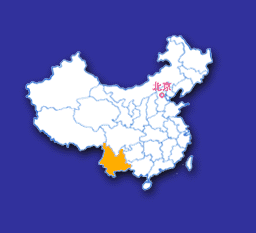
Yunnan is known as Yun or Dian for short. It is the most southwestern province in China, with the Tropic of Cancer running through its southern part. The province has an area of 394,000 square km, or 4.1 percent of the nation??s total. The province borders the Guangxi Zhuang Autonomous Region and Guizhou Province in the east, Sichuan Province in the north, and Tibet Autonomous Region in the northwest. It shares a border of 4,060 km with Myanmar in the west, Laos in the south, and Vietnam in the southeast.
I. Geography and natural conditions


Elevation
The highest point in the north is the Kagebo Peak in Deqin County on the Deqin Plateau, which is about 6,740 meters high; and the lowest is in the Honghe River Valley in Hekou County, with an elevation of 76.4 meters.

Natural resources
Yunnan abounds in natural resources. It is known as the kingdom of plants, animals and home of non-ferrous metals and medicinal herbs.

Plants
The province not only has more plant species of tropical, subtropical, temperate, and frigid zones than any other province in the country, but also has many ancient, derivative plants, as well as species introduced from foreign countries. Among the 30,000 species of plants in China, 18,000 can be found in Yunnan.

Minerals
More than 150 kinds of minerals have been discovered in the province. The potential value of the proven deposits in Yunnan is 3 trillion yuan, 40 percent of which comes from fuel minerals, 7.3 percent from metallic minerals, and 52.7 percent from nonmetallic minerals.

 Yunnan has proved deposits of 86 kinds of minerals in 2,700 places. Some 13 percent of the proved deposits of minerals are the largest of their kinds in China, and two-thirds of the deposits are among the largest of their kinds in the Yangtze River valley and in south China. Yunnan ranks first in the country in the deposits of zinc, lead, tin, cadmium, indium, thallium, and crocidolite.

Hydro-energy
Yunnan has sufficient rainfall and many rivers and lakes. The annual water flow originating in the province is 200 billion cubic meters, three times that of the Yellow River. The rivers flowing into the province from outside add 160 billion cubic meters, which means there are more than 10,000 cubic meters of water for each person in the province. This is four times the average in the country. The rich water resources offer abundant hydro-energy.

Tourism resources
Yunnan is attractive with its rich tourism resources, including beautiful landscape, colorful ethnic customs, and a pleasant climate.

Environment and current issues
Because of its high elevation, Yunnan is full of sunshine and has clear air.

 
II. Population
 

Total population: 41.44 million (1998)

Population growth rate: 1.21 percent (1998)

Life expectancy (average):  65.1 years (male) and 67.7 years (female).

Ethnicity
Yunnan has the highest number of ethnic groups among all provinces and autonomous regions in China. Among the country??s 56 ethnic groups, 25 are found in Yunnan. Some 38.07 percent of the province??s population are members of minorities including the Yi, Bai, Hani, Zhuang, Dai, Miao, Lisu, Hui, Lahu, Va, Naxi, Yao, Tibetan, Jingpo, Blang, Pumi, Nu, Achang, Jino, Mongolian, Drung, Manchu, Shui, and Bouyei. Each minority has at least 8,000 people.

Ethnic groups are widely distributed in the province. Some 25 minorities live in compact communities, each of which has a population of more than 5,000. Ten ethnic minorities living in border areas and river valleys include the Hui, Manchu, Bai, Naxi, Mongolian, Zhuang, Dai, Achang, Bouyi and Shui, with a combined population of 4.5 million; those in low mountainous areas are the Hani, Yao, Lahu, Va, Jingpo, Blang and Jino, with a combined population of 5 million; and those in high mountainous areas are Miao, Lisu, Tibetan, Pumi and Drung, with a total population of 4 million.

Literacy
By the end of 1998, among the province??s population, 419800 had received colleage education or above, 2.11 million, senior middle school education, 8.3 million, junior middle school education, 18.25 million, primary school education, and 8.25 million aged15 or above, illiterate or semi-literate.


III. Economy


GDP:
179.39 billion yuan (1998)

GDP growth rate:

Average GDP per capita: 4,355 yuan 1998

GDP ratio (1st, 2nd and tertiary industries): 22.8, 46.2 and 31.1 percent respectively.

Poverty alleviation plan
Yunnan is one of China??s undeveloped provinces with more poverty-stricken counties than other provinces. In 1994, about 7 million people lived below the poverty line of less than an annual average income of 300 yuan per capita, accounting for 9.7 percent of the country??s total poor people. They were distributed in the province??s 73 counties mainly financially supported by the central government.

The poverty alleviation plan includes five large projects aimed at improving infrastructure facilities. They involve soil improvement and water conservancy, electric power, roads and ??green belt?? building. Upon the completion of the projects, the province will solve the problem of the shortage of grain, water, electric power and roads and improve ecological conditions.

Inflation rate:

Unemployment rate:

Revenues: 16.82 billion yuan (1998)

Industrial output value: 150.32 billion yuan (1998)

Agricultural output value: 38.13 billion yuan (1998)

Foreign trade
Yunnan has trade contacts with more than 70 countries and regions in the world. It mainly exports tobacco, machinery and electrical equipment, chemical and agricultural products and non-ferrous metals. In 1998 its total imports and exports reached US$1.65 billion.

Foreign investment
In 1998, the province obtained direct foreign investment valued at US$146 million and had 1,575 enterprises with foreign investment.

Pillar industries
Four pillar industries involve tobacco, biology, mining and tourism.


IV. Telecommunications


Telephones:
1.88 million subscribers (1998)

Radio and TV stations: Yunnan People??s Broadcasting Station and Yunnan TV station.


V. Transportation


Railways
The 886 km-long first-level national railway from Nanning to Kunming links Yunnan with Guizhou Province and Guangxi Zhuang Autonomous Region. Second-level railways include those from Guangtong to Dali, and from Kunyang to Yuxinan.

Highways
Second-level national highways stretch 958 km, third-level highways, 7,571 km and fourth-level highways, 52,248 km. The province has formed a network of communication lines radiating from Kunming to Sichuan and Guizhou provinces and Guangxi and Tibet autonomous regions, and further on to Myanmar, Laos, Vietnam and Thailand.

Waterways
In 1995, the province put an investment of 171 million yuan to add another 807 km of navigation lines. It built 2 wharfs with an annual handling capacity of 300,000-400,000 tons each and 4 wharfs with an annual handling capacity of 100,000 tons each. The annual volume of goods transported was 2 million tons and that of passengers transported, 2 million.

Airports
The province has 19 domestic air routes from Kunming to Beijing, Shanghai, Guangzhou, Chengdu, Haikou, Chongqing, Shenyang, Harbin, Wuhan, Xian, Lanzhou, Hangzhou, Xiamen, Nanning, Shenzhen, Guiyang, Changsha and Guilin; three provincial air routes from Kunming to Jinghong, Mangshi and Simao; and four international air routess from Kunming to Bangkok, Yangon, Vientiane and Hong Kong.

The Wujiaba Airport in Kunming is a national first-class airport and Xishuangbanna, Mangshi and Simao airports are second-class terminals.

 
VI. Projects wanting foreign investment


Yunnan Province welcomes foreigners, overseas Chinese and compatriots from Taiwan, Hong Kong and Macao to invest in all the economic activities allowed and encouraged by the central government's industrial policy. According to the Provisional Regulations on the Guidance of Foreign Investment and the Guiding Catalogue of Industries for Foreign Investment promulgated by the State Council, together with the actual needs for development, Yunnan Province especially encourages foreign investment in the following sectors:

A.     Infrastructure

1. Construction and operation of local railways and connecting bridges and tunnels (solely foreign-funded is not allowed).

2. Construction and operation of highways, independent bridges and tunnels, and port facilities (in public ports, government capital must hold a dominant share);

3. Construction and operation of civil aviation airports (the Chinese part must have a majority share or take a dominant position).

4. Construction and operation of hydropower stations.

5. Construction and operation of thermal power stations with a capacity of 300000 kw or over for each generating unit.

B. Development of agricultural and biological resources

1. Tissue culturing, cultivation, preservation and processing of particular flowers and plants species.

2. Cultivation and processing of tropical cash crops.

3. Introduction of improved varieties of commercially valuable plants and fruit trees from tropical, subtropical and temperate zones. Establishing nursery, plantation, processing and developing technology for transporting perishable produce.

4. Cultivation and processing of natural perfumes.

5. Cultivation and processing of edible mushrooms.

6. Development of animal by-products (breeding, raising, slaughtering and processing of meat animals; processing of dairy products; processing of animal offal and blood products for use in pharmaceuticals; leather and fur production.)

7. Development of selected commercially valuable crops and their application (functional enzymes, functional proteins, pharmaceuticals from medicinal herbs, comprehensive development of castor and palm products, etc).

C. Development of mineral resources

1. High-density phosphorous compound fertilizers, food and feed additives, fire retardant, phosphate and phosphoric chemicals.

2. Iron and steel industry.

(1) mining and dressing of iron ores;

(2) mining, dressing, smelting and intensive processing of manganese ores;

(3) smelting of stainless steel;

(4) cold-rolled silicon steel sheets, galvanized sheets and tin-plated sheets, cold-rolled sheets and hot-rolled sheets;

(5) production of iron by direct reduction and molten reduction methods.

3. Non-ferrous metal industry.

(1) mono-crystalline silicon and polycrystalline silicon;

(2) hard alloys, tin compounds, antimony compounds;

(3) nonferrous composites, new alloys;

(4) mining of copper, lead and zinc ores (solely foreign-funded is not allowed);

(5) mining of aluminum ore (solely foreign-funded is not allowed), production of over 300,000 tons of aluminum annually.

4. Risk exploration for mineral resources.

5. Manufacture of building materials and nonmetal products.

(1) new types of building materials;

(2) technology for intensive plate glass processing;

(3) inorganic nonmetallic materials and related products (quartz glass, artificial crystal);

(4) mining and processing of natural stone outside the government protected areas;

(5) production of cement by the dry revolving kiln process (over 4000 tons daily).

D. Development of tourism resources

1. Development of national and provincial tourist destinations and scenic spots, including the construction of related facilities.

2. Construction of recreational facilities in vacation zones.

E. Hi-technology industry

1. Expansion and industrialization of high technology.

2. Upgrading of traditional industries using high technology focusing on electronics and machinery, biological pharmacy, food processing, metallurgical and chemical industries. Main items involved include: digitally controlled machine tools for export, electrical products, electronic devices for banding and commerce systems, electronic components. Upgrading of processing in sugar refineries and sugar produces, paper products, optical products, tire and rubber products, improved building materials, glassware, down stream timber processing.

F. Environmental protection

1. Recycling industrial wastes such as gases, water processing residues.

2. Manufacturing of equipment to improve urban sanitation.

3. Improvement of the ecological environment and any related construction projects.

4. Engineering and technology for pollution treatment and the introduction of pollution control measures.


VII. Favorite polices for foreign investment
 

??

1. Foreign-funded enterprises concerned with energy, communication, water conservancy, environmental protection, agriculture, forestry, animal husbandry and other related industries with terms of operation longer than 10 years will be exempt from corporate tax for 2 years starting from the first profit-making year. These enterprises will receive a full tax rebate from local financial departments for the third, fourth and fifth years of operation.

2. Foreign-funded enterprises approved as high-tech enterprises with terms of operation longer than 10 years will be exempt from corporate tax from the first to second profit-making year. They will receive a full corporate tax rebate from local financial departments from the third to seventh year of operation. For the first three years of operation, the proportion of VAT designated to the local financial departments will be rebated by these departments. Upon expiry of the above-mentioned preferential terms, favorable tax rates may still be obtained for enterprises which fulfill requirements of provincial tax departments.

3. Foreign-funded enterprises involved in energy, communication, environmental protection and urban public utilities whose actual investment exceeds US$10 million will have the proportion of their VAT designated for the local financial departments rebated for the first 3 years of operation upon approval.

4. For foreign-funded enterprises reinvesting their profits in the province and their term of operation longer than 5 years, local financial departments will rebate corporate tax according to the amount reinvested.

5. Foreign funded enterprises engaged in agricultural projects by using non-cultivated land will be exempt from agriculture tax for the first three years. In the 4th and 5th years, the above taxes paid will be rebated by local financial departments.

6. Foreign-funded enterprises will be given priority in the allocation of land-use rights. Allocation of these rights will be at the same price level for all enterprises (domestic or foreign). Arrangements can be made to pay by installments if necessary. When foreign-funded enterprises invest in residential houses, they may sell 30 percent of the floor area at commercial housing price.


国内精品一区二区三区最新_不卡一区二区在线_另类重口100页在线播放_精品中文字幕一区在线
国产精品一区二区久久不卡| 婷婷国产v国产偷v亚洲高清| 中文字幕亚洲欧美在线不卡| 国产精品全国免费观看高清 | 成年人午夜久久久| 99久久99久久综合| 国产人妖乱国产精品人妖| 亚洲色图欧美激情| 国产不卡在线一区| 精品国产91亚洲一区二区三区婷婷| 日本一区二区免费在线观看视频 | 国产色婷婷亚洲99精品小说| 久久 天天综合| 国产精品美女久久久久aⅴ | 日韩和欧美一区二区| yourporn久久国产精品| av在线综合网| 精品久久久久99| 综合久久一区二区三区| 奇米一区二区三区| 91麻豆免费看| 亚洲日本韩国一区| 国产一区日韩二区欧美三区| 91精选在线观看| 亚洲国产精品久久久男人的天堂 | 色噜噜狠狠色综合中国| 久久狠狠亚洲综合| 亚洲国产美国国产综合一区二区| 最新成人av在线| 亚洲第一搞黄网站| 国产一级精品在线| 9色porny自拍视频一区二区| 亚洲欧洲日韩在线| 亚洲sss视频在线视频| 成人黄色一级视频| 91国偷自产一区二区开放时间 | 18成人在线视频| 成人av资源在线观看| 国产精品污网站| 国产精品香蕉一区二区三区| 精品日韩一区二区三区| 午夜天堂影视香蕉久久| 久久精品国产久精国产| 亚洲午夜精品一区二区三区他趣| 日韩精品欧美成人高清一区二区| caoporn国产一区二区| 日韩欧美资源站| 夜夜精品视频一区二区| 日本视频中文字幕一区二区三区| 麻豆一区二区三区| 精品国产乱码久久久久久图片| 国产自产v一区二区三区c| 51精品久久久久久久蜜臀| 久久av资源网| 日本一区二区电影| 国产夫妻精品视频| 欧美国产日韩精品免费观看| 99精品久久久久久| 国产精品成人网| 欧美伦理影视网| 一区二区三区日韩精品| 日韩亚洲欧美成人一区| 夫妻av一区二区| 亚洲一区二区三区四区在线 | 亚洲午夜精品在线| 欧美大度的电影原声| 免费不卡在线观看| 91精品国产综合久久小美女| 午夜精品久久一牛影视| 综合欧美亚洲日本| 欧美精品在线观看一区二区| 另类小说欧美激情| 91精品国产高清一区二区三区| 蜜臀av一区二区| 国产精品国产自产拍在线| 制服视频三区第一页精品| www.av亚洲| 亚洲国产色一区| 国产精品系列在线| 欧美成人性福生活免费看| 成人av在线资源网| 夜夜亚洲天天久久| 欧美不卡123| 一本一道波多野结衣一区二区| 午夜精品123| 中文字幕一区在线观看| 91在线国产福利| 精品一区二区在线免费观看| 亚洲欧美区自拍先锋| 久久久精品天堂| 欧美精品久久一区| 91在线看国产| 免费精品视频最新在线| 一区二区三区免费在线观看| 日韩女优电影在线观看| 国产精品99久久久久久似苏梦涵| 国产精品情趣视频| 欧美一区二区在线观看| 91福利社在线观看| 国产在线播精品第三| 免费看日韩精品| 国产精品久久久久aaaa| 欧美精品一区二区三区蜜臀| 欧美丰满高潮xxxx喷水动漫| 色噜噜久久综合| 99久久久久久99| 综合av第一页| 国产精品国产a| 一区在线播放视频| 国产精品乱子久久久久| 欧美一区二区免费观在线| 国产精品一区二区在线看| 国内久久婷婷综合| 久久久综合激的五月天| 蜜臀av性久久久久蜜臀aⅴ四虎| 99久精品国产| 蜜臀av性久久久久av蜜臀妖精 | 国产精品国产三级国产aⅴ无密码| 国产精品综合一区二区三区| 91精品国产乱码久久蜜臀| 欧美日韩国产高清一区二区三区| 国产suv精品一区二区三区| 免费日本视频一区| 国产一区二区三区电影在线观看| 精品亚洲成a人在线观看| 国产精品亚洲综合一区在线观看| 国产成人精品免费看| 午夜久久电影网| 美女网站在线免费欧美精品| 国产中文一区二区三区| 国产精品综合二区| 成人av资源在线观看| 欧美日韩你懂的| 欧美亚洲国产一卡| 欧美一激情一区二区三区| 国产精品视频九色porn| 欧美日韩你懂得| 麻豆91免费看| 另类小说欧美激情| 青青草精品视频| 日韩精品电影一区亚洲| 亚洲一区二区黄色| 中文字幕高清不卡| 欧美日韩成人综合天天影院| 91亚洲精品一区二区乱码| 在线电影院国产精品| 国产精品天天看| 亚洲三级理论片| 另类调教123区| 91麻豆国产香蕉久久精品| 99久久精品国产精品久久| 不卡一区在线观看| 91精品欧美综合在线观看最新| 国产亚洲短视频| 亚洲国产精品久久一线不卡| 国产不卡免费视频| 欧美一级在线视频| 久久久国产精华| 日韩高清在线观看| 一本色道久久综合狠狠躁的推荐| 日韩午夜激情电影| 一区二区三区中文字幕电影| 国产一区二三区| 免费观看日韩av| 在线精品视频小说1| 国产片一区二区三区| 舔着乳尖日韩一区| 免费一级片91| 国产麻豆欧美日韩一区| 欧美日韩视频一区二区| 中文字幕日本不卡| 国产精品主播直播| 日韩精品专区在线影院观看 | 在线观看视频一区二区欧美日韩| 国产91丝袜在线播放0| 一本久久a久久免费精品不卡| 成人免费视频免费观看| 91黄色免费版| 欧美日韩成人一区二区| 欧美日韩在线播放三区| 精品国产欧美一区二区| 日韩亚洲欧美中文三级| 色综合久久综合网| 91福利视频在线| 这里只有精品免费| 一区二区三区波多野结衣在线观看| 久久99国产精品免费| 色婷婷香蕉在线一区二区| 自拍偷拍欧美激情| 国产在线播放一区二区三区| 精品少妇一区二区三区视频免付费| 中文字幕中文字幕中文字幕亚洲无线| 亚洲欧美福利一区二区| 97aⅴ精品视频一二三区| 精品入口麻豆88视频| 狠狠色综合日日| 欧美日韩成人在线| 成人欧美一区二区三区白人 | 国产精品不卡在线观看| 不卡电影一区二区三区|