Few historical records are left about small towns in ancient China. However, the Mingyueba Ruins of Yunyang County in the Chongqing Municipality are an exception. As ruins of the lower social class, they show a strong flavor of ordinary life, reflecting common customs from the past and the impact of the course changes of the Yangtze River. Before the flooding of the area by the Three Gorges Reservoir, archaeologists compiled this record.
A Surprising Tang Dynasty Quadrangle Courtyard
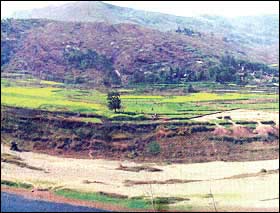
The Mingyueba market town ruins were situated about 78 km away from the new county proper of Yunyang. They were covered by wild reeds, shrubbery, Artemisia and creeping weeds. However, an archaeological team from the History Department of Sichuan University have dug out pits and ditches of different sizes, which look like trenches on a battlefield. Nearby, newly unearthed pieces of tiles, pottery and porcelain are laid out.
At the end of 2002, only one pit was made, measuring five meters in both length and width. Digging one meter deep, a building base appeared and further work brought to light a house site which was three rooms wide and two rooms deep. Traces show there were other buildings nearby. Further excavation led to two house sites at the east-west trend, where there were wing-houses on both sides of the former north-south house. While cleaning up the wing house ruins, archaeologists again found a new larger house base, sitting to the south of the first unearthed building base.
"This group of buildings looks like a siheyuan (quadrangle courtyard). We never expected to dig out a courtyard of the Tang Dynasty (618-907) in this area," said Li Yingfu, associate professor of archaeology in Sichuan University and head of the work team.
Huang Wei, also associate professor from the History Department of Sichuan University who is responsible for the salvage excavation of the Lijiaba Ruins, northwest of Mingyueba, said, "You never know what you get in archaeological work. One layer after another, the excavation arouses your curiosity. It poses new problems and then gives you answers. This particular site is like a magic box. When you open it, you see unbelievable things in succession. None of us thought we would stay here for years." He was invited to Mingyueba by Li to discuss the courtyard.
The case is the same for Li Yingfu. When he arrived in October 2000, he had planned to return to his own specialty once finishing the work, i.e., Neolithic archaeology. But the rich and generous finds in Mingyueba have retained him.
Mingyueba a ripe market town
Historians and archaeologists used to think that the Three Gorges was a closed and desolate area, so they expected no surprising findings at all. However, under the earth layer of Mingyueba, they discovered rich cultural deposits and precious historical relics. At the end of 2000, when a group of cultural relic experts came to inspect the site, they could not help expressing their delight.
By digging deep and drilling, the scale, layout, structure and nature of the ruin became more and more clear. Covering a total area of 150,000 square meters, it included dense buildings, necessary road network and tombs, having been a market town with complete functions.
The discovery was of special significance to the field of archaeology.
In fact, the excavation of Mingyueba started in 1994 by teachers and students from the History Department of Sichuan University. They initially judged the site an agricultural living community from the Tang Dynasty. Six years later, the excavation work was expanded. A Tang Dynasty house site was found, together with large-scale delicately-carved base stones in the shape of lotus flowers. As this kind of material was not applied to civil houses before, experts concluded that this was not merely an agricultural community, but rather an administrative and economic center of a prefecture.
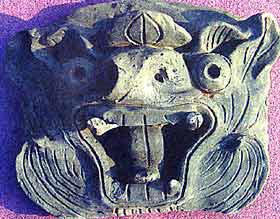
In the following days, nine other house sites were unearthed in succession, with two roads, a large number of eaves tiles, rectangular or square bricks carved with lotus flowers, beast faces or Buddha face designs, building materials for roof ridges, porcelain from famous Tang kilns such as the Changsha, Qiong and Qingyang kilns, pottery, iron and bronze ware, as well as coins and scales. Among them, there was even a tool for amusement.
Chinese archaeology is conducted on two historical stages: one is the prehistoric period, including the Paleolithic and Neolithic periods; the other is different dynasties, especially after the Xia (c. 2100 BC – c. 1600 BC) and Shang (c. 1600 BC – c. 1100 BC) dynasties.
No matter in which stage, tombs play an important role and many of them have been unearthed. However, excavation of city sites often focus on big cities such as Luoyang of central China's Henan Province, Chang'an (now Xi'an) of northwest China's Shaanxi Province and Yangzhou of east China's Jiangsu Province. Countless small cities and towns, due to their remote geographical location and little mention in historical records, are rarely found. But in a pyramidal society, towns should have occupied an important position. They connected cities and villages and passed the political, economic and cultural ideas of cities to the vast countryside. They were the basis of state and society.
Temple revived in mind
At the west end of the ruins was a temple relic site, where stone sculptures of a Buddha, two Bodhisattvas and their disciples, as well as stone scriptures and sutra beads were unearthed.
A little stone platform half buried into the earth indicated where the temple gate was, said professor Li Yingfu from Sichuan University. It would have been a stone base about one room wide and two-rooms deep, with stairs leading up to the top. The stone blocks scattered on two sides might have been a base of the enclosing wall.
Walking into the temple along the central line, it was possible to see a Buddha's hall. The whole base was uncovered in 2001 but covered by yellow earth and wild grass one year later. However, the pillar stones, wall base stones and stone stairs can still be seen clearly. Beside the Buddha's Hall were the monk's living rooms. In this place, a mortar used to husk rice was also found.
After getting to know the stratum situation and how its base was made, archaeologists will revive its original appearance on paper.
But for now it is possible to use our imaginations:
On the two sides of the temple gate there must have been a couplet expounding Buddhist doctrine. In the Buddha's hall yellow sutra stripes hung down from the roof and ever-bright oil lamps. Every morning, bells were sounded in the mountains to urge the monks to do their morning exercises and wisps of smoke rose from the town chimneys.
Every evening, drums would call back flocks and flocks of flying birds.
In the Tang Dynasty, monks would be given 30 mu (2 hectares) of farmland each and the temple also had its own permanent land. Today the temple has turned into farmland. Could we guess then that the farmland has changed into villages?
Adjacent to the temple was a 200-meter-long road paved with pebbles and rubble, which had undertaken the weight of hundreds of thousands of vehicles in the past. At the east end of it was another house site with an entrance hall. The rooms sat south and faced north, well-arranged. The lotus-shaped pillar stones were unearthed here in 2000. Together with other relics, Li and his colleagues believed this group of buildings were probably where an administrative agency of the Tang Dynasty was located.
To its south was a 4,000-square-meter square. It was neat and smooth, built with lime earth, broken bricks and pebbles. At its south side there was a building base and an east-west road. Maybe 1,000 years ago, it was a venue for local people to hold political activities.
In surrounding areas there would also have been hotels, bars, tea houses and shops, which received rich country gentlemen or businessmen and poor farmers and peddlers……
Wharf disappeared into the roaring river
The pebbled road in the south of the square soon disappeared, but a north-south stone plank road emerged, which led to the Pengxi River. Almost all the roads unearthed in Mingyueba came to the Pengxi River at last. Sailing upwards, the Tang people could get to Kaizhou, a significant town of Xiachuandong and now called Kaixian. Going downwards, people would go to the Yangtze River at Shuangjiang (Two Rivers) Town. In this way, Mingyueba was connected with Yizhou (today's Chengdu, capital city of Sichuan Province), the political and economic center of the upper reach of the Yangtze River, and Yangzhou, Jiangsu Province, the political and economic center of the lower reach of the Yangtze River.
There should have been ruins of ancient wharfs, but why not? Experts explained that buildings along the river were lashed severely by the water. If there had been wharfs 1,000 years ago, they would have been swallowed by the roaring river.
In fact, though there were residents there in the Shang and Zhou (c.1100 BC – 221 BC) dynasties, why didn't a town form until the Tang Dynasty?
This has much to do with the south transfer of the economic center in the later period of the Tang Dynasty, according to Li Yingfu.
Historical records show that this area had a backward economy at the beginning of the Tang Dynasty. After An Lushan and Shi Siming launched an armed rebellion in 755, a great number of people went southward. As a result, the Yangtze River began a high time of development. Mingyueba's economy was developed at that time. This can be proved by building relics of the early and later periods of the Tang Dynasty and unearthed items represented by porcelain there.
Another contributing factor was salt.
Xiachuandong area had a long history of salt production. Yun'an Town, not far from the Mingyueba Ruins, had been an important base for producing salt since the Han Dynasty (206 BC – AD 220). In the mid-Tang Dynasty, reforms were conducted in the salt industry, helping to revive a prosperous salt industry in the Three Gorges area. Mingyueba was a necessary passageway to transport the salt out of Yun'an. The salt of Yun'an was fist put onto a boat to be transferred to Yanqu. Then horses carried it to Gaoyang of Mingyueba. After being reshipped, it was sent to Kaizhou. By land around Kaizhou, the salt went to other places. Before the 1970s when the road linking Yunyang and Kaixian opened to traffic, this remained the most economical and quickest salt transportation line.
Yun'an Town still exists today. There is a Baigui (White Tortoise) Well. People got brine water from the well before the 1950s. In its most prosperous time, the Yun'an Salt Plant had a staff of 1,000. But today it has declined.
The largest course change of the Yangtze River in the past 5,000 years
Mingyueba today has become vast farming land.
Associate professor Li Yingfu said this is due to the upgrading and course change of the Pengxi River.
After the Northern and Southern Dynasties (386-589), the Mingyueba area was flooded. Archaeological findings show that on the first-grade platform closest to the Pengxi River are all buildings of the Tang Dynasty; while the Song Dynasty (960-1279) buildings are high and Qing Dynasty (1644-1911) ones even higher. By the end of the Qing Dynasty, no people lived in Mingyueba.
Mingyueba became prosperous after Lijiaba was deserted, which was flourishing between the Warring States Period (475-221 BC) and the Han Dynasty. After Mingyueba, the Gaoyangba again became thriving.
This is a common phenomenon in the gorges area. The ba, meaning dam, was formed by alluvion of the river. The river created these platforms but later eroded them continuously. Man had to move to other more suitable areas to live.
The old Gaoyang Town has now been emptied. At the same time, a new Gaoyang Town has been set up on a mountain to the north side of the Pengxi River. Standing on the Mingyueba Ruins, people can see clearly high buildings and high-voltage electricity pylons across the river.
The building of the Three Gorges Reservoir, the largest river course change for the Yangtze River in the past 5,000 years, have buried forever the Mingyueba, Lijiaba, old Gaoyang Town and old Yunyang County under water.
The new Gaoyang Town and Yunyang County get a historic opportunity to develop themselves. Whether the old locals or new migrants wish it, they have a rich and peaceful future.
(Beijing Youth Daily translated by Li Jinhui for China.org.cn, November 22, 2003)