All that remains now of the Badong County site of the Northern Song Dynasty (960 - 1127) are some stones, bricks and tiles. But its better protected overall arrangement and buildings were considered more valuable since there are fewer unearthed large Song Dynasty ruins. Kou Zhun, prime minister and famous judge of the Northern Song Dynasty, began his official career in this small county as its county head and made the county well known. This historic cultural county hit the top ten greatest archeological discoveries in China of 2002.
The ancient county government office
Taking a boat along the Yangtze River, a branch of the river works its way through the north bank. Above it lies the site of the ancient town of Badong.
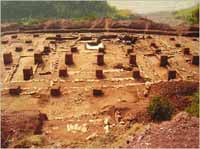
From the river, a twisting footpath comes across the remains of an old stone town -houses, slate roads and many barrel-drains. A road travels south from what was a government office area down to the river dockside. Kou Zhun more than likely used this as a landing platform during his time as an official in the town.
Archeologists can still outline the ancient Badong county seat. There was a group of official buildings of over 1,600 square meters. In front of an official gate, a slope remains, on which are some distorted clay patterns. Archeologists say that their identity remains unconfirmed.
There were sidesteps on both sides of the slope that have now disappeared. There are two stone columns, separated by 8 meters. Archeologists suggest this is the gate to the government office.
Once entering the office, a broad courtyard, an east-west slate road connects two stone pools. It's also suggested that originally there would have been two uncovered skylights surrounding them. But archeologists say the two pools aren't from the Song Dynasty. This argument is based on the fact that floods and mud-rock flows destroyed that archeological section plane during the Northern Song Dynasty. There is also a square flowerbed. More than 60 copper coins were found there. Archeologists argue there was a tree there in ancient times, and since many copper coins were found, perhaps the ancient people believed it to be a legendary money tree.
Climbing some steps, the main building appears. It's a 38-meter-long, 15-meter-wide building. From the thick stone column bases, with diameters of 40 centimeters each, the scale of the building can be imagined. The building's foundation was made of loess, and with the fact that local soil is of a different 'red' variety, the importance of the building can be estimated as the loess would have had to be imported from elsewhere.
To the east of the main building, there would have been a 13.8-meter-long, 11.7-meter-wide building. According to archeologists, there was a rigid system of social stratification in operation during that time and that according to the site and its scale, this was likely to be an official building. Intact drinking utensils, lamp stands, ink stones and seals unearthed at the site provide some evidence of its use. Archeologists say there are still many building sites to the north of this building, but so far none has been excavated.
Badong official storehouses
On an upland to the west of the ancient county government office site, archeologists found more than ten round and square partially-submerged store houses, enclosed by walls. The round ones have a diameter of 1.2 to 2.2 meters and the square one's sides measure 3 to 4 meters each. There are pillar holes and ditches arranged in order in the ground and around the building there are steps down to the storehouses. In the center of one storehouse, there is a pottery wheel with a diameter of 72 centimeters. A well-protected flagon was also found there. Archeologists argue that it was used as an ice cellar for food and wine. In another storehouse building, archeologists found a round stove on a square brick platform and argue that it was used to dry grain.
In this group of storehouses, a most important discovery found two identical, polished pottery bowls, originally used for measuring grain. The bowls are 13.4 centimeters high and have a diameter of 20.4. In contrast to their size, the bowls are thin, smooth and very light.
From the scale of the buildings, the archeologist Deng Hui, believes they were official storehouses.
Kougong Temple
The brick road was paved during the Sui (581-618) and Tang (618-907) dynasties but the poles were set in the Song Dynasty. From the remains of the foundation, it is possible to see that the temple was not on a large scale. During excavation many relics were found: glazed ware, tiles and religious articles such as the spiral hair of Buddha, the gathered hands and remaining parts of a Buddha as well as a gold-plated copper Buddha. Wang Ran, an archeologist working on the site believes there was a legendary Kougong Temple, a temple built to commemorate Kou Zhun.
The Kougong Temple reflects the respect the people had for Kou Zhun, a prime minister during the reign of the Song Taizong and Song Zhenzong. At only 19 he took the imperial examination and was given the rank of Jin Shi (palace graduate). Later, as just a young boy, he was appointed to an official position. Kou Zhun served as a county official in Badong for three years. He was known as an honest and just-minded official. In those three years, the ordinary people of Badong County made great progress. He was promoted several times and finally became the premier of the Song Taizong. He achieved many great things for the Song Dynasty. It's said that every time Kou Zhun went to the imperial court, court officials were scared of him naming their faults.
A story tells of the political talent of Kou Zhun. At that time, local people weren't willing to pay their taxes and junior officials were known to use extortion and corruption when they tried to levy them. Kou Zhun made a decision to post the tax roll and detailed information on the gate of the county. From then on, everyone paid their taxes and no official dared use extortion or corruption -- the earliest "open-government" system, perhaps.
There are still relics of Kou Zhun in the Badong County Museum -- a sliding weight of steel, of 0.67 meters high, 1.3 meters thick and 140 kg in weight.
There are two stories about this sliding weight.
According to Gao Yuanzhang, a scholar whose family lived in Badong from ancient times, because of a long stone crossing the river there were many whirlpools and rapids in that part of the Yangtze River that crossed Badong County. Any boat passing was likely to capsize. It is said that there were many holes on this huge stone and it looked just like the beam of a "steelyard", the holes like gradation markings. So the huge stone was called a beam stone. It is said that when Kou Zhun came he ordered a cast of this huge sliding weight or "steelyard" to press down on the beam stone. The beam stone is now completely submerged by water due to the Three Gorges Reservoir flooding program.
Li Qingrong, the leader of the Badong Museum, told the other tale. According to the story, Kou Zhun's mother loved him very much and he was also very fond of her. She always pushed him to study hard for greater knowledge and a big future. Little Kou Zhun was naughty and his mother always punished him. Once, when his mother wanted to beat him, he ran away, and unable to catch him, she threw a little sliding weight at him. From then on, he remembered his mother's teaching and worked hard. When he became the county's official he cast this huge sliding weight to remind himself of the teaching of his mother.
The Kougong Temple was built and rebuilt several times during the Song, Yuan, Ming and Qing dynasties, and was finally destroyed in the Qing Dynasty. When the Kougong Temple still existed sacrificial ceremonies were particularly grand, especially on July 14, Kou Zhun's birthday.
Ever prosperous and busy
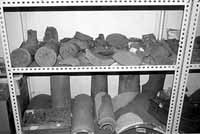
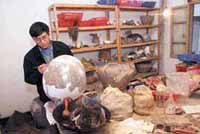
Many daily necessities have been unearthed at the site like bowls, dishes, pots, flagons, earthenware, lights and basins. These relics include pottery and porcelain, porcelain from both north and south, with both folk finishes and formal "official" finishes. Amongst the most interesting things are two flagons -- the larger 20 centimeters high, (holding one jin or half kilogram of wine), the smaller 6.2 centimeters high, (not holding even two liangs or 0.1 kg of wine). Both are delicate and it is possible to see the different temperaments and tastes of drinking at that time.
Many culture and entertainment artifacts have been excavated. Ink stones are characteristic -- they were produced from the area, and in all kinds. Entertainment artifacts include Chinese chess with round chess pieces and dice.
What was perhaps most surprising were the kinds of little pottery pots, from 4 centimeters to 8 centimeters, for raising birds. These artifacts give life to the civilian life in the Northern Song Dynasty.
The architectural material are all multiform -- ridges were decorated with huge sparrow hawks' beaks and backs of beasts; even the tiles were decorated with flowers, beasts' faces and human faces.
Money as a symbol of a prosperous economy was also found there. Money in its thousands was unearthed, left mainly from the Northern Song Dynasty. There were 32 kinds issued in the Northern Song Dynasty, in which 27 kinds were found at the Badong site.
The eclipsed Badong County
There's no large-scale official building on the site after the Northern Song Dynasty. The county seat moved under the Jinzi Hill on the southern bank of the Yangtze River. Archeologists say that a recent study shows the county official site was hit by flooding and mud-rock flows during the Northern Song Dynasty. After that, the county official site had to move out of Badong. The exact time is not clear but thought to be no earlier than in the Southern Song Dynasty (1127 - 1279).
Nevertheless, Badong had its most prosperous time in the Northern Song Dynasty and thereafter declined. Lu You, a poet from the Southern Song Dynasty, described Badong County in his Travel Notes to Sichuan: "The county is depressed: only some one hundred families live there. The houses are all made of thatch grass, not a single tile."
Li Qingrong, explained that the governors of all dynasties did not support the development of the ethnic economy of the area south of the Yangtze River. Its remote to the Central Plains, closed off by mountains and without convenient traffic facilities. The dwellers were conservative and took business as a debasing activity. Together with the natural disasters -- floods, landslides and mud-rock flows -- the productivity and culture there were far inferior to that developed on the Central Plains.
Background to Badong County
Badong County began its prosperity in the Sui (581-618) and Tang (618-907) dynasties, and had its heyday in the Northern Song Dynasty. There were county sites early in the Northern and Southern Dynasties (386-589), with names like Xinling County, and then renamed Lexiang County. It was named Badong in 598 in the Sui Dynasty.
The principal part of the Badong site is the whole county area. The official site area was in the middle of the county, including the government office, temples and storehouses. There were business areas in the south of the official government site near a brook, where archeologists found an alehouse and other shop sites. The east and west part of the site were residential areas, where more than 80 houses were unearthed. Specialists say that at least 3,000 people lived in the county then.
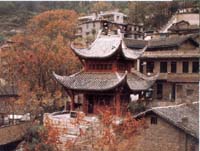
Baiyun pavilion and Qiufeng pavilion, which were constructed by Kou Zhun according to some historical records, have all disappeared. There is still a Qiufeng pavilion at the Badong site, but it was constructed during the Ming Dynasty. Kou Zhun wrote 120 poems in the three years he lived there, accounting for half of all his work. Lu You, Su Shi, Su Sun and other poets wrote articles to commemorate Kou Zhun when they passed through, leaving many works behind.
(China.org.cn by Chen Lin and Daragh Moller, January 13, 2004)