One August morning in 1944, a timid schoolboy from suburban
Shanghai went to visit his classmates in the middle of the
Japanese-controlled metropolis.
What happened on Feng Yiping's journey has left a deep scar on
his life.
Feng was kidnapped by Japanese soldiers and later became a slave
laborer at the Kakeda coalmine in Kuriyama, Yubari, on the island
of Hokkaido, along with hundreds of other Chinese citizens.
"Over 60 years have passed. But I am still haunted by the
hellish days I spent at the Japanese coalmine," the 77-year-old
told China Daily.
On that fateful day in 1944, Feng had his money and ID card
confiscated by Chinese guards who had collaborated with Japanese
army. Empty-handed, he kept walking down Nanjing Road and was
stopped by Japanese soldiers at the Sichuan Road Bridge.
Unable to show his ID card, Feng was taken with 300 others to a
concentration camp near Hongqiao and stayed there for more than two
weeks. One night at bayonet point, they were marched onto a cargo
ship half-filled with iron ore. After spending more than 20 days at
sea, the ship reached a Japanese port.
"The first night on the Japanese soil, every one was sleepless,
without any idea of what life would be like," Feng says.
The next day, they were transferred to a train that took them to
the Kakeda coalmine at Kuriyama, in Hokkaido. The 300 kidnapped
Chinese were then divided into six working groups and each was
issued a worker number.
Feng was put in Group One and given the worker number 41.
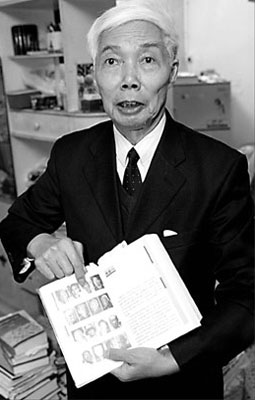
Feng Yiping shows He
Tianyi's book Oral History of Chinese Slave Laborers in Japan
during WWII, which includes Feng's experience. (photo: China
Daily)
Not far from the coal pit, rows of simple, wooden huts were
built for the laborers to live in. The huts, with 50 workers
crammed in each, were behind high fences in isolated camps with
armed guards.
"We did not have enough clothes and all the forced laborers were
in rags," Feng says.
They were each offered a blanket. When it was too cold, they
would have to work with their blankets wrapped around them.
"We barely had personal belongings," says Feng, who added that
the daily ration for every laborer was less than 25 grams of rice,
carrots or potatoes.
Most of the time, they had to fill up on chaff, herbs and bark.
"I always felt hungry," Feng says.
Feng and his fellow laborers were ordered to go down into the
pit at about 4 or 5 in the morning and usually got back to their
huts at about 11 at night.
"Some of my fellow laborers got killed by the blasting dynamite
or by falling chunks of coal in the pit."
Feng and other Chinese forced laborers worked day and night
shifts. "If you failed to meet the quota, the Japanese would force
you to keep working."
When the laborers returned from a day's work, they would be
covered with thick coal dust.
"Only the rolling eyes are recognizable. And when you spat,
you'd find coal dust in the phlegm," Feng recalls. Besides the
terrible working and living conditions, the Japanese treated the
laborers cruelly, Feng says.
The laborers were not given water to drink. Instead, "we drank
water dripping from the cracks on the shaft, or the water running
along the main shafts."
Nor could they bathe and as a result, lice, fleas and bedbugs
were very common.
"In their eyes, we were not humans but beasts that knew about
coal cutting; but in my eyes, they were lower than beasts," Feng
says.
If a Chinese laborer fell sick, it would usually cost him his
life.
"Many people who were ill never recovered. Instead, they died of
illness or hunger," Feng says, adding that three of his fingers on
the left hand were cut by an angry Japanese overseer and have never
fully recovered.
Feng remembers that five laborers attempted to escape. When they
were recaptured, they were beaten till they passed out. The men
later died in the freezing cold.
Feng admits that at one point he tried to take his own life but
was stopped by fellow laborers.
Fei Duo (worker number 70) and Shan Yaoliang (worker number 71)
used to be primary school teachers. In a small notebook, they wrote
information about dead laborers, such as their names, their worker
numbers, where they probably lived in China and how they lost their
lives.
Fei passed the notebook to Feng before dying of hunger.
"Little Feng, you are the youngest. If some day you go back to
our motherland, take this notebook back with you. We must let
people know about our suffering here," Fei said.
Despite having doubts of whether he would make it out of the
camp, Feng says he was determined to carry out the task.
He hid the notebook under his tatami bed and told two of his
most-trusted fellow laborers.
According to Feng's remaining record, during their stay at the
Kakeda coalmine, at least 98 out of the 300 Chinese died.
Feng and his fellow laborers worked day after day until around
August 1945 when their hours in the pit were cut back.
"We came out of the huts at 8 am and returned to the huts around
5 pm. We even saw sunsets sometimes," Feng says. "We sensed that
something must have happened outside."
On September 15, the Japanese unexpectedly declared a day off.
at 9 am, two American soldiers drove a jeep into the mine. They
came in search of missing comrades.
The groups of Asians in rags soon caught their attention.
"Where are you from?" one of the Americans asked.
"We are from Shanghai, from China," a Chinese laborer who spoke
English answered.
Feng and his fellow laborers were told that Japan was defeated
and they were free to go home.
On hearing the news, all of the laborers ran out of the huts,
and embraced each other.
In October 1945, Feng and some 3,000 Chinese laborers from
different working sites in Japan were sent back to Shanghai by
Japanese ships. Without decent clothes, they had to wear Japanese
army uniforms.
Arriving at his home in suburban Shanghai, Feng found his mother
on her deathbed. A month later, she passed away.
Feng later learned that his mother fell ill soon after his
sudden disappearance.
For a long time after his return, Feng dreamed of his days at
the Japanese coalmine and woke up screaming. He found it hard to
discuss and even more difficult to control his emotions.
Gradually, he became reticent, heavy-hearted and spent most of
the time studying at high school.
"Studying was the only way I could find to help heal my wounds,"
Feng says.
In 1949, he changed his name from Feng Yonggang to Feng Yiping
(literally meaning a piece of floating duckweed).
"I wanted to break away from my painful past and start a new
life," Feng says.
In September the same year, Feng passed the entrance exam for
Zhenjiang Medical College in Jiangsu Province, ranking 39th out of
the hundreds of candidates.
"I thought that even if I didn't become a doctor in the future,
I could at least improve my own health," says Feng, who after his
graduation in 1954, worked for the Nanjing Medical College. Later
he worked briefly in Beijing, and finally settled in Guangzhou in
1987.
First majoring in urology and later in andrology, Feng rose to
become a renowned medical professor and surgeon with the No 2
Hospital attached to Guangzhou Medical College, South China's
Guangdong Province.
Sixty years later, Feng is still haunted by his ordeal.
"What can I do about this notebook and the 98 deceased laborers
I knew about? I just cannot let go of the past," he says.
Even today, the families of the forced laborers who died in
Japan may have not known about their whereabouts or what happened
to them. "I have the responsibility of letting the world know about
the truth," Feng says.
In May 1979, Feng wrote a letter in Chinese to the Tokyo-based
Japan-China Friendship Association about his experience as a
wartime laborer and the notebook he has kept for decades.
The letter was translated and printed in the Japanese newspaper
in Japan and China on July 15. "The records from Feng are
invaluable evidence and will be kept with great care," an official
wrote about his published letter.
In April 18, 1990, Feng was invited to attend a memorial
ceremony at another coalmine in Kumamoto, Kyushu, where he showed
the notebook.
"Several Japanese journalists interviewed me, asking me about
200 questions," Feng says.
"Later, I learned that only five of the media outlets ran the
interviews. I wish more Japanese could read my story."
In July 2005, Feng donated the worn-out notebook he had kept for
more than half a century, to the Shanghai Memorial for the War of
Resistance against Japanese Aggression.
From August 6-9, 2006, he traveled again to Tokyo, attending
memorials for the forced laborers who were buried on Japanese
soil.
According to statistics from the Foreign Ministry of Japan,
between April 1943 and May 1945, at least 41,762 Chinese citizens,
in 169 batches, were captured. Of these, 3,470 died at sea and
38,117 were taken to Japan as slave labors. Of these, 6,830 never
made it back to China alive.
"I think it is a big mistake that the Japanese government
refuses to recognize the war crimes it committed during WWII on
Chinese people," Feng says.
Last week, he attended a series of commemorative events for the
Nanjing Massacre, including an international symposium on the
Japanese invasion.
"In my opinion, we should not hate the Japanese people. The
militarist extremists are to blame for the inhumane wrongdoings and
tragedies Chinese have suffered," Feng says.
(China Daily December 17, 2007)