|
Underground Palace
The underground palace, built on a grand and magnificent scale, is also known as inner palace or serene palace. An important component to the whole of imperial tombs, it can, to some extent, match the palaces where emperors or kings had lived. Exact locations of underground palaces were usually kept secret because they were the places where many priceless funeral objects were buried with the deceased. Details of the underground palaces were mysteries until the palace of the Dingling Tomb, one of the Ming Tombs, was brought to light. From small cave to grand underground palace the tomb evolved through roughly three stages:
1) Wooden funeral chamber in earth. In the early period of the primitive society, burial of a body was quite simple: A pit without inner or outer coffins or a coffin chamber would do, even the body was not wrapped in anything special. In about the late period of the matrilineal commune special attention was paid to protection of the deceased remains. In the beginning, bodies of the deceased were covered by tree twigs and then by soil, probably to keep them from being eaten by animals. Still, the process was quite simple, with no coffin chamber. Up to the late period of the patriarchal clan commune, the funeral form developed along with polarization between rich and poor.
At that time a burial pit was lined on all four sides with timbers. Illustrative is a clan graveyard at Dawenkou, Tai'an, Shandong Province: Pits three to four meters long and two to three meters wide are found with sides and bottom lined in timbers. Some pit floorings were painted scarlet. At Majiabang, Jiaxing, Zhejiang Province, site of the Liangzhu Culture, coffin chambers were lined with processed wood plank.
Though this kind of tomb is much simpler than any of the underground palaces of slave owners, emperors and kings, it symbolizes the beginning of development of coffin chambers.
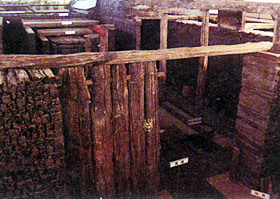
2) Wooden coffin and huangchang ticou. Huangchang, as explained in Yan Shigu's notes on the Sulin Tomb, is the heaping of yellow xylem cores of cypresses around the outside of a coffin, while ticou is the setting of timbers or logs outside the cypress coves. An important stage in the development of imperial mausoleums, huangchang ticou provides a height in development of the wooden underground palace. This kind of structure existed at least in the Spring and Autumn Period (770 BC-476 BC).
According to the Records of the Historian, the structure of a monarch's mausoleum was "jade stone carved as inner coffin; the outer coffin is made of catalpa wood painted with designs, and maple and camphor wood are used as ticou." During the Western Han Dynasty (206 BC-AD 24) tomb structures like this developed more extensively, including catalpa wood palaces, convenience halls, inner and outer winding corridors, and huangchang ticou.
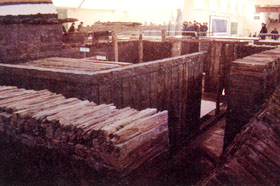
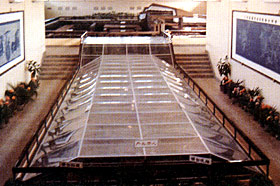
In the Han Dynasty the big outer coffin of a deceased emperor, made of catalpa wood, was called catalpa palace. The front half of the catalpa palace was the convenience hall, which was seen as the hall where the deceased entertained and feasted his guests. Huangchang ticou was first recorded in the biography of Huo Guang in the History of the Han Dynasty, which orders, "Give him a convenience hall, huangchang and ticou." This type of tomb was not discovered until June 1974, when a tomb of the Western Han, most probably the tomb of Prince Dan of Yan, was excavated at the Guogong Village in Fengtai District, Beijing.
Tomb of King Yan of the Western Han at Dabaotai, Beijing
Winding tomb corridor
A restored funeral chamber
From the discovery we may guess that the five mausoleums of the Western Han in Chang'an were also built in the huangchang and ticou style; however, as emperors' mausoleums they should be on a much greater and grand scale than that of Prince Dan of Yan.
In the slave society, slave owners devoted lots of manpower and great quantities of materials to the building of palaces, halls, altars, and temples, as well as tombs and mausoleums. Of course, an underground palace was one of their important projects.
As a result, in the place of simple outer coffins were large solid wooden inner palaces rapidly developed, and even the exquisite huangchang ticou structures appeared, marking the beginning of building underground palaces for emperors and princes. This wooden structure for mi inner palace had been used for about 2,000 years from the beginning of the slave society to the early years of the feudal society, that is from the reign of King Qi of the Xia (c. 21st-16th centuries BC) to Western Han (206 BC-AD 24).
A large tomb discovered at the Yin Ruins on the Northwest Ridge in Houjia Village, Anyang, Henan Province, covering an area of more than 300 square meters, is probably the tomb of a slave owner. The coffin was placed at the center of the underground palace, enclosed in an outer covering made of thick timbers. The architecture is exquisitely done with the inside wall of the outer coffin engraved in design.
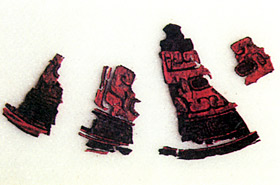
Lacquer fragments excavated from the Yin ruins in Hebi
Large funeral chambers were features of mausoleums of slave owners and emperors in the Spring and Autumn (770 BC-476 BC) and the Warring States (475 BC-221 BC) periods and in the Western Han Dynasty. The outer coffin actually is the underground palace structure containing the inner coffin. The outer coffin is the shape of a big flat box with movable bottom and cover. The very large box is separated into parts: The inner coffin is put in the center around which are east room, west room (or left room, fight room), front room and rear room. The rooms by the inner coffin hold sacrificial objects. Typical is the outer coffin in No. 1 Tomb of the Western Han Marquis of Dai at Mawangdui, Changsha, Hunan Province, which has left, right, front and rear rooms, and the inner coffin is divided into layers. The tomb is rather grand for a marquis.
Imperial mausoleums, however, were much more ornate. According to historical records, construction of the Maoling Mausoleum took 53 years and the mausoleum contains many funeral objects; however, it remains unknown whether the funeral chamber was made of wood. This was not recorded, nor has it been unearthed. Judging from archaeological excavations done through several decades, most tombs of the period from the Spring and Autumn Period to the early years of Western Him are likely to feature wooden funeral chambers.
3) Stone and brick underground palace. In the Eastern Han Dynasty (25-220) wooden underground palaces were gradually replaced by those built with stones and bricks. The change may have been caused by a combination of vulnerability of wooden outer coffins to looting or burning and development of brick architecture and construction techniques. The stone and brick tomb chamber, discovered in archaeological excavations, started in the later years of the Western Han Dynasty.
In Luoyang, Henan Province, a few brick tomb chambers built by the end of the Western Han have been excavated. The size of bricks is quite large, about one meter long, 40 to 50 centimeters wide and over 10 centimeters thick. Such large, hollow bricks, with various designs carved on the surface, were convenient for building tomb chambers. But a small number of chambers were built using small bricks.
From the Sui Dynasty (581-618) through the Tang, Song, Yuan and Ming dynasties to the Qing Dynasty brick and stone tombs built in arches or tiered form were developed and refined. For the Six Dynasties and the Sui and Tang dynasties the cave-type underground palace using a dry well or a niche in a cliff prevailed on the loess plateau, such as the tombs of Princess Yong Tai, Prince Zhang Huai and Yi De in the Qianling Mausoleum, Xi'an, Shaanxi Province. Then, in the Ming and Qing dynasties, tombs were built on much greater and more refined scales. The Dingling Tomb, one of the Ming Tombs is an example:
The Dingling underground palace is directly under the dome mound within a circular wall and on a line from the platform with soul tower through Ling'en Hall to Ling'en Gate. The underground palace, 27 meters from the palace roof to the top of the dome mound, covers 1,195 square meters and its floor plan is of audience hall in front and bed chamber at the rear, imitating the style in which the emperor lived. The first half of the underground palace is a long, wide tunnel, regarded as a prelude, such as the gates and wide path leading to the Imperial Forbidden City.
The second half is divided into five chambers: front, middle, rear, and two side chambers in the manner of palace buildings, separated by doors and passages.
Before the front chamber there is an arched square room, symbolizing the square in front of the Forbidden City. The front chamber is also an anteroom to the middle chamber, which is the audience hall. In the audience hall stand three thrones carved from white marble, with the center one designed for Emperor Wan Li. In front of his throne, normally flanked by attending subjects, lay five sacrificial vessels made of glazed materials and an everlasting light, an oil jar in a large dragon design. Height and width measurements of the front chamber are the same as those of the middle one, 7.2 and 6 meters respectively and the total length of the two chambers is 58 meters.
The rear chamber is the main room in the underground palace, called the "rear sleeping chamber." The room is 9.5 meters high, 31.1 meters long and 9.1 meters wide. The coffin of Zhu Yijun, Emperor Wan Li, lies in the middle of the coffin platform with those of Empress Xiao Duan and Empress Xiao Jing on each side. Around the coffins were spread jade stones, plum vases and large scarlet wooden boxes fitted with gold and silver objects, pearls and jade and articles for daily use.
The Dingling underground palace, an arched structure, is mainly made of large blocks of white marble, porphyry and greenish stone, with a floor of "golden" bricks. Such arched brick or stone structures, with the advantages of greater grandeur, more durability and fireproof construction, were used for over a thousand years once they replaced the wooden tombs.
|