|
Imperial Tombs and Mausoleums
After the concept of soul was formed in the primitive society more and more importance was attached to the tomb. Due to primitive productivity, little surplus was yielded for offering sacrifices to the deceased; therefore, there was no need to designate tombs.
In ancient documents "tomb," which means that it disappears when it is buried, has the same meaning as "nil." The chapter "Tan Gong" in the Book of Rites states: "In ancient times the tomb had no mound." A note explains that "the burial spot which is not mounded or planted with trees is called a tomb." The chapter "Divinatory Symbols" in the Book of Changes says, "In ancient times the dead, after being covered with thick straws or sticks, were buried in a wild field. The burial spot was neither piled as a mound nor planted with trees. The location was not marked or remembered." This is proved by archaeological excavations of tombs of primitive people, including those of the matriarchal and patriarchal groups.
Only in the clan tombs of the Majiayao Culture, Midiqian, Gaolan County, Gansu Province, were one or two slabs found near a bone frame. However, they were only signs within the tomb, but not marks above the ground. Even on the large tombs of the Xia (21st-16th centuries BC) and Shang (16th-11th centuries BC) dynasties no huge mounds or other outward indicators have been discovered. After more than 300 years as the capital of the Shang Dynasty moved there by King Pan Geng, Anyang of Henan Province showed no signs of Shang Dynasty tombs in Yin Ruins. The absence of visible signs made it certain that the Shang Dynasty remained in the stage of tombs without heaped mound or tree plantings; otherwise traces of mounds, even had they been damaged, would have been found as have later mounds marking the tombs of kings who had been honored with luxurious and extravagant entombment.
However, in the Yin Ruins, a house base somewhat larger than a tomb was discovered at the tomb of an imperial concubine named Fu Hao. A similar house base was also found at the tomb of a high official. These bases may be foundations for sacrifice-offering buildings, but still no grave mounds were found in connection with these tombs.
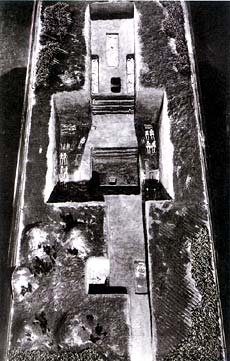
A bird's-eye view of imperial tombs at the Yin ruins in Henan
Grave mounds date from the Zhou Dynasty (c.11th century-771 BC) "Protocol Official" in the Rites of the Zhou Dynasty records, "The size of the grave mound is decided by the rank of nobility." From the Spring and Autumn and the Warring States periods (770 BC-221 BC) clay piles on tombs became larger and larger, finally as large as a qiu, a small hill; as a result a graveyard is also called qiu, such as King Wuling's Qiu and King Yanzhao's Qiu.
Why was it necessary to build clay mounds and plant trees at tombs? Perhaps it was related to the convenience of the slave system and frequent needs for offering sacrifice and memorializing the souls of ancestors. People during the Shang Dynasty believed in ghosts; whenever something important was to be done they would pray to ghosts or to their ancestral kings beforehand.
It was more natural to pray on the spot where ancestors had been buried than to pray in temples. With mounds and trees as marks it was easier then to recognize the tombs. Moreover these ancient people frequently felt the need to pray while cherishing the memories of ancestors before their tombs.
The custom of piling clay as mounds on tombs and planting trees nearby developed into a system for burial mainly among the ruling classes. Mounds on imperial tombs evolved through three main development forms:
The first form is called square top, the form of tomb mound adopted earliest. Builders piled many layers of clay above the underground palace in the tomb pit, and shaped and packed each layer until they formed a low trapezoid. It got such a name because of its square flat top. The mausoleum of Qin Shi Huang, the First Emperor of the Qin Dynasty (221BC-207 BC) at Lintong, Shaanxi, is the largest of this type, appearing from a distance to the hill. In the Han Dynasty (206 BC-AD 220) most imperial tombs had a mound in this shape. This type of tomb can still be seen near Xi'an.
The second form is of a mausoleum built inside a mountain with its peak serving as grave mound. The earlier form of piling enormous amounts of clay into a tomb, such as the mausoleum of Emperor Qin Shi Huang, required much labor. The project was so ambitious that an ordinary emperor or king could not accomplish it. Besides, this kind of imperial tomb was not secure; it was more susceptible to looters.
Therefore, in the Tang Dynasty (618-907) the practice of building mausoleums inside a mountain was adopted. The Zhaoling Mausoleum of Emperor Tai Zong (Li Shimin, 599-649) of the Tang Dynasty, has Mt. Jiuzong, 1,188 meters above sea level, as its grave mound. Tunneled and hollowed, the mountain had the mausoleum built inside. It is said that this kind of burial was first suggested by Queen Zhangsun: "Bury me in a mountain and you can avoid piling up the grave mound" when she was dying, for the sake of frugality.
In fact, this was Li Shimin's own attitude, spoken first, however, by the queen. Later, Emperor Li Shimin wrote an inscription on a tablet for the queen: "A person of royal lineage should regard the world as home. Is it necessary, then, to place such precious things as the occupant's own property in the tomb? Now, Mt. Jiuzong is used as the imperial tomb, which contains no gold, jade, people, horses, housewares or vessels, but only imitations made of wood or clay. Therefore, it will not attract thieves and robbers and there is no need to worry." Actually, mountains used as mausoleums are selected for their magnificence to show the grandness of imperial kinsmen, and they are more effective in preventing thefts and looting.
Two mountain mausoleums, the Zhaoling of Emperor Tai Zong, and the Qianling of Emperor Gao Zong (Li Zhi) who was on the throne from 650 to 683 and Queen Wu Zetian, who reigned from 684 to 704, are much more imposing than even the huge piled clay mound of Qin Shi Huang. Yet, the Zhaoling Mausoleum could not avoid the looter's hand. It was excavated by warlord Wen Tao when the Tang Dynasty was eliminated. Only the Qianling Mausoleum remained untouched, largely because of the mountain's hard rocks and an effective seal of huge stones and melted lead.
The third tomb form is of the castle or dome type, built on piled clay grave mounds within high walls. Tombs in mountains were limited by topography. Difficulties were thus created in excavation. Typical are trapezoidal grave mounds of the Qin and Han dynasties popular until the Song Dynasty (960-1279), with some changes influenced by the mountain tombs of the Tang Dynasty. The sharp edges of piled clay were quickly rounded by erosion and weathering. As a result, many imperial tombs and mausoleums were built with round mounds towards the end of the Tang Dynasty and in the Five Dynasties. Examples include two imperial tombs of the Southern Tang Dynasty in Nanjing, Jiangsu and the Yongling Tomb of Wang Jian in Chengdu, Sichuan. To reduce soil erosion from the mound, Wang Jian's tomb had rectangular slabs laid around its base. Later this practice was widely adopted for ordinary tombs. The imperial tombs of the Northern Song Dynasty restored the trapezoidal mound with flat surfaces and sharp comers; however, the mound was much smaller than those of the Qin and Han dynasties, and double, stacked trapezoids appeared.
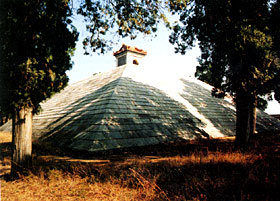
In the Song Dynasty (960-1279), Shao Hao was said to be the chief of the Dongyi ethnic group, had his tomb built of stone blocks in a pyramid shape resembling the Egyptian pyramids in present-day Qufu, Shandong Province.
Tomb of Shao Hao
As for the imperial tombs of the Yuan Dynasty (1271-1368) not a single one has been discovered, but from surviving documents and other materials it is known that they returned to the initial tomb system--tombs without conspicuous mounds.
In the Ming (1368-1644) and Qing (1644-1911) dynasties pyramidal mounds for imperial tombs were completely transformed. More than 30 imperial tombs of emperors and 100 tombs of queens and imperial concubines are topped by domed mounds surrounded by walls. These were constructed by first building a high brick wall around the underground palace and filling the space within the surrounding wall with day to an elevation higher than the wall and with a domed top. At the top of the wall crenels and parapets were built as decoration to give the structure the look of a small city wall. The domes were either circular, as on many Ming imperial tombs, or elliptical, adopted for many Qing imperial tombs. Outside the wall at the front of the tomb a square platform was laid on which a soul tower was built and the entire complex is called a square castle with soul tower.
The domed mound surrounded by a wall and complemented by a square platform with a soul tower for imperial tombs is much more complicated and artistic than earlier clay on stone pyramids, conveying an impression of substance and solemnity.
|